41% ultra‑rapid charging growth in 2025: design notes for UK infrastructure engineers
Reviewed by Tom Sullivan
First reported on New Civil Engineer
30 Second Briefing
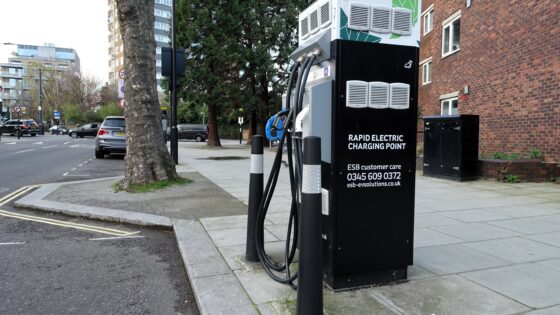
Ultra‑rapid public EV chargers in the UK expanded 41% year‑on‑year in 2025, driving an overall 20% increase in public chargepoints and shifting provision towards high‑power units suitable for long‑distance motorway and trunk‑road corridors. Investment is concentrating on clustered charging hubs, rather than dispersed single units, to handle higher peak loads and faster dwell times in both inter‑urban and dense urban locations. For civil and electrical engineers, this points to growing demand for upgraded grid connections, reinforced pavements, and bay layouts optimised for simultaneous high‑power charging.
Technical Brief
- Ultra‑rapid units are now the fastest‑growing charger class in the UK public network by percentage.
- Growth is strongest on strategic long‑distance corridors, rather than local residential or workplace sites.
- Regional deployment is accelerating outside London and the South East, reducing historic concentration in early‑adopter areas.
- Investment is being directed into multi‑bay hubs, requiring coordinated civil, electrical and traffic‑flow design.
- Higher‑power hubs are driving demand for upgraded distribution connections and local substation capacity at brownfield forecourts.
- Civil layouts must accommodate short dwell times with one‑way circulation, avoiding queuing back onto trunk roads.
- For similar infrastructure, clustering chargers simplifies protection coordination, metering and future modular expansion of capacity.
Our Take
Within the 395 Infrastructure stories in our database, only a small subset deal with UK-wide network effects, so a 41% expansion in ultra-rapid capacity in 2025 is likely to be a key reference point for future transport and grid-planning pieces.
For UK civil and electrical contractors, a 20% rise in public chargepoints in 2025 implies sustained demand for high‑capacity connections, trenching and substation upgrades, which can be bundled with other urban regeneration or highway schemes rather than delivered as stand‑alone EV projects.
Given the article’s Sustainability tag and UK focus, this ultra‑rapid rollout will likely feature in upcoming coverage on grid resilience and peak‑load management, as higher‑power chargers tend to drive reinforcement needs more sharply than the broader but lower‑intensity public network.
Prepared by collating external sources, AI-assisted tools, and Geomechanics.io’s proprietary mining database, then reviewed for technical accuracy & edited by our geotechnical team.
Related Articles


Related Industries & Products
Construction
Quality control software for construction companies with material testing, batch tracking, and compliance management.
Mining
Geotechnical software solutions for mining operations including CMRR analysis, hydrogeological testing, and data management.
CMRR-io
Streamline coal mine roof stability assessments with our cloud-based CMRR software featuring automated calculations, multi-scenario analysis, and collaborative workflows.
HYDROGEO-io
Comprehensive hydrogeological testing platform for managing, analysing, and reporting on packer tests, lugeon values, and hydraulic conductivity assessments.
GEODB-io
Centralised geotechnical data management solution for storing, accessing, and analysing all your site investigation and material testing data.