Geomechanics, Streamlined.
© 2026 Geomechanics.io. All rights reserved.
Vinci Energies has acquired CDD Automation Solutions from the Bühler Group, adding a 32-strong systems integration team specialising in bespoke control systems for Rockwell Automation, Siemens and AVEVA industrial platforms in food and feed plants. The deal brings CDD, founded in 1981 and part of Bühler since 1991, into Vinci Energies’ UK and Ireland ecosystem of more than 230 control systems specialists. Vinci Energies plans to use the acquisition to expand advanced process optimisation, energy efficiency and manufacturing resilience services, while Bühler refocuses on its core plant and equipment offering.
Groundworks and civils contractor M&J Evans Construction reported 2025 turnover up 15% to £374.3m, with operating profit rising 70.2% to £8.7m and profit before tax more than doubling to £8m. The figures follow a period of rapid expansion in residential and infrastructure groundworks, where the company delivers bulk earthworks, foundations and drainage packages for major housebuilders and developers. Stronger margins at this scale signal continued demand for large-volume enabling works and may support more aggressive bidding on complex, multi-phase sites.
BAM UK & Ireland has completed the £23m Eastern Entrance at Bristol Temple Meads, extending the existing passenger subway beneath platforms 13 and 15 to connect directly into the new Temple Quarter development. The works, carried out through existing structures within the Grade I-listed station and alongside an operational railway and the adjacent Sloane Robinson Building, are designed to handle around 2.5m passengers a year by 2030. The entrance forms part of wider Temple Quarter plans for 10,000 new homes and 22,000 jobs, reshaping access and pedestrian flows on the eastern side of the station.
AECOM and Jacobs have been appointed by Transport Infrastructure Ireland, with support from Ramboll and Nicholas O’Dwyer, to deliver MetroLink, Dublin’s first fully segregated metro railway. The predominantly underground, high-capacity, high-frequency line will run from Swords to Dublin Airport and the city centre with 16 new stations, interfacing with Irish Rail, DART, Luas and BusConnects to form a multi‑modal network across the Greater Dublin Area. The JV will provide integrated programme management, governance, interface control and risk management across multiple contracts on one of Ireland’s largest infrastructure investments.
Wates Construction has appointed Sasha Simmonds as head of social value and Josh Steiner as head of sustainability, as the group reports £464m of social value generated in 2025. Simmonds, formerly head of social value at O’Neill & Brennan, previously supported more than 300 people in prison into employment via release on temporary licence schemes and will now lead Wates’ next phase of social value strategy and partnerships. Steiner, who has spent nearly a decade shaping Wates’ sustainability approach, will deliver a five-year roadmap focused on carbon reduction and resource efficiency towards net zero.
York Central, a £2bn mixed-use scheme by McLaren Regeneration and Arlington Real Estate, has secured planning approval from City of York Council for more than 1,000 homes plus a hotel, innovation hub, and retail and leisure space. Backed publicly by the Housing Secretary, the project will redevelop a major brownfield site adjacent to York railway station, tying into existing heavy rail and local road networks. Civil and geotechnical teams can expect complex ground remediation and phased infrastructure delivery to support high-density residential and commercial loads.
United Utilities has been fined £900,000 after admitting five environmental permit breaches linked to a major raw sewage discharge on the Fylde coast in June 2023, following failures in its wastewater treatment and overflow control systems. The incident involved untreated effluent bypassing normal screening and settlement processes during storm conditions, leading to prolonged discharge through combined sewer overflows into coastal waters used for bathing. For civil and environmental engineers, the case reinforces regulatory scrutiny on stormwater storage capacity, real-time CSO monitoring, and resilience of ageing sewer networks under intense rainfall events.
A National Audit Office review warns that the UK’s £70bn programme of electricity transmission upgrades, costed by Ofgem, will be “very challenging” to deliver to current timescales. The plan involves major reinforcement of the high‑voltage network to connect large volumes of offshore wind and other low‑carbon generation, requiring extensive new overhead lines, substations and cable routes. NAO flags risks around planning consents, supply‑chain capacity and delivery sequencing, signalling likely pressure on design teams, geotechnical investigations and construction logistics.
Stockton-on-Tees Borough Council plans to demolish two disused railway bridges on the former Stockton & Darlington Railway alignment, prompting the Historical Railways Estate (HRE) Group to accuse it of “incompetence or scaremongering” over structural risk claims. Campaigners argue the masonry arches could be retained or infilled for active travel use, citing similar Network Rail and National Highways Historical Railways Estate schemes where parapets were upgraded and decks waterproofed instead of removed. The dispute raises design questions on life-extension versus demolition for ageing brick and stone overbridges in low-traffic corridors.
Vinci Energies in the UK and Republic of Ireland has acquired Bühler Group’s CDD Automation Solutions, a UK-based systems integrator specialising in process automation for the food and feed industry. The deal expands Vinci Energies’ capabilities in PLC/SCADA-based control systems and plant-wide automation upgrades for bulk handling, milling and mixing lines. For civil and industrial project teams, this strengthens in-house delivery options for highly automated process plants, particularly where brownfield refurbishments must integrate new digital controls with existing mechanical and structural assets.
Edinburgh’s tram expansion has advanced with the southern section between the city centre and the Edinburgh BioQuarter prioritised over the full Granton–BioQuarter corridor. The decision concentrates early design, utilities coordination and ground investigation on the BioQuarter link, where hospital and research campus demand is highest and interfaces with existing heavy traffic corridors are most complex. For contractors and consultants, this signals near-term opportunities in track slab design, junction remodelling and integration with current tram power and signalling systems on constrained urban streets.
Cornish Lithium has produced lithium hydroxide monohydrate from ore at its Trelavour project and confirmed the material performs successfully in coin cell battery manufacture at its demonstration plant. The LHM was generated from hard-rock feed rather than imported chemicals, validating the full flowsheet from Cornish ore through to battery-grade product. This marks a key technical de-risking step for scaling a UK domestic lithium supply chain, with implications for future commercial plant design, process control and product qualification with cell manufacturers.
Spencer Group’s building and civil engineering arm has secured National Grid contracts for groundworks and enabling works at two substations in West Yorkshire and Merseyside that are being upgraded to interface with large-scale battery storage. The packages will focus on substation platform formation, below-ground services and foundations to accommodate new battery systems and associated switchgear. For contractors and designers, the works signal continuing demand for civils capability around grid-scale storage integration, including high-capacity cable routes, heavy equipment bases and stringent electrical safety clearances.
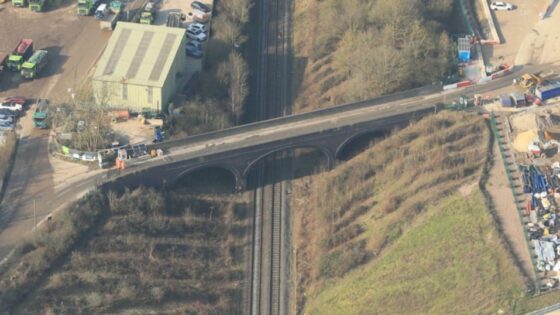
Network Rail and contractors will this weekend upgrade the Chiltern Main Line between Northolt Park and Haddenham & Thame Parkway, combining track and signalling reliability works with demolition of an HS2 bridge. Possession of this intensively used commuter and inter-urban corridor will allow renewal of life-expired components and removal of a redundant structure in a single blockade, reducing future access needs. Geotechnical and structural teams will need to manage demolition-induced vibration, track support conditions and interface with adjacent HS2 earthworks.
Tokamak Energy has completed a 14‑month test campaign on Demo4, its high‑temperature superconducting (HTS) magnet testbed in Oxford, aimed at validating magnet performance for compact spherical tokamak fusion reactors. The Demo4 system is designed to operate HTS coils at cryogenic temperatures while subjecting them to high magnetic fields and mechanical loads representative of reactor conditions, a critical step for future fusion power plant infrastructure. Results will inform structural design, thermal management and lifecycle performance of full‑scale HTS magnet assemblies for grid‑scale fusion demonstrators.
RSK Group has acquired Mason Street Furniture (MSF), a specialist highways electrical and technology contractor focused on roadside lighting, signalling and ITS installations, to deepen its capability on road and wider transport schemes. The deal expands RSK’s in-house capacity for motorway and trunk road electrical works, including gantry-mounted equipment, traffic monitoring systems and associated ducting and cabling. For designers and contractors, the move signals more integrated delivery of M&E, controls and civils packages on complex highways projects under single project governance.
Transport for London has released an updated Corporate Environment Plan detailing more than 70 actions to cut operational and embodied carbon and improve network resilience to extreme weather across the Underground, bus and road systems. Measures include accelerating fleet electrification, retrofitting stations and depots for energy efficiency, and upgrading drainage and track assets to cope with more intense rainfall and heat events. Civil and geotechnical engineers can expect tighter carbon requirements in design, materials selection and asset renewal, alongside higher design thresholds for flooding, overheating and slope stability.
Transport Infrastructure Ireland has appointed an Aecom–Jacobs joint venture as programme delivery partner for the £8.4bn (€9.5bn) MetroLink, the long-planned rail line linking Swords, Dublin Airport and Dublin city centre. The JV will oversee integrated design, procurement and construction management for the mostly segregated, high-capacity metro system, which is expected to form the backbone of Dublin’s future mass transit network. Geotechnical, tunnelling and station box design will be critical, with interfaces around the airport and dense city-centre utilities likely to drive construction methodology and risk management.
Brazil’s newly approved Bill No. 2,780/2024 creates the National Policy on Critical and Strategic Minerals (PNMCE), establishing a CIMCE council of up to 20 members to classify minerals, prioritise projects and oversee transactions involving changes of control, foreign “significant influence”, strategic geological data access and sensitive offtake contracts. Exploration licences for critical/strategic minerals face an absolute 10‑year term with no extensions or tolling except for environmental licensing, raising timing risk where deposits are complex or critical minerals are identified mid‑programme. To offset tighter oversight, the bill enables a BRL 2 billion Mineral Activity Guarantee Fund funded by a 0.2% revenue levy, mandates 0.3–0.5% R&D spend, and offers CSLL tax credits capped at BRL 1 billion per year (2030–2034) for domestic processing investments.
Rio Tinto has secured a long-term agreement with the Nyangumarta Warrarn Aboriginal Corporation for its Winu copper-gold project in the Great Sandy Desert, about 300 km south of Broome, clearing a key consent hurdle on Nyangumarta Country. The deal, building on a 2023 project planning pact, sets processes to avoid impacts on Aboriginal cultural heritage and the local environment as mine design and approvals progress. Rio holds 70% of Winu in joint venture with Sumitomo Metal Mining and is targeting first copper production by 2030, subject to regulatory approvals and final investment decision.
Osisko Metals has extended mineralisation beneath the historic Gaspé Copper mine in eastern Quebec, with hole 30-1228 cutting 257 m at 0.85% Cu and 5.13 g/t Ag from 33 m, including 28.5 m at 4.74% Cu and 27.4 g/t Ag about 200 m downhole, 50 m below the historical C zone to 275 m vertical depth. The porphyry copper-skarn project now hosts 1.83 billion measured and indicated tonnes at 0.27% Cu and 0.017% Mo, supporting a planned 160,000 t/d operation with estimated initial capex of about US$1.4 billion. Infill and expansion drilling, including June’s 80 m at 1.93% Cu at Needle Mountain, is aimed at upgrading inferred resources and testing zones currently modelled as waste inside the conceptual pit.
Aya Gold & Silver has more than doubled the after-tax NPV of its Boumadine gold-silver-zinc-lead project in Morocco to US$3.5 billion, with a 93% IRR and 0.7-year payback at US$3,500/oz gold and US$50/oz silver, while initial capex rises only 4% to US$463 million. The plan envisages six open pits transitioning to underground, feeding an 8,000 t/d flotation plant (potentially 10,000 t/d by year 3–4) over a 14-year mine life, producing 2.25 Moz gold, 81.2 Moz silver, 422,000 t zinc and 195,000 t lead. Economics lean heavily on richer price and payability assumptions, while lower life-of-mine grades (1.77 g/t Au, 63.5 g/t Ag, 1.37% Zn, 0.58% Pb) and a 400,000 m infill drill programme will be key de-risking points ahead of a 2H 2027 feasibility study.
Switzerland has banned the purchase, import and transit of Sudanese gold and restricted mining supplies such as mercury and cyanide, aligning its sanctions with European Union measures adopted on 13 July to cut funding to Sudan’s three-year conflict between the SAF and RSF. The Swiss rules also block related technical, brokering and financial services, and will be folded into its existing Ordinance on measures against Sudan, which already enforces a UN arms embargo and financial and travel bans on 36 listed individuals and entities. For refiners, traders and chemical suppliers, this tightens due-diligence and effectively closes a key European route for Sudan-linked gold flows.
Global coal demand is now forecast by the IEA to rise 1.2% in 2026 to 8.94 billion tonnes, reversing an expected decline as Strait of Hormuz disruptions drive LNG shortages and push thermal coal prices up to around $150/t. Increased coal-fired generation in Europe, Japan, South Korea, China and other gas-reliant markets with idle coal capacity, combined with an unusually strong El Niño cutting hydropower, is tightening supply. Global output will stay above 9 Bt but dip in 2026 after Chinese safety inspections, with a modest production rebound only expected in 2027.