Geomechanics, Streamlined.
© 2026 Geomechanics.io. All rights reserved.
Tender has opened for New South Wales’ South West Active Transport Link (SWATL), a continuous “MetroWay” cycling and walking corridor running the full length of the Sydney Metro Southwest extension. The package will integrate paths with multiple new and existing stations, requiring complex interfaces with rail viaducts, drainage, and road crossings along the corridor. Civil and geotechnical scopes are expected to focus on retaining structures, pavement design for shared paths, lighting foundations, and managing utilities in a constrained brownfield rail environment.
BHP’s Australian copper division has delivered record results, driven by strong output from Copper South Australia and the Olympic Dam underground mine–smelter complex. Higher copper production from these assets, which integrate large-scale sublevel open stoping with onsite concentration and smelting, is lifting group earnings at a time of tight global copper supply. For mine planners and process engineers, the performance signals continued capital focus on deep underground copper orebodies and associated concentrator–smelter debottlenecking in South Australia.
Liebherr’s R 9800 G6 backhoe excavator at Yancoal’s Mount Thorley Warkworth mine in New South Wales has set new performance benchmarks for ultra-class loading, working the main overburden fleet alongside 340-tonne haul trucks. The machine, in the 800-tonne class, is designed for high-volume overburden removal with a nominal bucket capacity around 40 m³ and electric-drive assistance for faster cycle times. For mine planners and maintenance teams, the deployment signals growing confidence in ultra-large excavators for sustained production in hard overburden conditions.
Surging global demand for lithium-ion batteries for electric vehicles and grid storage is pushing Australia to move beyond spodumene concentrate exports into domestic refining and cathode‑grade chemical production. Industry proposals centre on converting hard‑rock feed into battery‑grade lithium hydroxide and carbonate in Western Australia, leveraging existing Tier‑1 deposits and port infrastructure but facing high energy costs, skills shortages and permitting timelines. For miners and process engineers, the shift implies greater focus on impurity control, reagent optimisation and integration of hydrometallurgical circuits with upstream mine planning.
New Hope Group has lifted coal output across its Australian assets and is advancing growth plans at the Bengalla thermal coal mine in the Hunter Valley, where it holds an 80 per cent interest alongside Mitsui, Taipower and J-Power. The open-cut operation, which typically produces export-quality thermal coal for Asian power utilities via the Port of Newcastle, is the company’s key near-term expansion focus. For mine planners and geotechs, any Bengalla growth path will centre on additional strip mining, dragline and truck–shovel sequencing, and associated waste dump and haul road reconfiguration.
Australian miners are hitting a data wall as high‑bandwidth sensors, autonomous fleets and video streams overwhelm traditional cloud links, pushing operations towards private LTE networks and on‑site edge computing. Vendors such as Vocus are pairing Starlink Business Rural satellite backhaul with 4G/5G private LTE to keep haul trucks, crushers and fixed plant connected in real time, even on remote pits and waste dumps. For engineers, this shift means designing networks and control systems around low‑latency, on‑site processing for fleet dispatch, collision avoidance and condition monitoring rather than centralised data centres.
Niger’s junta has moved an estimated 1,000 tonnes of uranium concentrate from Orano’s seized Somaïr open-pit mine to Air Base 101 beside Niamey’s main airport, where it remains unsold despite talks with potential buyers from Russia, China, the US and the UAE. The stockpile is subject to an ICSID order prohibiting sale or transfer without Orano’s consent, while the French state-owned company threatens “any and all actions” to block third-party acquisition. Security analysts warn the base location is highly exposed after Islamic State-linked militants approached the capital in a recent attack.
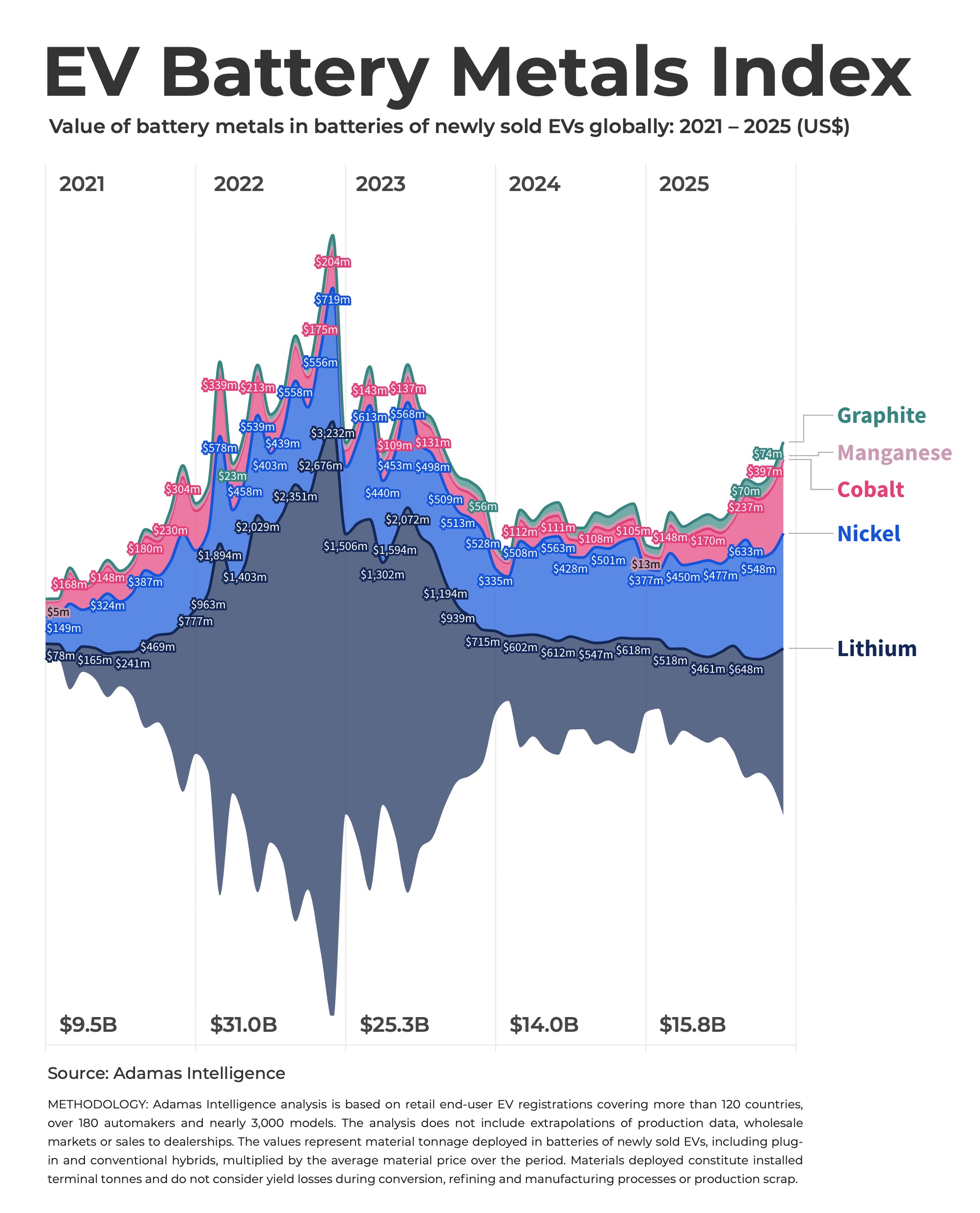
EV raw material spend for lithium, graphite, nickel, cobalt and manganese in newly sold passenger EVs reached $15.8 billion in 2025, up 13% year on year, with December’s monthly bill topping $2 billion for the first time since August 2023 as lithium hydroxide/carbonate and nickel sulphate prices climbed. Global EV battery capacity deployment is on track to exceed 1 TWh in 2025, nearly quadruple 2021’s 286 GWh, with LFP packs accounting for almost 50% of capacity and 83% of LFP roll-out concentrated in China. Cobalt’s share of the EV Metal Index rebounded to 14% ($2.4 billion) on >200% year-on-year sulphate price gains, while nickel and lithium each surpassed $6 billion in contained value, supported by high‑nickel NCM chemistries in the US and Europe despite growing LFP penetration.
Copper exchange inventories on Comex, the LME and Shanghai Futures Exchange have climbed to 1.012 million tonnes, breaching the 1 million tonne mark for the first time since 2004 as tariff-driven stockpiling in the US combines with weak Chinese demand. In thin holiday trade, March copper in New York slipped nearly 1% to $5.76/lb ($12,700/t), around 12% below late-January highs after a more than 40% price gain through 2025. Satellite data also show January global smelter activity at its lowest level in nearly a decade of monitoring, signalling tighter refined output despite swollen visible stocks.
Project Vault will create a US$12 billion US critical minerals stockpile, combining US$1.67 billion in private capital with a US$10 billion Export-Import Bank loan to buy and store materials for automakers, tech firms and other industrial users. Following a Section 232 probe covering the full USGS critical minerals list plus uranium, the administration found imports threaten national security but chose negotiated price floors and trade mechanisms over tariffs. Forthcoming US–Mexico and US–EU–Japan action plans, under the new FORGE framework, will define which minerals are prioritised, how any border-adjusted price floor is calculated, and how rules of origin or downstream products are treated.
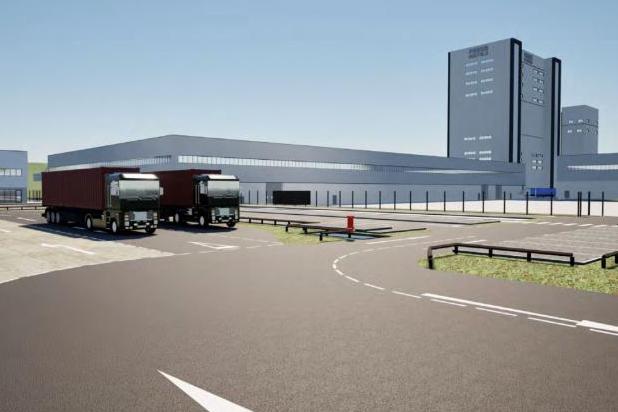
Erewash Borough Council has approved Fassa Bortolo’s new UK headquarters and building materials factory at New Stanton Park, a 170,000 sq ft complex with manufacturing plant, training academy and warehousing. The facility will feature a 60-metre main tower, three metres higher than the former Stanton Ironworks chimney, on a 220-acre brownfield business estate masterplanned for up to 4,000 jobs. For materials suppliers and contractors, the site signals a significant East Midlands production hub for renders, mortars and plasters within a £350m global expansion programme.
Alumno has started construction of a £23m, six-storey purpose-built student accommodation block on St George’s Road in Glasgow’s Woodlands district, delivering 262 beds in four- and five-bed cluster flats plus studios. Clark Contracts is acting as design-and-build contractor, with Stallan Brand Architects, RankinFraser Landscape Architecture, Will Rudd Davidson, Ridge & Partners and Sound Advice Acoustics forming the professional team, and funding from Henderson Park. The scheme includes a ground-floor common room, sixth-floor dining, study and lounge spaces, and rear landscaped courtyards, with completion targeted for summer 2027.
Blackburn with Darwen Borough Council has appointed Barnfield Construction as main contractor for an £8.5m conversion of the fire‑damaged, Grade II listed St John’s Church into a digital and cyber business centre. Designs by Manchester-based OMI Architects provide 9,500 sq ft of flexible workspace within the 239-year-old structure, linked to the planned Blackburn Skills Campus and opportunities from the National Cyber Force at Samlesbury Enterprise Zone. Enabling works start in March, main construction begins in summer, with completion targeted for early 2028.
Delays at the Building Safety Regulator’s Gateway 3 stage are linked by law firm Irwin Mitchell to 44 undecided schemes and 5,594 completed higher-risk residential units remaining unoccupied, with one case waiting 550 days against an eight‑week target. Of 158 Gateway 3 applications in 2023, 55 took more than three months for a decision, raising concerns over cashflow impacts on developers and handover timing for residents. The BSR disputes the interpretation, stating no new-build higher-risk building that passed Gateway 2 has yet applied for Gateway 3 and that current cases are mainly transitional legacy projects with significant safety issues.
Graham has secured a £286m contract to redevelop Manchester Metropolitan University’s Cambridge Halls, delivering 2,302 student bedrooms in two new multi‑storey blocks rising up to 30 storeys on the site of demolished 1990s accommodation. The Cartwright Pickard–designed scheme combines cluster flats, studios, ground‑floor commercial units and a community health centre fronting Cambridge Street. Targeting BREEAM Excellent with air source heat pumps, PV panels, low‑energy heat recovery ventilation and intelligent BMS, phase one is due in 2029 with final completion in 2030.
Women into Home Building is opening applications for its eighth fully funded three-week intake, combining one week of online training with two weeks of on-site placements in site management and new building inspector roles with NHBC. Since its 2023 launch by the Home Builders Federation and partner house-builders, over 150 women have completed introductory training, but only about one-third have secured industry jobs, against a backdrop of women making up just 15% of the construction workforce and 5% of site managers. Applications for May 2026 placements run from 16 February to 22 March via pathwayctm.com.
Two in five UK construction firms report a direct hit to their bottom line despite political promises of accelerated infrastructure delivery, exposing a gap between headline commitments and actual project flow. Contractors cite delayed notice-to-proceed on major road and rail schemes, stop–start funding cycles for schools and hospitals, and prolonged planning approvals as key drivers of margin erosion. For geotechnical and civil specialists, this means underutilised design and site teams, disrupted ground investigation programmes, and greater commercial risk when pricing long-lead works.
Autonomous battery-electric haul trucks deployed by EACON at Shougang Group’s Shuichang Iron Ore Mine have completed a full year of operation, delivering quantified reductions in both unit haulage cost and diesel-related CO₂ emissions versus conventional diesel fleets. The system integrates autonomous driving, battery swapping and centralised dispatch to manage multiple BEV trucks on steep open-pit ramps and long-distance waste hauls. For mine planners and geotechnical teams, the shift to BEVs changes ramp ventilation assumptions, traffic patterns and braking heat loads, affecting haul road design and pit wall interaction.
Sandvik Rock Processing has completed a full rebuild of a Sandvik BR3288i hydraulic breaker and BB8094R breaker boom for a major Ghanaian gold mine at its Kumasi technical workshop. The unit, installed at the run-of-mine grizzly, is a large-range breaker used for primary rock size reduction and clearing oversize at the crusher feed. Localised refurbishment capability in Kumasi cuts downtime and shipping delays for future overhauls, which is critical for maintaining ROM throughput and crusher utilisation on West African hard-rock gold operations.
Atlas Salt has expanded its strategic relationship with Sandvik Mining as part of an updated feasibility study for the Great Atlantic underground salt project near St George’s, Newfoundland and Labrador, building on a comprehensive non‑binding MOU signed in September 2024. The enlarged scope is expected to cover Sandvik’s input on underground mobile equipment fleets and automation-ready mining systems for large-scale room-and-pillar extraction. For engineers, the move signals early vendor integration into mine design, equipment selection and life-of-mine operating cost assumptions ahead of project sanctioning.
Weir’s Alrode facility in Gauteng has become the first plant globally dedicated solely to manufacturing ENDURON Elite banana screens, adding 1,600 m² of covered production space to support the new range. Concentrating production in South Africa signals longer-term localisation of high-performance screening technology, with implications for regional supply chains and aftermarket support for large vibrating screens in coal, iron ore and aggregate operations. For process engineers, this may shorten lead times for custom screen sizes and deck configurations while standardising critical components across Weir’s global footprint.
Tungsten West has appointed Duo Group as EPC contractor for a new-build crushing, screening and ore sorting plant at the Hemerdon tungsten-tin mine in Devon, and signed an agreement to deploy Gekko Systems’ In Line Pressure Jigs in the flowsheet. The project centres on upgrading run-of-mine ore through pre-concentration and sensor-based sorting ahead of jig-based gravity recovery, aiming to improve tungsten and tin yield from the existing open-pit resource. For process engineers, the move signals a flowsheet shift towards higher early-stage rejection of waste and lower downstream milling load.
The MINEXCHANGE 2026 SME Annual Conference & Expo in Salt Lake City will close next week with SME’s Signature Awards Event recognising more than 70 recipients across mining, metallurgy and exploration. Honours span technical excellence, health and safety, environmental stewardship and professional service, reinforcing SME’s role in setting practice benchmarks for US and international operations. For engineers and operators, the awards list often signals emerging leaders, influential research directions and projects likely to shape upcoming guidance and conference content.
ESCO’s ESCO division has launched the Nexsys Ripper System for Cat D11 dozers, targeting high-load ripping in mining, aggregate and heavy construction applications. The system uses premium alloy steels and a redesigned shank–tooth interface to improve penetration and wear life under highly abrasive conditions typical of large open pits and quarries. Faster tooth changes and reduced unplanned change-outs are aimed at increasing dozer utilisation on primary ripping benches and hard overburden, with direct implications for drill-and-blast requirements and fleet productivity.