Geomechanics, Streamlined.
© 2026 Geomechanics.io. All rights reserved.
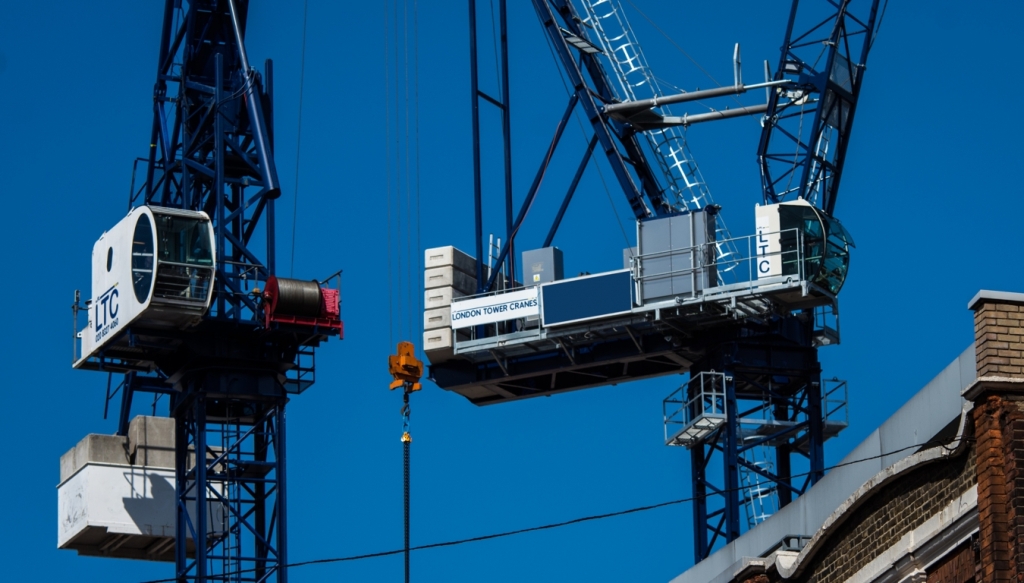
JRL Group has widened its pre-tax loss to £36.9m on £784.7m turnover over 16 months to 30 April 2025 and, following a £50m equity injection from Malaysia’s IJM, is launching a multi-year overhaul of its integrated delivery model. Core units J Reddington (groundworks and concrete frames), Midgard (main contracting) and McMullen Facades all remained loss-making, while London Tower Crane Hire & Sales delivered a £7.1m pre-tax profit on £57.7m revenue and Ark M&E Services and Thames Reinforcements also stayed in the black. The review will target overheads, operating centres, gross margins, offsite manufacturing and fixed-price risk allocation, underpinned by a £2bn order book and net assets of £113.2m.
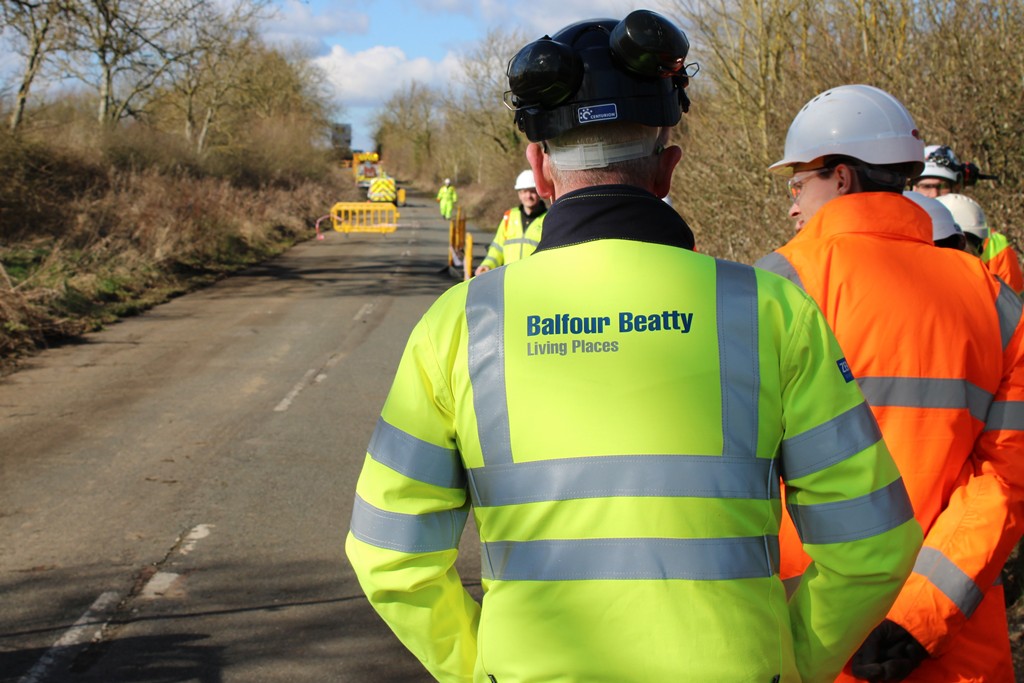
Balfour Beatty Living Places has secured a seven-year, £315m highways maintenance contract from Warwickshire County Council, Coventry City Council and Solihull Metropolitan Borough Council, covering more than 5,000 km of roads and cyclical maintenance of over 55,000 streetlights from spring 2026. The deal, Balfour Beatty’s third consecutive term since 2011, will employ around 160 staff at peak and could be extended by six years to 2039, lifting the total value to about £900m. For asset managers, the long-term framework supports planned pavement, lighting and public realm interventions rather than short-cycle reactive works.
Gateway 2 approval has been granted by the Building Safety Regulator for the first two higher-risk buildings in Viridis Living’s Fallowfield Campus redevelopment at the University of Manchester, both 14-storey blocks providing 205 and 207 beds. The consortium of Equitix, John Graham Construction and Derwent FM has submitted seven HRBs in total, with structural works on the first two to start this month after a 15-week turnaround from planning to approval. Key technical choices include a precast cross-wall system and extended concrete use for inherent fire resistance, within a 3,300-bed masterplan targeting Passivhaus certification at European scale and BREEAM Excellent.
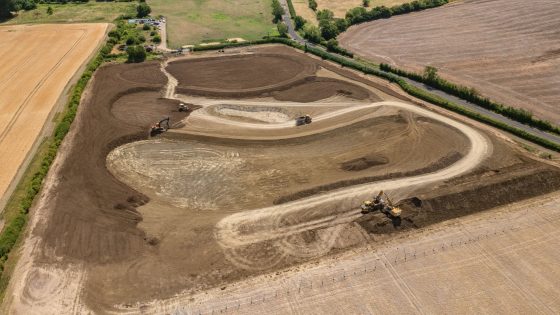
Southern Water has launched a £1.3bn framework tender for sustainable drainage and habitat restoration across its catchment, targeting large-scale SuDS retrofits, nature-based flood management and river corridor enhancement. The multi-year programme will call for design-and-build teams to deliver measures such as swales, wetlands, infiltration basins and floodplain reconnection to cut surface water inflows to sewers and reduce CSO spills. Contractors will need strong geotechnical, hydrological and ecological capability, with emphasis on whole-catchment modelling and long-term asset performance.
Major UK construction and engineering firms are reshaping senior teams as staff return from the holiday period, with new appointments spanning civil engineering, project delivery and corporate leadership. Key moves include senior roles overseeing large infrastructure portfolios and complex construction programmes, signalling continued demand for experienced project directors and discipline leads. For practitioners, the churn at the top suggests potential shifts in procurement strategies, risk appetite and design standards on upcoming transport, water and urban regeneration schemes.
Transport for London will close the elevated A40 Westway between the Westway roundabout and Marylebone flyover from 20 March to late April for safety‑critical renewal of the 1960s viaduct structure. Works are expected to focus on concrete and steel bridge elements, including deck waterproofing, expansion joints and corrosion‑affected components, to maintain load capacity on this key dual three‑lane route into central London. The month‑long closure will force significant diversion of HGV and commuter traffic, with temporary traffic management likely to affect adjacent arterial routes and local access.
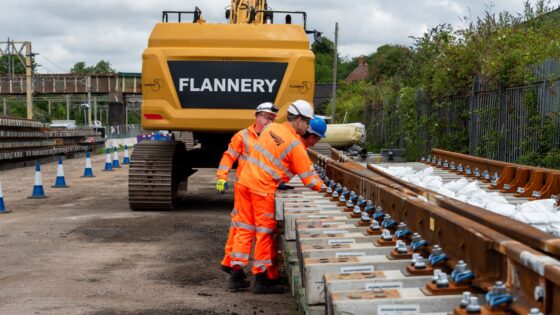
Network Rail has issued a pipeline notice for Track Focused Railway Systems Contracts worth up to £5bn to deliver track renewals, upgrades and associated rail systems works across the UK network in Control Periods 8 and 9 (2028–2039). The programme will bundle multi-disciplinary activities—track, signalling interfaces and related civil works—into long-term Rail Systems Alliances. Contractors should expect large-scale, regionally packaged frameworks with sustained volumes of plain line and S&C renewals, demanding robust possession planning and standardised design to manage whole-life asset performance.
Skanska has completed Anglian Water’s first integrated constructed treatment wetland at Everton Water Recycling Centre in Bedfordshire, designed to strip phosphorus and iron from final effluent using a nature‑based flow path rather than chemical dosing. The wetland forms part of the WRC outfall stream, using engineered reed beds and controlled hydraulic residence times to polish treated wastewater before discharge. For civil and water engineers, the scheme signals growing scope for low‑energy, passive treatment trains to meet tightening nutrient consents on small to medium works.
BHP has expanded its Xplor accelerator to its largest cohort yet, selecting 10 early-stage exploration and technology companies for the 2026 intake in the programme’s fourth year. The group combines junior explorers, geoscience organisations and tech teams aimed at covering the full “discovery system”, from targeting through to resource definition. For geoscientists and project developers, the move signals stronger backing for early-stage concepts and integrated data-driven exploration workflows under a major’s umbrella.
Orca Fuel Solutions and VERIDAPT will present an integrated fuel management platform at Investing in African Mining Indaba 2026 in Cape Town from 9–12 February, targeting tighter control of diesel use across African mine sites. The partnership combines Orca’s on-site storage and dispensing hardware with VERIDAPT’s real-time monitoring, automation and data analytics to track fuel from bulk delivery to individual assets. For operators, the pitch is reduced fuel theft and shrinkage, auditable Scope 1 emissions data, and better optimisation of haul truck and plant fuel consumption.
IMDEX has taken full ownership of Australian geoscience analytics firm Datarock Holdings, moving from its earlier 51% stake (built between November 2021 and July 2024) to 100% control to deepen its AI-driven subsurface characterisation offering. Datarock’s cloud-based tools for automated core logging, drillhole imagery analysis and 3D geological modelling will be integrated with IMDEX’s existing drilling optimisation and downhole sensing platforms. The deal targets faster turnaround from raw drill data to resource models for mining, energy and civil projects, with more consistent logging and reduced manual interpretation.
Global Tailings Management Institute has appointed Ed Toms as its inaugural CEO and created a Technical Committee to drive implementation of the Global Industry Standard on Tailings Management across diverse jurisdictions and legacy facilities. The independent body, formed after the Brumadinho failure and ICMM/UNEP/PRI standard-setting, is tasked with supporting operators on governance, independent review, and performance metrics for high-consequence tailings storage facilities. For geotechnical and mining engineers, this signals tighter scrutiny of dam design, monitoring, and closure practices against a globally benchmarked framework.
A new electric bus depot has opened in Preston, Melbourne, incorporating a Victorian-first overhead gantry charging system to maximise yard space and increase charging capacity for Zero-Emission Buses (ZEBs). The gantry layout removes the need for individual ground-mounted chargers beside each bay, allowing denser bus parking and simplified cable management for future fleet expansion. The facility is a key node in Victoria’s shift from diesel to ZEB operations as the state targets net zero emissions by 2045, with implications for high-load electrical supply design and depot pavement performance under changed traffic patterns.
Victoria’s completion of the Metro Tunnel ‘Big Switch’ integrates the twin nine‑kilometre tunnels and five new underground stations into Melbourne’s network, enabling more than 1200 additional weekly train services. Peak frequencies on key corridors including the Sunbury, Cranbourne and Pakenham lines now reach trains every three minutes through the tunnel, materially increasing track and signalling utilisation. New regional rail services and revised bus timetables will shift passenger loads across the network, with implications for station access design, intermodal interfaces and surrounding urban infrastructure.
Queensland Mining & Engineering Exhibition (QME) 2026 has expanded its outdoor exhibition area after the initial floor space sold out, opening more room for full-scale surface and underground equipment displays. OEMs and service providers are expected to bring large plant such as 100-tonne-class haul trucks, drill rigs and modular processing units that cannot be accommodated indoors, enabling live demonstrations of manoeuvrability, noise levels and dust-control systems. For mine planners and maintenance teams, the enlarged outdoor zone offers direct comparison of fleet options and support gear under realistic operating conditions.
Motion’s Fluid Power Solutions (FPS) Mobile Workshops are providing rapid on-site hydraulic hose repairs for mine sites using Gates and Exitflex hose systems carried in truck-mounted service units. The vehicles are fitted with crimping, cutting and pressure-testing equipment, allowing technicians to fabricate and replace high-pressure hoses in situ rather than sending components off-site. For maintenance planners, this model reduces unplanned downtime on critical assets such as excavators and haul trucks and supports more flexible hose management in remote pits and processing areas.
Magnetite Mines is advancing its Razorback magnetite project in South Australia to supply high-grade iron ore concentrate tailored for low-emissions and green steel production, targeting direct reduction (DR) pellet and pellet feed markets. The company is ramping up global partnerships with downstream steelmakers and technology providers to align Razorback’s product specifications with DR furnace and hydrogen-based steelmaking requirements. For mine planners and process engineers, this signals growing demand for consistent, low-impurity magnetite concentrates optimised for DR-grade pellets rather than traditional blast furnace sinter feed.
Rehabilitation works at Energy Resources of Australia’s Ranger uranium mine near Jabiru will continue after Federal Resources Minister Madeleine King approved a new rehabilitation authority under the Commonwealth’s Environment Protection and Biodiversity Conservation Act. The authority replaces the expired mining authority and allows ERA to keep progressing tailings reprocessing, landform recontouring and water treatment required before the site can be handed back to Traditional Owners within Kakadu National Park. The decision removes a key regulatory risk for long-term radiological containment design and closure scheduling.
New South Wales has approved the Constellation critical minerals and high‑tech metals project near Cobar, positioning the state to grow copper output towards “super‑producer” scale alongside existing long‑life operations in the Cobar Basin. The project targets copper, gold and associated critical minerals, leveraging established regional infrastructure and brownfields mining services to accelerate development. For geotechnical and mining teams, the approval signals a pipeline of new underground and open‑pit work in highly altered, structurally complex ore systems typical of central NSW.
Bravo Mining has raised C$86 million via an oversubscribed public offering at C$4.40 per share, including a C$34.5 million non-brokered placement with Orion Mine Finance, to advance the Luanga nickel-PGM project in Pará, Brazil and fund preliminary and full feasibility studies. An updated PEA gives a base-case NPV of $1.25 billion, rising to $1.86 billion under a vertical-integration scenario with a local smelter, now supported by the new Barcarena Export Processing Zone decree. Laboratory Jameson Cell rougher flotation tests show 5–10% higher PGM and 5–30% higher nickel recoveries with 50% lower mass pull, implying higher concentrate grades, lower plant capex/opex and improved payabilities.
Rio Tinto Iron Ore is reassessing high wall designs in its Pilbara open pits after finding current slope angles are generally conservative, with most wall exposures performing to plan and showing no major instability. The work focuses on identifying specific levers for safe slope steepening, such as refined geotechnical domains, updated design acceptance criteria and tighter control of wall excavation to design. Any move to steeper inter-ramp or overall pit slopes would directly affect strip ratios, haul distances and long-term pit economics across multiple Pilbara operations.
International Tower Hill Mines has raised $118 million for its Livengood gold project in Alaska, including a $40 million private placement and an extra $3.3 million from hedge fund Paulson & Co., lifting Paulson’s stake to 35% at US$2.22 per share. The 2023 technical report pegs initial capex at US$1.93 billion with an after-tax NPV of US$2.35 billion at US$2,500/oz gold, but shows the project becomes marginal with modest price declines. About US$50 million is earmarked for feasibility and technical studies and US$35 million for permitting and community engagement, with additional metallurgical work planned on antimony recovery from stibnite veins.
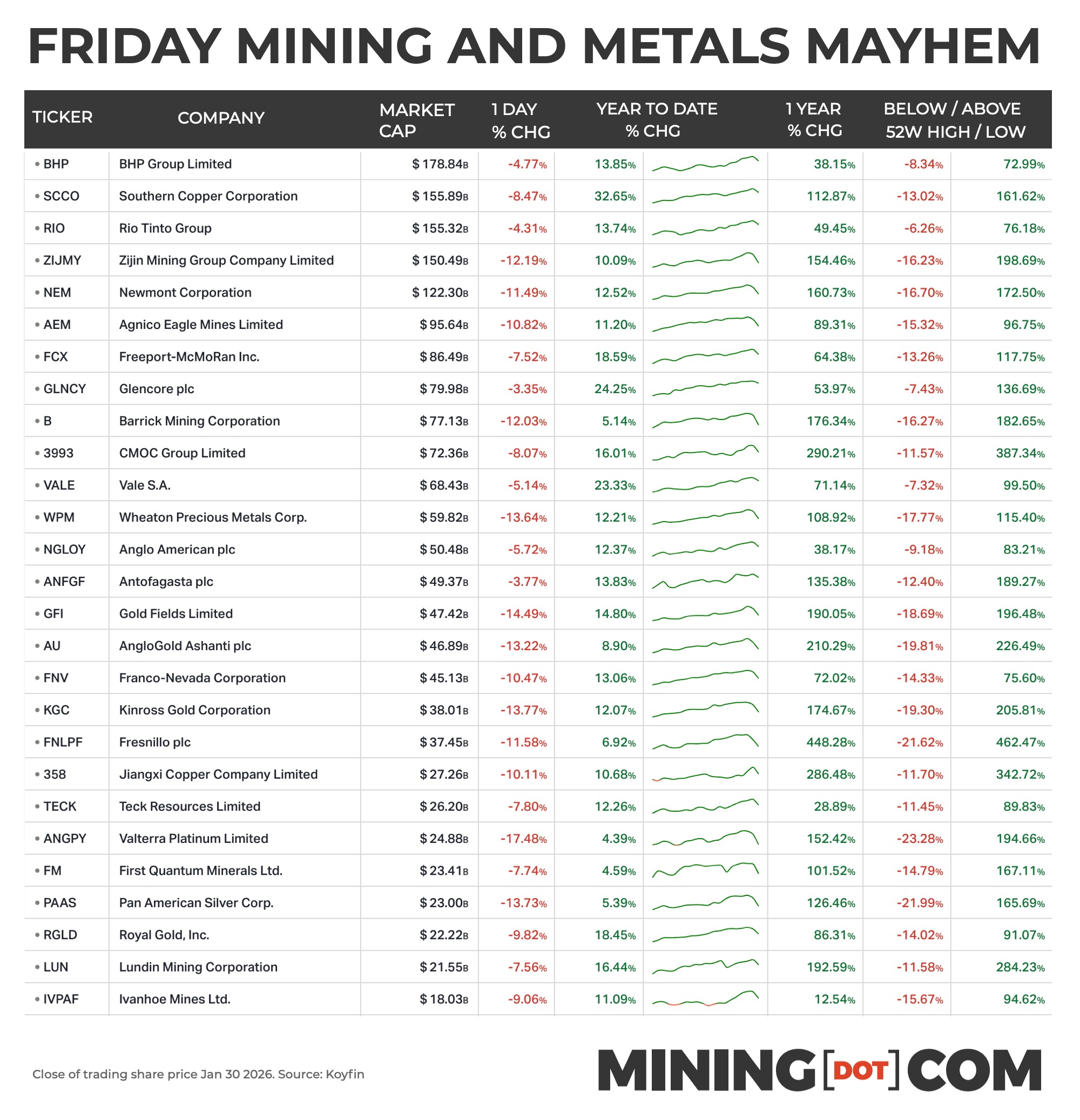
Precious metals and copper prices plunged on Friday after the US Fed chair nomination triggered profit-taking, with April gold futures crashing 11.4% to $4,745/oz and silver suffering a record 35.9% drop to $78.53/oz, while March copper briefly fell 9.5% to $5.76/lb before closing 4.5% lower at $5.92/lb. The sell-off wiped billions from miners: Newmont fell 11.5% to a $122bn valuation, Barrick 19%, and silver-focused Pan American Silver 13.7% to $23bn. Diversified and copper majors were hit less severely, with BHP down 4.8%, Rio Tinto 4.3%, Glencore 3.4% and Southern Copper 8.5%, yet most leading miners remain strongly positive year-on-year.
Tether’s reported accumulation of roughly 140 tonnes of physical gold in Swiss underground-vaults converted from nuclear shelters, with purchases at times above $1 billion per week, is presented by Erik Groves, corporate strategy lead and in-house counsel at Morgan Companies, as a signal of growing unease with fiat-based reserve systems. He argues that both a re-gold-backed US dollar and a proposed gold-backed BRICS currency would still be constrained by domestic politics, repeating Bretton Woods’ core flaw. The op-ed points instead to a non-sovereign, gold-backed stablecoin combining gold’s reserve credibility with crypto settlement rails as a more durable anchor for global trade.