West Midlands Metro expansion: design and construction notes for urban engineers
Reviewed by Joe Ashwell
First reported on New Civil Engineer
30 Second Briefing
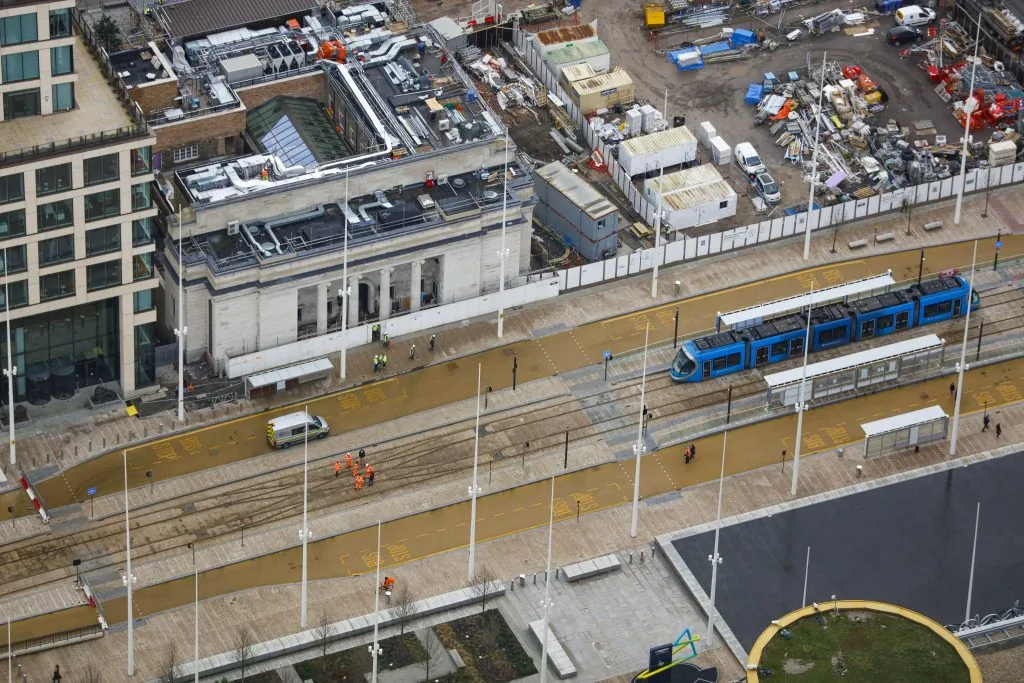
The expansion of the West Midlands Metro, more than a decade in delivery, is reshaping Birmingham’s core with new on-street tram alignments threading through the city centre and into previously rail-poor districts. Construction has required complex utility diversions beneath historic streets, tight-radius curves around existing structures, and slab track integrated with high footfall public realm. For civil and geotechnical teams, the scheme is driving demand for shallow foundation solutions, vibration control adjacent to sensitive buildings, and staged traffic management to keep constrained urban corridors operational.
Technical Brief
- On-street alignment through historic cores introduces heritage façade protection and settlement monitoring obligations.
- Urban realm upgrades around new stops require coordinated hard landscaping, drainage and street furniture design.
- Long programme duration increases exposure to changing standards, utility asset renewals and adjacent developments.
- For other UK light rail schemes, the project offers a reference for decade-scale city-centre delivery logistics.
Our Take
Among the 744 Infrastructure stories in our database, only a small subset deal with UK light rail, so the West Midlands Metro stands out as one of the few large-scale urban transit reshaping projects outside London.
For Birmingham and the wider West Midlands, fixed-rail schemes like the West Midlands Metro typically trigger tighter utility corridors and more complex ground-works than bus-based upgrades, which can materially affect geotechnical risk management and long-term maintenance planning.
Because the Midlands Metro is an in-street system in a dense UK city, contractors often face legacy ground conditions and buried services from multiple historical eras, which tends to drive demand for detailed ground-penetrating surveys and phased construction to control disruption.
Prepared by collating external sources, AI-assisted tools, and Geomechanics.io’s proprietary mining database, then reviewed for technical accuracy & edited by our geotechnical team.
Related Articles


Related Industries & Products
Construction
Quality control software for construction companies with material testing, batch tracking, and compliance management.
Mining
Geotechnical software solutions for mining operations including CMRR analysis, hydrogeological testing, and data management.
QCDB-io
Comprehensive quality control database for manufacturing, tunnelling, and civil construction with UCS testing, PSD analysis, and grout mix design management.