Geomechanics.io

  • Free Tools
Sign UpLog In

Geomechanics.io

Geomechanics, Streamlined.

© 2026 Geomechanics.io. All rights reserved.

Geomechanics.io

CMRR-ioGEODB-ioHYDROGEO-ioQCDB-ioFree Tools & CalculatorsBlogLatest Industry News

Industries

MiningConstructionTunnelling

Company

Terms of UsePrivacy PolicyLinkedIn
    AllGeotechnicalMiningInfrastructureMaterialsHazardsEnvironmentalSoftwarePolicy
    Projects

    South America as West’s safest minerals bet: risk and supply notes for mine planners

    February 12, 2026|

    Reviewed by Tom Sullivan

    South America as West’s safest minerals bet: risk and supply notes for mine planners

    First reported on MINING.com

    30 Second Briefing

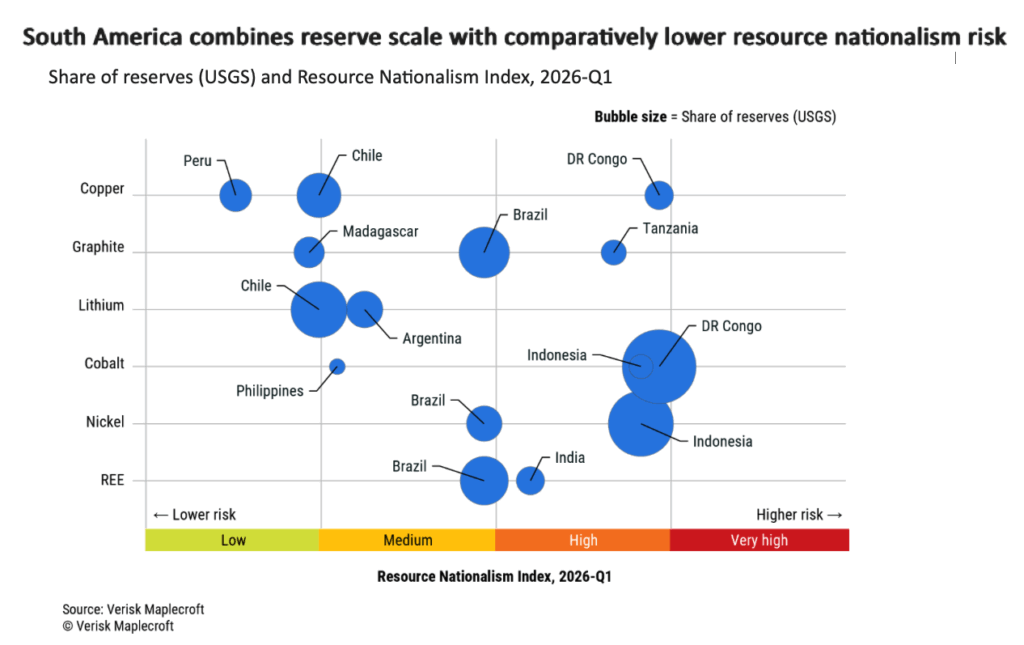
    South America is identified by Verisk Maplecroft’s Resource Nationalism Index and Political Risk Data as the most stable option for Western critical mineral diversification, with Argentina, Brazil, Chile and Peru combining large lithium, copper, cobalt, nickel, graphite and rare earth endowments with moderate state intervention. DR Congo, Indonesia and Tanzania sit among the 20 most exposed jurisdictions globally, yet remain unavoidable for some minerals, as shown by the US Strategic Minerals Cooperation Framework with DRC and the EU’s rare earth-linked trade deal with India. Geopolitical Alignment Tool scores place Argentina and the Philippines as close US allies and Chile, Madagascar and India as strategically aligned, making South America a relatively low-risk anchor in a fragmented supply landscape.

    Technical Brief

    • Verisk Maplecroft benchmarked 10 emerging producers using its Resource Nationalism Index plus Political Risk Data.
    • DR Congo, Indonesia and Tanzania fall within the 20 most resource‑nationalism‑exposed jurisdictions out of 198 assessed.
    • Peru, Chile and Argentina are classed among the strongest global performers for low resource‑nationalism risk.
    • Some states combine high political volatility with assertive state control, elevating risk of export bans or mandated beneficiation.
    • India’s rare earths regime, and policy settings in DR Congo and Indonesia, exemplify tighter state control plus value‑add demands.

    Our Take

    Verisk Maplecroft also underpinned a January 27 piece in our database on Latin America’s ‘security zone’ status for lithium and copper, signalling that Washington’s push for a 55-country critical minerals bloc is being framed around the same Andean jurisdictions highlighted here.

    Northern Star’s 49% first-half profit jump, tied to gold, sits against a backdrop of only a handful of gold-price pieces in our recent coverage, suggesting that cash-generative precious metals producers may become important internal financiers for diversification into copper, nickel or lithium assets in safer jurisdictions such as Chile and Brazil.

    Across the 267 keyword-matched cobalt and copper items in our database, most high-grade new supply is still concentrated in higher-risk states like DR Congo and Indonesia, which likely reinforces why South American copper and nickel deposits are being treated as ‘premium’ options in Western supply-chain planning despite more mature regulatory regimes.

    Geotechnical Software for Modern Teams

    Centralise site data, logs, and lab results with GEODB-io, CMRR-io, and HYDROGEO-io.

    No credit card required.

    • Save and export unlimited calculations
    • Advanced data visualisation
    • Generate professional PDF reports
    • Cloud storage for all your projects

    Prepared by collating external sources, AI-assisted tools, and Geomechanics.io’s proprietary mining database, then reviewed for technical accuracy & edited by our geotechnical team.

    Related Articles

    Global battery demand and Australian lithium: processing shift for mine engineers
    Mining
    about 1 hour ago

    Global battery demand and Australian lithium: processing shift for mine engineers

    Surging global demand for lithium-ion batteries for electric vehicles and grid storage is pushing Australia to move beyond spodumene concentrate exports into domestic refining and cathode‑grade chemical production. Industry proposals centre on converting hard‑rock feed into battery‑grade lithium hydroxide and carbonate in Western Australia, leveraging existing Tier‑1 deposits and port infrastructure but facing high energy costs, skills shortages and permitting timelines. For miners and process engineers, the shift implies greater focus on impurity control, reagent optimisation and integration of hydrometallurgical circuits with upstream mine planning.

    Bengalla growth for New Hope: strip mine sequencing and design notes for planners
    Mining
    about 1 hour ago

    Bengalla growth for New Hope: strip mine sequencing and design notes for planners

    New Hope Group has lifted coal output across its Australian assets and is advancing growth plans at the Bengalla thermal coal mine in the Hunter Valley, where it holds an 80 per cent interest alongside Mitsui, Taipower and J-Power. The open-cut operation, which typically produces export-quality thermal coal for Asian power utilities via the Port of Newcastle, is the company’s key near-term expansion focus. For mine planners and geotechs, any Bengalla growth path will centre on additional strip mining, dragline and truck–shovel sequencing, and associated waste dump and haul road reconfiguration.

    Mining smarter with AI and data: edge network design notes for engineers
    Mining
    about 2 hours ago

    Mining smarter with AI and data: edge network design notes for engineers

    Australian miners are hitting a data wall as high‑bandwidth sensors, autonomous fleets and video streams overwhelm traditional cloud links, pushing operations towards private LTE networks and on‑site edge computing. Vendors such as Vocus are pairing Starlink Business Rural satellite backhaul with 4G/5G private LTE to keep haul trucks, crushers and fixed plant connected in real time, even on remote pits and waste dumps. For engineers, this shift means designing networks and control systems around low‑latency, on‑site processing for fleet dispatch, collision avoidance and condition monitoring rather than centralised data centres.

    Related Industries & Products

    Mining

    Geotechnical software solutions for mining operations including CMRR analysis, hydrogeological testing, and data management.

    CMRR-io

    Streamline coal mine roof stability assessments with our cloud-based CMRR software featuring automated calculations, multi-scenario analysis, and collaborative workflows.

    HYDROGEO-io

    Comprehensive hydrogeological testing platform for managing, analysing, and reporting on packer tests, lugeon values, and hydraulic conductivity assessments.

    GEODB-io

    Centralised geotechnical data management solution for storing, accessing, and analysing all your site investigation and material testing data.