Prolonged Iran war and copper: cost, demand and margin risks for mine planners
Reviewed by Joe Ashwell
First reported on MINING.com
30 Second Briefing
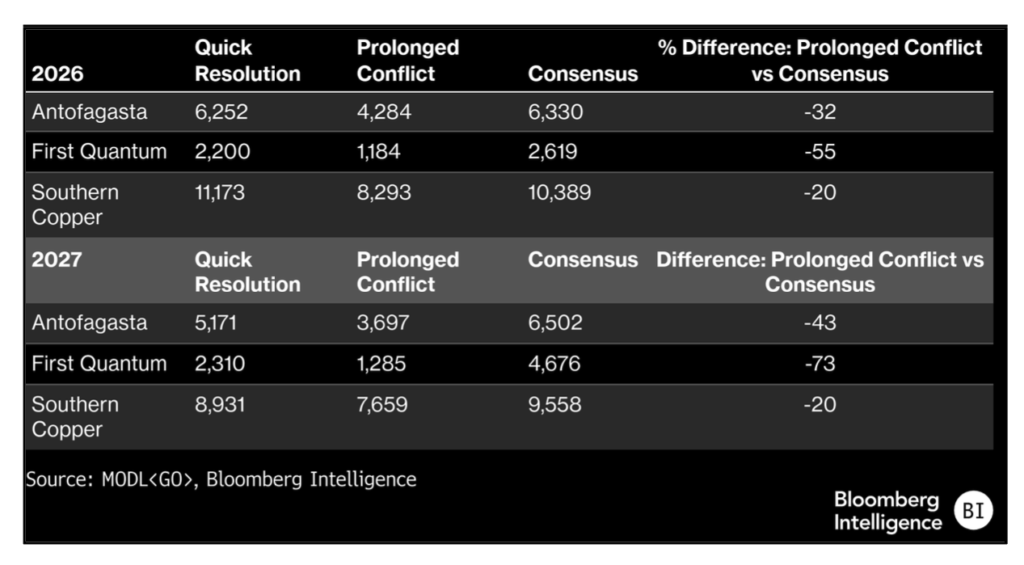
A prolonged Iran conflict that drives oil above $150 a barrel and constrains Strait of Hormuz flows could cap global copper demand growth at 0.5%–1%, push prices below $10,000/t and create a 100,000–200,000 t refined surplus, Bloomberg Intelligence warns. Under this scenario, 2026 earnings may drop about 20% at Southern Copper, 32% at Antofagasta and up to 55% at First Quantum, with unit costs rising 10%–20% and high-cost producer margins compressing from ~70% to ~40%. Sulfur and sulfuric acid supply from the Gulf emerges as a key constraint, particularly for DRC operations where 50%–60% of output depends on acid leaching.
Technical Brief
- Multi‑month conflict case keeps 2026 market roughly balanced with prices around $10,500–$11,500/t.
- Fast resolution scenario restores a modest refined deficit and supports prices near $12,000/t in 2026.
- Southern Copper’s downside resilience is attributed to its structurally low unit cost base versus peers.
- First Quantum’s risk is amplified by uncertainty over Cobre Panama restart, expected by consensus to matter from 2027.
- Analysts note persistent stoppages at major operations and tight concentrate markets could cap any meaningful mine‑supply lift in 2026.
Our Take
The projected 10–20% unit cost increase for copper under an Iran conflict scenario would hit DRC operations especially hard, as our database shows a large share of that country’s copper output already constrained by the 50–60% dependence on imported sulfuric acid highlighted here.
First Quantum, Southern Copper, Antofagasta and BHP all feature in recent pieces on metals entering technical bear markets, so the additional earnings declines modelled here would likely compound equity pressure that is already evident across copper-heavy portfolios.
With Cobre Panama only expected to contribute meaningfully by 2027 and global copper demand growth in 2026 capped at 2–2.3% in this scenario, developers such as Deep Sea Minerals in the Clarion-Clipperton Zone and BHP’s Jansen potash project may find it easier to secure capital than high-cost, late-cycle copper expansions.
Prepared by collating external sources, AI-assisted tools, and Geomechanics.io’s proprietary mining database, then reviewed for technical accuracy & edited by our geotechnical team.
Related Articles


Related Industries & Products
Mining
Geotechnical software solutions for mining operations including CMRR analysis, hydrogeological testing, and data management.
CMRR-io
Streamline coal mine roof stability assessments with our cloud-based CMRR software featuring automated calculations, multi-scenario analysis, and collaborative workflows.
HYDROGEO-io
Comprehensive hydrogeological testing platform for managing, analysing, and reporting on packer tests, lugeon values, and hydraulic conductivity assessments.
GEODB-io
Centralised geotechnical data management solution for storing, accessing, and analysing all your site investigation and material testing data.