PDAC Silicon Discovery of the Year: mapping and drilling lessons for mine geologists
Reviewed by Joe Ashwell
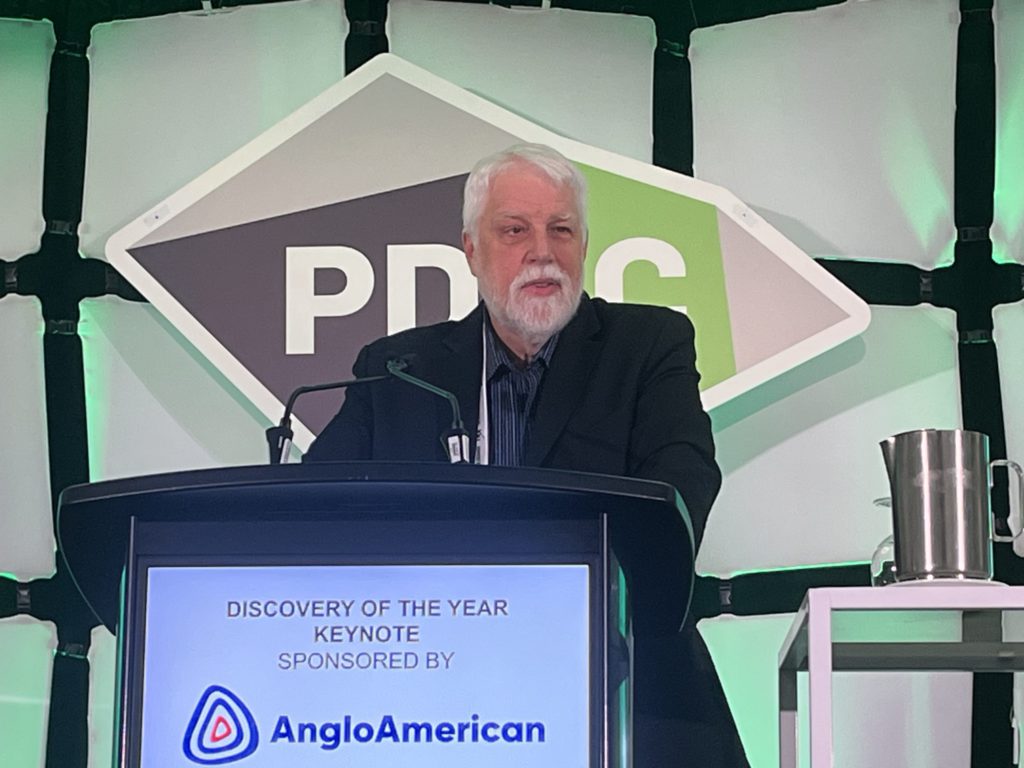
First reported on MINING.com
30 Second Briefing
AngloGold Ashanti’s Silicon project in southern Nevada has earned PDAC’s Thayer Lindsley Discovery of the Year after detailed field mapping and core logging converted an “oddball” alteration system into one of the largest recent US gold finds. Probable reserves now stand at 88 million tonnes grading 1.75 g/t gold and 2.75 g/t silver, totalling about 5 million oz. gold and 7.8 million oz. silver, 200 km from Las Vegas. Geologist Paul Bartos stressed that Landsat-based alteration mapping, followed by systematic drilling, was critical in a district long dismissed as over-explored.
Technical Brief
- Discovery concept originated in a 2016 technical meeting between AngloGold Ashanti and Renaissance Gold.
- Bartos had prior discovery experience at San Bartolome silver (Bolivia) and Chert Cliffs Carlin gold (Nevada).
- Early Silicon work was funded in part by Callinan Royalties, which shared in the PDAC award.
- Initial AngloGold internal view treated Nevada as a mature, over-explored diversion with low expectations.
- Bartos was initially authorised to pursue Silicon with effectively no budget, staff or dedicated field vehicle.
- Renaissance’s pre-option work included Landsat satellite alteration mapping, later reused and extended by AngloGold’s team.
- An option agreement signed in 2017 formalised AngloGold’s access to Renaissance’s data and the Silicon ground.
- Bartos emphasised detailed structural and alteration field mapping plus systematic core logging as decisive technical inputs.
- Silicon’s alteration style conflicted with prevailing district exploration models, contributing to decades of under-testing.
- Case reinforces value of re‑evaluating “mature” belts using remote sensing plus rigorous boots‑on‑ground geology.
Our Take
With 5 Moz gold and 7.8 Moz silver in probable reserves at Silicon, AngloGold Ashanti moves into the same tier of Nevada-scale deposits that have featured prominently in our 373 gold- and silver-keyword pieces, giving it optionality against peers like Newmont and Barrick that dominate our US gold coverage.
The Nevada location and 1.75 g/t gold grade position Silicon as a relatively de-risked North American growth asset for AngloGold Ashanti at a time when our database shows many new ounces coming from higher-jurisdiction-risk regions, which can shift portfolio weighting and capital allocation away from frontier projects.
The incident metrics tied to Mexico and Coahuila in this piece underline that, compared with jurisdictions like Sinaloa and Coahuila where worker fatalities and trapping events are noted, southern Nevada’s regulatory and safety environment is likely to be a non-trivial competitive advantage for project execution and financing timelines toward the summer 2026 horizon.
Prepared by collating external sources, AI-assisted tools, and Geomechanics.io’s proprietary mining database, then reviewed for technical accuracy & edited by our geotechnical team.
Related Articles


Related Industries & Products
Mining
Geotechnical software solutions for mining operations including CMRR analysis, hydrogeological testing, and data management.
CMRR-io
Streamline coal mine roof stability assessments with our cloud-based CMRR software featuring automated calculations, multi-scenario analysis, and collaborative workflows.
HYDROGEO-io
Comprehensive hydrogeological testing platform for managing, analysing, and reporting on packer tests, lugeon values, and hydraulic conductivity assessments.
GEODB-io
Centralised geotechnical data management solution for storing, accessing, and analysing all your site investigation and material testing data.