Geomechanics.io

  • Free Tools
Sign UpLog In

Geomechanics.io

Geomechanics, Streamlined.

© 2026 Geomechanics.io. All rights reserved.

Geomechanics.io

CMRR-ioGEODB-ioHYDROGEO-ioQCDB-ioFree Tools & CalculatorsBlogLatest Industry News

Industries

MiningConstructionTunnelling

Company

Terms of UsePrivacy PolicyLinkedIn
    Projects

    Patterson Lake South uranium decision by 2027: capex and schedule lens for engineers

    April 11, 2026|

    Reviewed by Tom Sullivan

    Patterson Lake South uranium decision by 2027: capex and schedule lens for engineers

    First reported on MINING.com

    30 Second Briefing

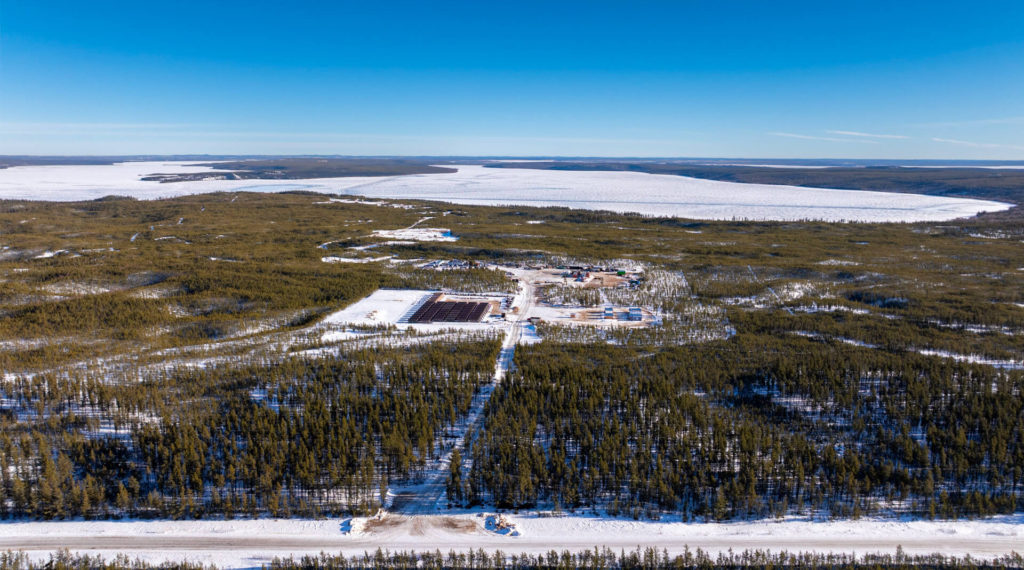
    Paladin Energy plans a final investment decision by end-2027 on the Patterson Lake South uranium project in Saskatchewan, centred on the high-grade Triple R deposit with 93.7 million lb U3O8 in probable reserves at 1.41% starting about 50 m below surface. A 2023 feasibility study outlines average output of 9.1 million lb U3O8 per year over 10 years, pre-production capex of $1.2 billion and life-of-mine cash costs of $11.7/lb, with first production targeted for 2031. Progress through FEED and Canadian Nuclear Safety Commission licensing runs alongside a judicial review filed by Métis Nation–Saskatchewan challenging the February 2025 provincial environmental approval.

    Technical Brief

    • Judicial review filed 31 March by Métis Nation–Saskatchewan challenges 19 February provincial environmental approval.
    • Challenge alleges inadequate consultation; Paladin denies the claims and will defend in Saskatchewan Court of King’s Bench.
    • Paladin has secured an exemption from Canada’s non-resident ownership policy specifically for Patterson Lake South.
    • Mutual benefits agreements already signed with Buffalo River Dene Nation and Clearwater River Dene Nation.
    • Paladin acquired Fission Uranium in December 2024, consolidating ownership and project control at Patterson Lake South.
    • Current drilling aims to convert 25.1 Mlb indicated and 10.9 Mlb inferred U3O8 into mineable reserves.
    • Patterson Lake corridor in western Athabasca is characterised as a structurally fertile belt for shallow, basement-hosted uranium.
    • Benchmarking by Paladin ranks PLS among top undeveloped uranium projects globally on grade, cost and jurisdictional risk.

    Our Take

    With probable reserves of 93.7 million lb U3O8 at 1.41% starting from about 50 m depth, Patterson Lake South sits at the high-grade, shallow end of the Athabasca cost curve, which tends to support financing even if long-term uranium prices soften from current levels.

    Targeted conversion of a further 36 million lb (indicated plus inferred) into reserves at PLS would materially extend the initial 10-year mine life, which in our database is a common prerequisite for utilities considering longer-term offtake from greenfield uranium projects.

    Geotechnical Software for Modern Teams

    Centralise site data, logs, and lab results with GEODB-io, CMRR-io, and HYDROGEO-io.

    No credit card required.

    • Save and export unlimited calculations
    • Advanced data visualisation
    • Generate professional PDF reports
    • Cloud storage for all your projects

    Prepared by collating external sources, AI-assisted tools, and Geomechanics.io’s proprietary mining database, then reviewed for technical accuracy & edited by our geotechnical team.

    Related Articles

    US DOE $10M critical minerals R&D: process insights for mining engineers
    Mining
    about 12 hours ago

    US DOE $10M critical minerals R&D: process insights for mining engineers

    The US Department of Energy has awarded $10 million via the Critical Materials Innovation Hub to seven early-stage R&D projects targeting more efficient recovery and refining of rare earth elements, gallium, copper and other critical materials. Funded work includes chloride-based molten salt electrolysis for heavy rare earth production at Case Western Reserve, hydro and bio-hydrometallurgical copper extraction at Colorado School of Mines, and nanobubble–surfactant–reactive oxygen leaching of copper sulphides at the University of Arizona. FAST Metals, Indium Corporation, Oak Ridge National Laboratory and the University of Illinois will trial solid-phase extraction, advanced ion-exchange resins and redox-adsorbents to recover gallium and mixed rare earth oxides from bauxite-alumina circuits, zinc refinery residues and industrial byproduct streams.

    Maglut Heavy Industries rare earth strategy: ARC-1 process insights for mine planners
    Mining
    about 12 hours ago

    Maglut Heavy Industries rare earth strategy: ARC-1 process insights for mine planners

    Maglut Heavy Industries is developing a chromatography-based rare earth processing platform at its pilot-scale Long Beach, California facility, reporting 99.9%+ purity for individual rare earth oxides using its ARC-1 water-based separation process. The company designs and manufactures its own resin and ligand systems, aiming for globally competitive costs versus conventional solvent extraction as US defence contractors face January 2027 rules to eliminate Chinese rare earth magnets. A demonstration-scale plant is planned to be fully operational by August 2027, producing commercial rare earth oxides and potentially expanding to other critical minerals.

    Gold price retreats from three‑month high: risk notes for mine planners
    Mining
    about 12 hours ago

    Gold price retreats from three‑month high: risk notes for mine planners

    Gold retreated from a three-month high after July US PCE inflation printed at 3.7% headline and 3.3% core, with Comex December futures down 1% to $4,649.10/oz and spot off 1.4% at $4,592.53 by late morning in New York. The pullback follows a 14% August surge in bullion, driven by US Treasury bond-market intervention and a 28-tonne weekly inflow into gold-backed ETFs, ahead of Kevin Warsh’s first Jackson Hole speech as Fed chair. Gold and silver miners still post outsized August gains, with Eldorado up 55%, Equinox 53% and Newmont 41%.

    Related Industries & Products

    Mining

    Geotechnical software solutions for mining operations including CMRR analysis, hydrogeological testing, and data management.

    CMRR-io

    Streamline coal mine roof stability assessments with our cloud-based CMRR software featuring automated calculations, multi-scenario analysis, and collaborative workflows.

    HYDROGEO-io

    Comprehensive hydrogeological testing platform for managing, analysing, and reporting on packer tests, lugeon values, and hydraulic conductivity assessments.

    GEODB-io

    Centralised geotechnical data management solution for storing, accessing, and analysing all your site investigation and material testing data.

    AllGeotechnicalInfrastructureHazardsEnvironmental