McLaren breaks ground on Wrexham Kop: construction sequencing insights for engineers
Reviewed by Tom Sullivan
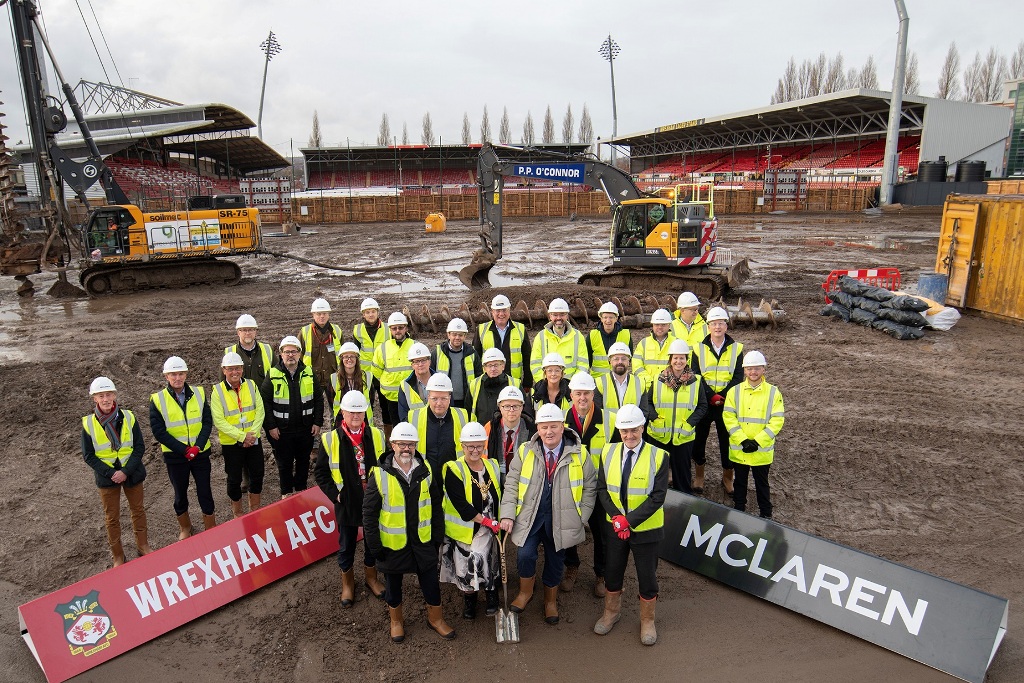
First reported on The Construction Index
30 Second Briefing
McLaren Construction has started main works on Wrexham AFC’s new 5,500-seat Kop Stand, a Populous-designed structure that will lift the Racecourse Ground’s capacity above 18,000 and is targeted for UEFA Category 4 compliance by the 2026/27 season. Early works have included reduced-level excavation, a stabilised construction platform, piling mat installation, crane platforms and initial piling, with foundations, reinforced concrete lift cores and internal service ducting now progressing on a tight, live stadium footprint. The steel frame will comprise about 1,500 tonnes of steel, followed by precast terrace units, slip-formed concrete cores for roof stability, and a brick façade referencing Wrexham’s “Terracottapolis” heritage.
Technical Brief
- Early-phase works included reduced-level excavation and a stabilised construction platform to support piling rigs.
- A dedicated piling mat and crane platforms have been formed to manage heavy plant on the constrained footprint.
- Breakout of temporary piles and casting of permanent foundations are scheduled across December and January.
- Reinforced concrete lift cores are being constructed early to act as primary stability elements for the steel frame.
- Internal service ducting, drainage runs and preparation of the main ground floor slab are progressing in parallel with substructure works.
- Slip-formed reinforced concrete cores for the roof’s lateral stability are planned for early 2026, decoupled from initial frame erection.
- The steelwork package includes c.1,500 tonnes of steel with long-lead tubular truss sections requiring early procurement and logistics planning.
- Precast concrete terrace units will be installed onto the steel frame before roofing, façade brickwork and internal fit-out.
- Construction sequencing and trade movements are tightly programmed to maintain operations within a live, historically sensitive stadium bowl.
- Logistics plans have been coordinated with Wrexham Council, Wrexham University and nearby businesses to minimise access and traffic disruption.
Our Take
McLaren Construction’s Midlands and North division features only sporadically in our 167 Infrastructure stories, so the Wrexham Kop work signals the firm pushing more visibly into higher-profile regional stadia and civic projects in the UK outside the main London corridor.
With completion targeted during the 2026/27 season, the programme length aligns with other major stand redevelopments in our Projects-tagged coverage, suggesting a typical two-season window that contractors and clubs are increasingly using to phase works around live match operations.
The involvement of Wrexham County Borough Council, the Welsh government and Wrexham University alongside Wrexham AFC mirrors other multi-stakeholder schemes in our database, where stadium upgrades are leveraged as anchor assets in wider ‘gateway’ or regeneration frameworks rather than treated as stand-alone sports builds.
Prepared by collating external sources, AI-assisted tools, and Geomechanics.io’s proprietary mining database, then reviewed for technical accuracy & edited by our geotechnical team.
Related Articles


Related Industries & Products
Construction
Quality control software for construction companies with material testing, batch tracking, and compliance management.
Mining
Geotechnical software solutions for mining operations including CMRR analysis, hydrogeological testing, and data management.
QCDB-io
Comprehensive quality control database for manufacturing, tunnelling, and civil construction with UCS testing, PSD analysis, and grout mix design management.