Komatsu MC51 at Niobec: mechanical cutting trial insights for mine engineers
Reviewed by Joe Ashwell
First reported on Australian Mining
30 Second Briefing
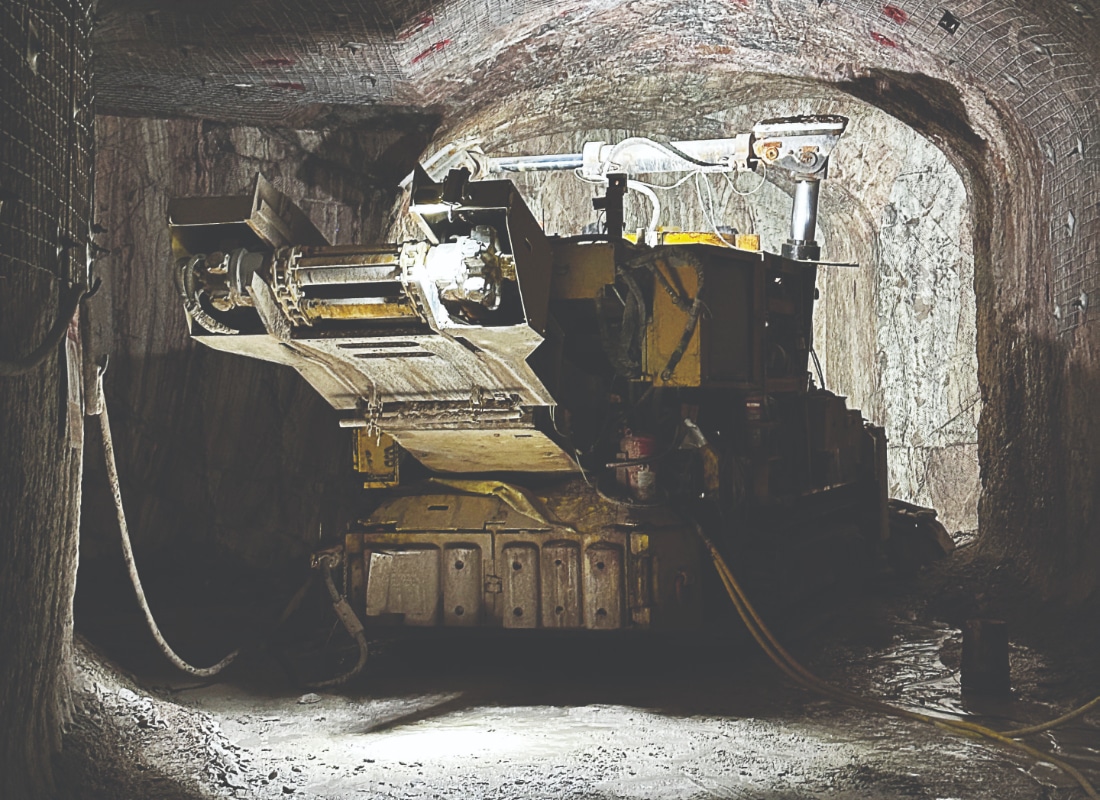
Komatsu is running a full-scale proof-of-concept of its MC51 hard-rock continuous miner at Niobec’s underground niobium operation in Québec, using the DynaCut mechanical cutting system instead of drill-and-blast. The MC51 integrates continuous mechanical excavation with precise profiling to reduce overbreak, improve ground control and cut energy use per tonne, while enabling more consistent tunnel cross-sections for services and ventilation. For engineers, the trial will provide real production, wear and fragmentation data to benchmark mechanical cutting against conventional development in competent hard rock.
Technical Brief
- MC51 integrates Komatsu’s DynaCut mechanical cutting head, enabling continuous rock excavation without explosives.
- Continuous cutting allows personnel to remain further from the face compared with drill-and-blast charging.
- More uniform profiles support predictable rock support layouts and reduce localised stress concentrations around openings.
- Mechanical excavation reduces blast-induced vibration, benefiting adjacent excavations, shaft infrastructure and sensitive equipment.
- Fewer explosives and detonators on site simplify storage, transport and handling risk management.
- Consistent cross-sections improve ventilation control, aiding contaminant dispersion and heat management in deeper levels.
- Outcomes will inform risk assessments and mine design choices for non-blasting development in similar hard-rock mines.
Our Take
Across our mining coverage, Komatsu appears frequently in safety‑ and product‑tagged pieces, and the MC51 at Niobec in Quebec sits alongside recent items on autonomous haulage and electric rope shovels as part of a broader push to automate and electrify underground and surface fleets.
The Canadian deployment at Niobec complements Komatsu’s recent commissioning of the first P&H 2300XPC AC electric rope shovel in British Columbia, signalling that Canada is becoming an early proving ground for the company’s lower‑emission, high‑capital equipment in both underground and open‑pit environments.
With Komatsu Australia simultaneously upgrading aftertreatment systems to meet local emissions and safety rules, the MC51’s use in Canada suggests Komatsu is tailoring its ‘greener’ underground solutions to distinct regulatory regimes in Canada and Australia rather than relying on a single global configuration.
Prepared by collating external sources, AI-assisted tools, and Geomechanics.io’s proprietary mining database, then reviewed for technical accuracy & edited by our geotechnical team.
Related Articles


Related Industries & Products
Mining
Geotechnical software solutions for mining operations including CMRR analysis, hydrogeological testing, and data management.
Tunnelling
Specialised solutions for tunnelling projects including grout mix design, hydrogeological analysis, and quality control.
CMRR-io
Streamline coal mine roof stability assessments with our cloud-based CMRR software featuring automated calculations, multi-scenario analysis, and collaborative workflows.
HYDROGEO-io
Comprehensive hydrogeological testing platform for managing, analysing, and reporting on packer tests, lugeon values, and hydraulic conductivity assessments.
GEODB-io
Centralised geotechnical data management solution for storing, accessing, and analysing all your site investigation and material testing data.