Kazakhstan ground view: critical minerals and corridor risks for mine planners
Reviewed by Joe Ashwell
First reported on MINING.com
30 Second Briefing
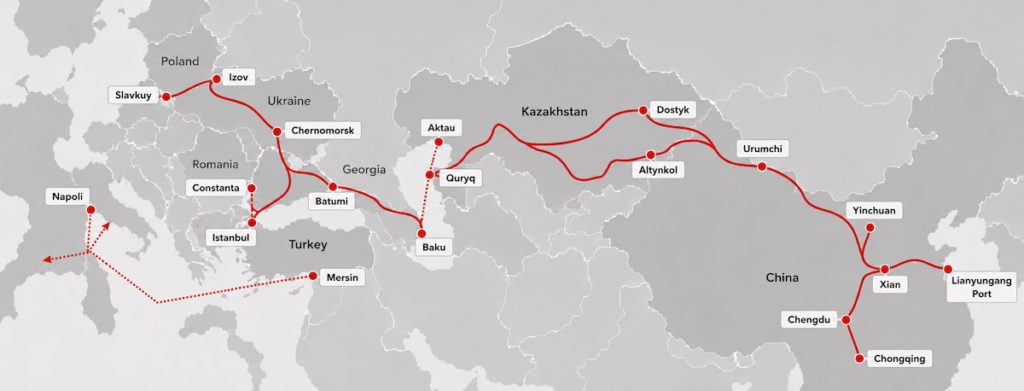
Kazakhstan’s role in critical minerals supply chains is being probed on the ground in Astana, where Erik Groves attended the C5+1 Critical Minerals Dialogue alongside US Special Envoy Sergio Gor, the US International Development Finance Corporation and the Commerce Department’s Commercial Service. Discussions centred on the Trans-Caspian International Transport Route (Middle Corridor) and the US-backed Trump Route for International Peace and Prosperity (TRIPP) as alternative westward export paths constrained by closed Russian and Ukrainian airspace. Kazakhstan’s mining ministry is pushing regulatory reforms and international reporting standards to attract foreign capital and embed “international best practices” in new copper, uranium and other critical mineral projects.
Technical Brief
- Commercial flights from Europe to Astana now detour via Georgia, Azerbaijan and the Caspian, bypassing Russian/Ukrainian airspace.
- That same narrow air corridor coincides geographically with the Trans-Caspian International Transport Route (“Middle Corridor”).
- C5+1 Critical Minerals Dialogue sessions in Astana included formal plenaries plus informal side discussions in the same venue.
- US Special Envoy Sergio Gor repeatedly framed US engagement as “win-win”, emphasising commercial partnerships over traditional aid.
- Kazakhstan’s host minister publicly stressed existing regulatory reforms and reporting standards as already exceeding many regional peers.
- US International Development Finance Corporation and Commerce Department Commercial Service attended as active deal participants, not passive observers.
- The Trump Route for International Peace and Prosperity (TRIPP) was discussed as a specific westbound transit alternative for mined output.
- Ground View reporting is based on in-room observation of officials, financiers and operators rather than desktop document review.
Our Take
Kazakhstan’s copper and uranium endowment sits squarely in the ‘critical minerals’ theme that dominates our 361 keyword‑matched pieces, but very few of those currently focus on Central Asia, suggesting operators along the Middle Corridor may face less competition for Western strategic capital than peers in Latin America or Africa.
Glencore’s presence in both this Kazakhstan piece and multiple recent copper and iron ore market analyses in our database signals that any expansion or restructuring of its Kazakh portfolio would be closely watched as a bellwether for how majors price geopolitical and logistics risk in Central Asia versus more traditional hubs.
The C5+1 Critical Minerals Dialogue and US International Development Finance Corporation involvement give Kazakhstan a route to tap the same Western policy tailwinds that have lifted valuations in our Top 50 mining rankings, which could translate into more favourable financing terms for copper, zinc and uranium projects tied into the Middle Corridor rather than Russian transit routes.
Prepared by collating external sources, AI-assisted tools, and Geomechanics.io’s proprietary mining database, then reviewed for technical accuracy & edited by our geotechnical team.
Related Articles
Related Industries & Products
Mining
Geotechnical software solutions for mining operations including CMRR analysis, hydrogeological testing, and data management.
CMRR-io
Streamline coal mine roof stability assessments with our cloud-based CMRR software featuring automated calculations, multi-scenario analysis, and collaborative workflows.
HYDROGEO-io
Comprehensive hydrogeological testing platform for managing, analysing, and reporting on packer tests, lugeon values, and hydraulic conductivity assessments.
GEODB-io
Centralised geotechnical data management solution for storing, accessing, and analysing all your site investigation and material testing data.