Geomechanics.io

  • Free Tools
Sign UpLog In

Geomechanics.io

Geomechanics, Simplified.

© 2026 Geomechanics.io. All rights reserved.

Geomechanics.io

CMRR-ioGEODB-ioHYDROGEO-ioQCDB-ioFree Tools & CalculatorsBlogLatest Industry News

Industries

MiningConstructionTunnelling

Company

Terms of UsePrivacy PolicyLinkedIn
    Projects

    HS2 Water Orton viaducts: balanced cantilever construction insights for engineers

    January 5, 2026|

    Reviewed by Joe Ashwell

    HS2 Water Orton viaducts: balanced cantilever construction insights for engineers

    First reported on The Construction Index

    30 Second Briefing

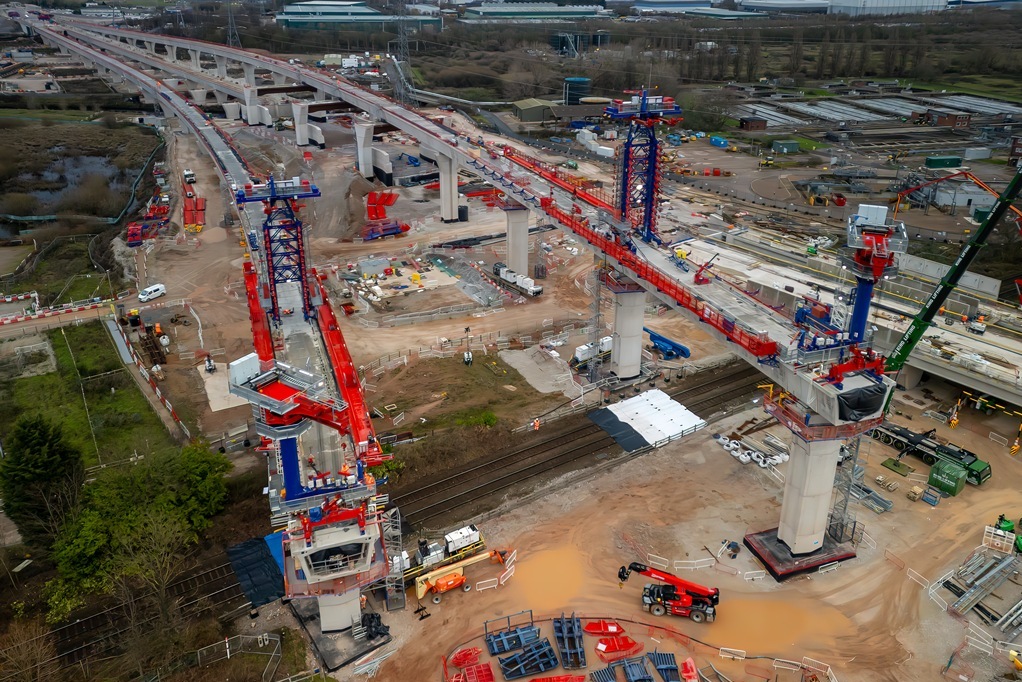
    Construction of HS2’s Delta junction advanced over Christmas with Balfour Beatty Vinci completing two parallel Water Orton viaduct spans across the live Birmingham–Peterborough railway during a five-day blockade. The single‑track precast segmental viaducts will run for about 1.4km, supported on 32 in‑situ concrete piers up to 20m high, carrying 360km/h mainline and 200km/h approach tracks over two railways, the A446, the River Tame and the M42. Segments are installed by a balanced cantilever method using a 22m mast and 14m swivel crane, with 2,742 units cast at Lea Marston.

    Technical Brief

    • Delta junction comprises 2.6 miles of track with underpasses, flyovers and five major viaducts.
    • Water Orton viaducts sit at the northern end, feeding Birmingham Curzon Street and Washwood Heath depot.
    • Around 3.7 miles of viaduct across Delta junction are being built using the same segmental method.
    • Each span is post-tensioned internally, allowing temporary cable stays to be progressively advanced span by span.
    • Piers up to 20 m high are cast in situ using bespoke formwork and prefabricated reinforcement cages from Coleshill.

    Our Take

    The 3.7 miles of viaduct across the Delta junction being built with segmental and cantilever methods sits alongside other HS2 deck-move innovations, such as the 4,600t M6 viaduct slide reported on 15 December 2025, signalling that BBV is standardising complex erection techniques to minimise motorway and rail disruption.

    Running HS2 trains at 360km/h on the London–Birmingham mainline with 200km/h approaches into Birmingham Curzon Street means tight geometric and dynamic constraints at Delta junction, so the 1.4km Water Orton viaducts effectively act as high-speed transition structures rather than conventional approach spans.

    Within our 343 Infrastructure stories, HS2 and HS2 Ltd recur as some of the most frequently cited UK clients, which suggests that lessons from the Water Orton and M6 viaduct operations are likely to influence Network Rail and National Highways practice on future high-speed and major road–rail interface schemes.

    Geotechnical Software for Modern Teams

    Centralise site data, logs, and lab results with GEODB-io, CMRR-io, and HYDROGEO-io.

    No credit card required.

    • Save and export unlimited calculations
    • Advanced data visualisation
    • Generate professional PDF reports
    • Cloud storage for all your projects

    Prepared by collating external sources, AI-assisted tools, and Geomechanics.io’s proprietary mining database, then reviewed for technical accuracy & edited by our geotechnical team.

    Related Articles

    Xihe on Tung Chung Line down-track: TBM turnback method and risks for tunnel engineers
    Infrastructure
    in 5 months

    Xihe on Tung Chung Line down-track: TBM turnback method and risks for tunnel engineers

    TBM Xihe, a 7.3m-diameter, 100m-long, 1,000-tonne Herrenknecht slurry machine, has completed the up-track drive to the future Tung Chung West Station and has begun boring the down-track tunnel towards Tung Chung Station for MTR’s Tung Chung Line Extension in Hong Kong. The Bouygues Travaux Publics–Dragages Hong Kong JV turned the TBM underground within the launch shaft using a push-pull method and self-propelled modular transporter, avoiding full disassembly and surface transport. About 1.3km of new twin-bore tunnels are being driven close to existing rail and urban structures, with commissioning targeted for 2029.

    Sydney Metro Stations Package West: design and delivery notes for engineers
    Infrastructure
    in 4 months

    Sydney Metro Stations Package West: design and delivery notes for engineers

    Gamuda Engineering has secured the Sydney Metro Stations Package West as principal contractor, covering design and construction of five new underground stations at Westmead, North Strathfield, Burwood North, Five Dock and The Bays on the 24km Sydney Metro West line between Greater Parramatta and the CBD. The scope includes deep station boxes, entrances and access points, full station fit-out and integration with surrounding precincts, with Laing O’Rourke and DT Infrastructure joining as MetroVista delivery partners. Site works are scheduled to start on Monday, 5 January 2026.

    Nottingham Forest City Ground expansion: design and crowd-flow notes for engineers
    Infrastructure
    about 21 hours ago

    Nottingham Forest City Ground expansion: design and crowd-flow notes for engineers

    Nottingham Forest has submitted new plans to expand the City Ground from 30,445 to about 52,000 seats, replacing last year’s approved but smaller 35,000-capacity scheme focused on rebuilding the Peter Taylor Stand. The revised project team is led by KSS Design Group, with Buro Happold, Gleeds and Savills advising, and owner Evangelos Marinakis committing “significant investment” for a “sustainable and iconic” redevelopment. For civil and structural engineers, the jump to a 52,000-seat bowl signals substantially larger crowd loading, egress, services and transport interface requirements on an already constrained riverside site.

    Related Industries & Products

    Construction

    Quality control software for construction companies with material testing, batch tracking, and compliance management.

    QCDB-io

    Comprehensive quality control database for manufacturing, tunnelling, and civil construction with UCS testing, PSD analysis, and grout mix design management.

    AllGeotechnicalMiningInfrastructureMaterialsHazardsEnvironmentalSoftwarePolicy