HS2 lower train speeds: alignment, tunnelling and cost trade‑offs for engineers
Reviewed by Joe Ashwell
First reported on New Civil Engineer
30 Second Briefing
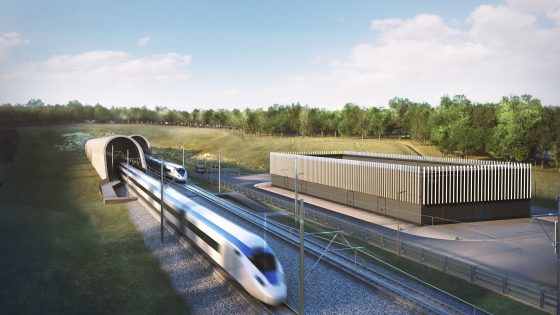
HS2 Ltd has been instructed by the transport secretary to assess lower‑speed, simplified technical options for the high‑speed rail scheme, with claims that this could save “billions” of pounds and recover programme delays. Reducing design speeds from current high‑speed specifications would allow relaxation of some horizontal and vertical alignment constraints, potentially shortening tunnels, easing curve radii and reducing earthworks volumes. Any change would have direct implications for trackform design, slab track versus ballast choices, OLE configuration and geotechnical risk profiles along critical sections such as long cuttings and deep bored tunnels.
Technical Brief
- Mandate is to produce worked‑up alternative technical options, not just high‑level concept sketches.
- Lower‑speed options must still interface with existing classic network geometry and signalling constraints at connection points.
- Any revised specification will need re‑checking against previously completed GRIP / PACE design stages and assurance gates.
- Change control will trigger re‑opening of some Development Consent Order assumptions, particularly where land‑take shrinks.
- Supply chain design-and-build contracts may require re‑pricing or scope variation if alignment or systems standards change.
- Geotechnical baseline reports and ground risk registers would need updating where tunnel lengths or cutting geometries are altered.
Our Take
HS2 Ltd appears repeatedly in our infrastructure coverage as Britain’s largest live scheme, and the 2025 build progress piece suggests that any design-speed change now would have to be retrofitted into already-advanced earthworks, tunnels and viaduct geometry rather than designed in from first principles.
The Department for Transport’s early market engagement for a PPP-led HS2 Euston terminus indicates that any move to lower line speeds will have to be reconciled with private-finance expectations on journey-time performance and long-term asset utilisation at the London end of the route.
Within our 722 Infrastructure stories, HS2-related items stand out for their combination of political scrutiny and complex staging, so a speed reduction directive is likely to be read by contractors and financiers as a signal that further value-engineering of civil works and systems design remains politically acceptable on this project.
Prepared by collating external sources, AI-assisted tools, and Geomechanics.io’s proprietary mining database, then reviewed for technical accuracy & edited by our geotechnical team.
Related Articles


Related Industries & Products
Construction
Quality control software for construction companies with material testing, batch tracking, and compliance management.
Tunnelling
Specialised solutions for tunnelling projects including grout mix design, hydrogeological analysis, and quality control.
QCDB-io
Comprehensive quality control database for manufacturing, tunnelling, and civil construction with UCS testing, PSD analysis, and grout mix design management.