Geomechanics.io

  • Free Tools
Sign UpLog In

Geomechanics.io

Geomechanics, Streamlined.

© 2026 Geomechanics.io. All rights reserved.

Geomechanics.io

CMRR-ioGEODB-ioHYDROGEO-ioQCDB-ioFree Tools & CalculatorsBlogLatest Industry News

Industries

MiningConstructionTunnelling

Company

Terms of UsePrivacy PolicyLinkedIn
    AllGeotechnicalMiningInfrastructureMaterialsHazardsEnvironmentalSoftwarePolicy
    Projects

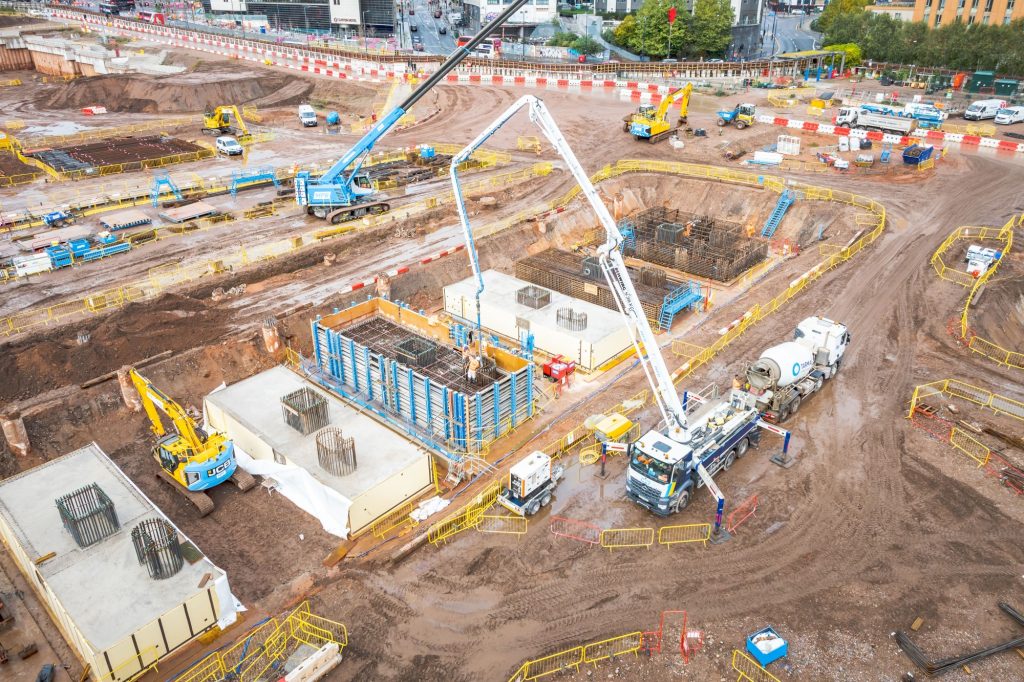
    HS2 Curzon Street piling completion: programme and foundation notes for engineers

    March 5, 2026|

    Reviewed by Joe Ashwell

    HS2 Curzon Street piling completion: programme and foundation notes for engineers

    First reported on New Civil Engineer

    30 Second Briefing

    Completion of more than 2,000 concrete piles for HS2’s Curzon Street station in Birmingham marks the end of the main deep-foundation phase for the city-centre terminus. The piled foundations will carry the station’s multi-platform superstructure and associated over-track development, designed to accommodate high-speed rail loads and complex urban constraints. With piling finished, contractors can shift resources to pile caps, ground beams and station box works, compressing the programme’s critical path for structural and rail systems installation.

    Technical Brief

    • Piling completion allows transfer of heavy plant and labour to superstructure and station box works.
    • Urban setting likely demanded strict vibration, noise and working-hour controls during piling operations.
    • Completion of deep foundations reduces geotechnical risk on the programme’s critical path.

    Our Take

    Curzon Street piling completion in Birmingham sits alongside HS2’s planned 18‑month Saltley Viaduct replacement on the A47, signalling that disruptive heavy civil works around the city’s rail approaches will overlap and need tight traffic and stakeholder management.

    With Keltbray delivering 2,011 CFA piles for Curzon Street under the Mace Dragados JV and Ferrovial Bam and Ayesa/Egis engaged on HS2 track systems, our coverage shows HS2 increasingly segmented into specialist packages, which can complicate interface risk at key nodes like Birmingham.

    Among the 728 Infrastructure stories in our database, HS2 appears frequently as a multi-node programme (Curzon Street, Euston PPP, Saltley Viaduct), so contractors working in Birmingham should expect sustained procurement and coordination activity rather than a single peak of construction demand.

    Geotechnical Software for Modern Teams

    Centralise site data, logs, and lab results with GEODB-io, CMRR-io, and HYDROGEO-io.

    No credit card required.

    • Save and export unlimited calculations
    • Advanced data visualisation
    • Generate professional PDF reports
    • Cloud storage for all your projects

    Prepared by collating external sources, AI-assisted tools, and Geomechanics.io’s proprietary mining database, then reviewed for technical accuracy & edited by our geotechnical team.

    Related Articles

    National Grid TBM under the Thames: tunnelling design and risk notes for engineers
    Infrastructure
    in 8 months

    National Grid TBM under the Thames: tunnelling design and risk notes for engineers

    A 271.5‑tonne Herrenknecht Mixshield TBM, Caroline, has started driving a 2.2km electricity cable tunnel with a 4m internal diameter beneath the River Thames in Essex for National Grid’s Grain to Tilbury project, delivered by the Ferrovial BEMO joint venture. The drive will pass through variable Thames estuary ground conditions between 35m‑deep launch and reception shafts of 15m and 12m diameter, with tunnelling continuing into 2026 and overall scheme completion targeted for 2029. The new tunnel will replace the 1969 Thames Cable Tunnel and carry new high‑voltage circuits between Grain and Tilbury substations.

    Panama Canal Mixshield undercrossing: design and tunnelling lessons for engineers
    Infrastructure
    in 8 months

    Panama Canal Mixshield undercrossing: design and tunnelling lessons for engineers

    A 13.46m diameter Herrenknecht Mixshield TBM has broken through into the future Balboa station on Panama Metro Line 3 after completing the first-ever TBM undercrossing of the Panama Canal at depths exceeding 60m below sea level. The 5,600kW, 26,616kNm machine, fitted with an accessible cutterhead and more than 4,500 sensors linked via the Herrenknecht.Connected platform, has achieved peak advance of 150 segment rings (about 300m) per month through mixed sandstone, tuff, breccias and basalt. Around 1.5km of the 4.5km twin-track tunnel remains to final breakthrough.

    Hudson Tunnel funding deadline: schedule and risk takeaways for project teams
    Infrastructure
    in 7 months

    Hudson Tunnel funding deadline: schedule and risk takeaways for project teams

    Federal funding for New York’s US$16bn Hudson Tunnel Project has been frozen, forcing the Gateway Development Commission to suspend works from 6 February after spending over US$1bn and employing about 1,000 site workers. A Manhattan federal judge has issued a temporary restraining order, giving the administration until 5 p.m. on 12 February to restore reimbursements or appeal, while contractors warn that demobilisation, resequencing and remobilisation will add cost and delay. Sites are now in “safe-pause” mode, with dewatering, ground support and environmental monitoring maintained, and assembly of two Herrenknecht TBMs in New Jersey likely to slip beyond the planned spring 2026 launch without funding certainty.

    Related Industries & Products

    Construction

    Quality control software for construction companies with material testing, batch tracking, and compliance management.

    Mining

    Geotechnical software solutions for mining operations including CMRR analysis, hydrogeological testing, and data management.

    QCDB-io

    Comprehensive quality control database for manufacturing, tunnelling, and civil construction with UCS testing, PSD analysis, and grout mix design management.