Gold price slump and liquidity crunch: Sprott’s macro signals for mine planners
Reviewed by Joe Ashwell
First reported on MINING.com
30 Second Briefing
Gold’s March slump from a late-January peak of $5,589.38/oz to about $4,400/oz is being driven by a global liquidity squeeze and disrupted reserve flows rather than weaker fundamentals, says Sprott strategist Paul Wong. The closure of the Strait of Hormuz has stalled oil revenues for Gulf Cooperation Council states, curbing their central bank gold buying, while deleveraging by hedge funds and systematic strategies has turned gold into a cash source amid rising volatility and a stronger US dollar. Wong likens the move to 2008 and 2020 stress episodes and sees scope for a rebound if renewed quantitative easing follows further financial tightening.
Technical Brief
- Gold fell from $5,589.38/oz in late January to about $4,400/oz by late March.
- Strait of Hormuz closure has disrupted roughly 20% of global oil shipments, stalling GCC energy receipts.
- Gulf Cooperation Council central banks have paused, and in some cases reversed, gold reserve accumulation.
- Higher oil prices are eroding Asian trade surpluses, reducing excess FX reserves available for gold allocation.
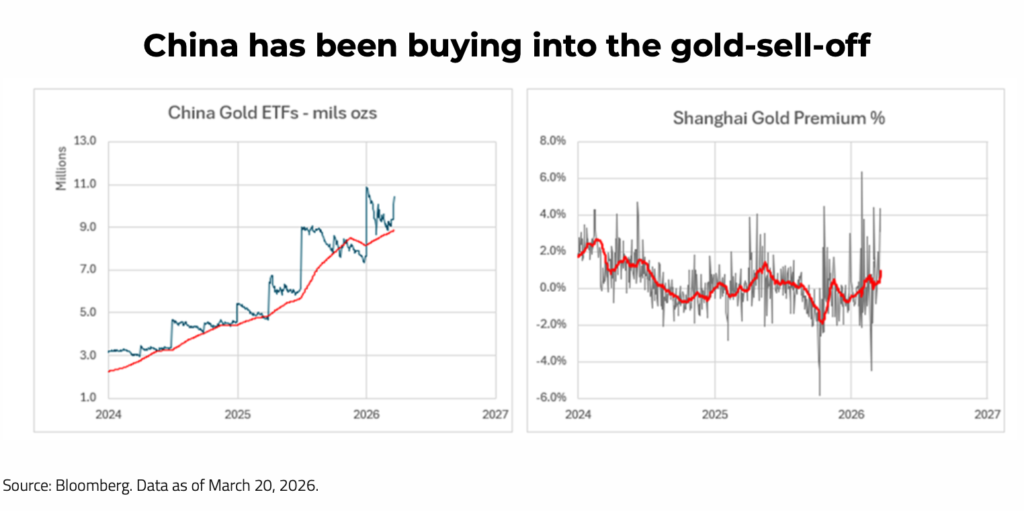
- China diverges, with ETF inflows and Shanghai gold trading at a 4.4% premium to London.
- Volatility across equities, FX and rates has triggered deleveraging by hedge funds and systematic strategies.
- Unwinding of short US dollar positions and rate-linked models is mechanically cutting gold exposure.
- Silver has swung from >$121/oz in February to about $65/oz, dominated by derivatives-driven trading.
Our Take
Sprott’s framing of the gold move as liquidity-driven rather than fundamental aligns with its recent positioning in uranium and physical trusts, where our coverage shows it has been willing to lean into dislocations in spot pricing rather than follow short-term sentiment.
The 4.4% Shanghai premium over London spot for gold echoes other recent pieces in our database where China-linked pricing (for both gold and oil) has increasingly decoupled from Western benchmarks, a dynamic project developers now watch closely when modelling long-term revenue assumptions.
With about 20% of global oil shipments exposed to potential disruption in the Strait of Hormuz, our other oil-tagged mining coverage suggests operators in regions like Chile and Liberia are stress-testing opex and logistics against higher fuel and shipping costs even when their primary commodity is gold or iron ore rather than hydrocarbons.
Prepared by collating external sources, AI-assisted tools, and Geomechanics.io’s proprietary mining database, then reviewed for technical accuracy & edited by our geotechnical team.
Related Articles


Related Industries & Products
Mining
Geotechnical software solutions for mining operations including CMRR analysis, hydrogeological testing, and data management.
CMRR-io
Streamline coal mine roof stability assessments with our cloud-based CMRR software featuring automated calculations, multi-scenario analysis, and collaborative workflows.
HYDROGEO-io
Comprehensive hydrogeological testing platform for managing, analysing, and reporting on packer tests, lugeon values, and hydraulic conductivity assessments.
GEODB-io
Centralised geotechnical data management solution for storing, accessing, and analysing all your site investigation and material testing data.