Gold price loses its grip: Q2 mining capex and project signals for engineers
Reviewed by Tom Sullivan
First reported on MINING.com
30 Second Briefing
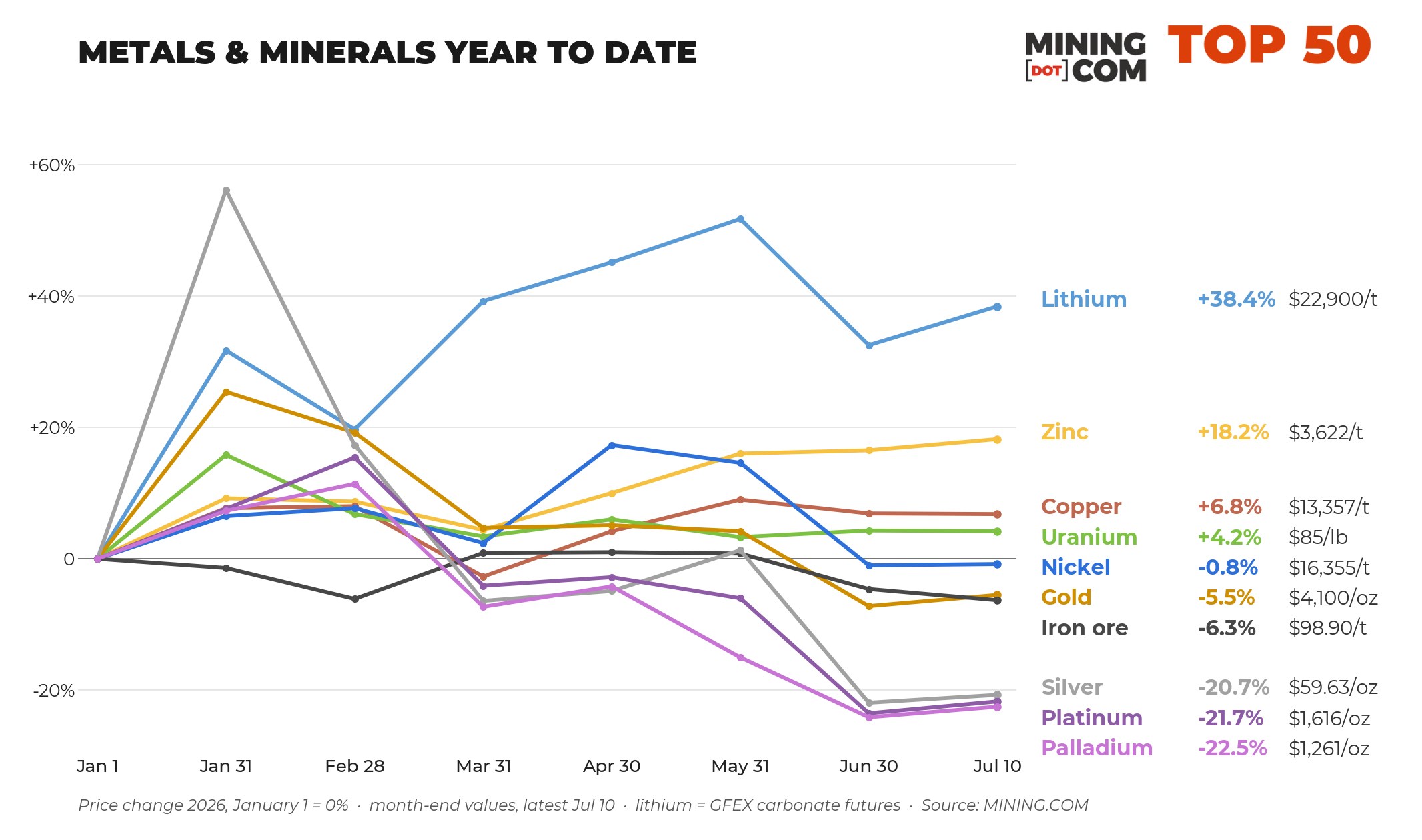
Gold’s drop from near $5,589/oz in January to below $4,000/oz by late June erased most of mining’s 2026 equity gains, with the MINING.COM TOP 50’s combined value falling $228 billion in Q2 to $2.19 trillion and gold majors such as Agnico Eagle, Gold Fields and Shandong Gold losing 26%–40%. Diversified giants bucked the trend: BHP added $28 billion to reach $209 billion, Rio Tinto reclaimed second at $162 billion, and Anglo American advanced on its Teck merger, which would create an ~$82 billion copper-heavy group. Uranium producers Cameco and Kazatomprom strengthened their positions despite spot price softness, while lithium equities (SQM, Ganfeng, Albemarle) decoupled from a one‑third rise in carbonate prices to around $22,400/t.
Technical Brief
- Newmont’s Red Chris copper-gold mine expansion in British Columbia secured regulatory approval in June, de-risking growth capex.
- Shandong Gold’s 40% value loss drove a 16-place fall to number 46, one of the steepest quarterly ranking drops recorded.
- Glencore’s market cap briefly touched ~$95 billion in early June before a ~20% slide and DRC tax office closures in Kolwezi.
- First Quantum’s 10% equity gain and 10-place jump to number 31 followed an audit finding Cobre Panama 88% compliant with environmental obligations, improving restart prospects.
- KGHM re-entered at number 42 after an 18‑month absence, supported by a 21% quarterly surge and an $8.55 billion domestic investment plan.
- Hindustan Zinc entered at number 30 after Vedanta’s break-up, with the parent’s aluminium, power, oil and steel units now separately listed and bauxite sourced rather than mined.
- Amman Minerals, first Indonesian entrant, has surrendered ~75% of peak value since its 2023 debut and fell 35% in Q2 to sit at number 50.
- China Northern Rare Earth, valued at $26 billion and ranked 28th, is now the only rare earths producer in the Top 50, underscoring China’s dominance of magnet supply chains.
- Uranium majors Cameco (17th) and Kazatomprom (37th, up 32% in 2026) are tracking long-term contract pricing rather than spot, which has eased to the mid‑$80s/lb.
Our Take
Earlier in 2026 our coverage showed the MINING.COM Top 50 adding about $250 billion in value, so the current $228 billion Q2 drawdown effectively wipes out most of that early-year uplift and signals how quickly sentiment has flipped for gold and other precious metals names such as Agnico Eagle and Newmont.
The related copper-focused pieces highlight that producers like BHP, Rio Tinto, Freeport-McMoRan and KGHM are leveraged to record copper pricing, which helps explain why diversified and copper-heavy groups in this Top 50 list have generally held up better than pure-play gold companies despite the overall $2.19 trillion market cap still being under pressure.
With uranium-focused Cameco and Kazatomprom both sitting comfortably in the Top 50 while yellowcake prices idle in the mid-$80s, the database suggests nuclear-fuel equities are now behaving more like growth or transition-metal plays than traditional commodities, contrasting sharply with the de-rating seen in lithium names such as SQM, Ganfeng and Albemarle over the same period.
Prepared by collating external sources, AI-assisted tools, and Geomechanics.io’s proprietary mining database, then reviewed for technical accuracy & edited by our geotechnical team.
Related Articles


Related Industries & Products
Mining
Geotechnical software solutions for mining operations including CMRR analysis, hydrogeological testing, and data management.
CMRR-io
Streamline coal mine roof stability assessments with our cloud-based CMRR software featuring automated calculations, multi-scenario analysis, and collaborative workflows.
HYDROGEO-io
Comprehensive hydrogeological testing platform for managing, analysing, and reporting on packer tests, lugeon values, and hydraulic conductivity assessments.
GEODB-io
Centralised geotechnical data management solution for storing, accessing, and analysing all your site investigation and material testing data.