Gold price declines: macro drivers and project valuation notes for miners
Reviewed by Joe Ashwell
First reported on MINING.com
30 Second Briefing
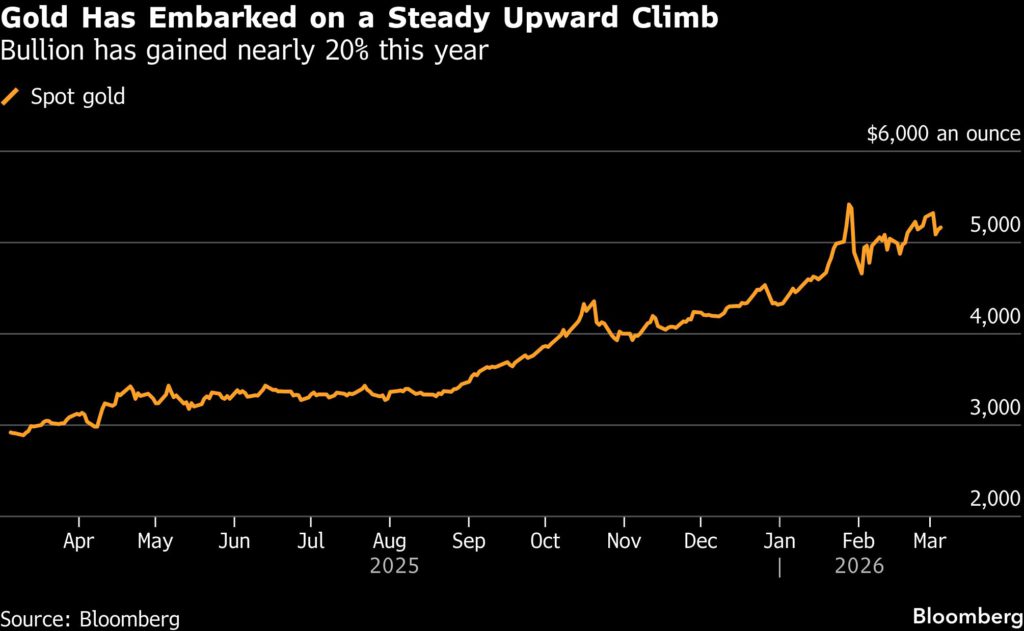
Gold fell as much as 1.5% to $5,053/oz on Thursday, with US futures down about 1% to $5,080/oz, as a stronger dollar and expectations of reduced US Federal Reserve easing outweighed safe‑haven demand from the escalating Middle East conflict. Swaps markets now price only about 35 basis points of Fed cuts by year‑end, down from 60 bps last week, raising the opportunity cost of holding non‑yielding bullion. ING commodity strategist Ewa Manthey attributes part of the drop to investors liquidating gold to meet losses in US equities, rather than a shift in fundamentals.
Technical Brief
- Spot gold’s intraday low of $5,053/oz wiped out all earlier week-on-week gains.
- US gold futures in New York traded around $5,080/oz during the same session.
- February saw roughly a 3% gold price increase, rebounding from a late‑January ~12% selloff.
- War in Iran has disrupted a “significant portion” of global energy supply, fuelling inflation concerns.
- Higher energy‑driven inflation reduces likelihood of US Fed rate cuts, raising carrying cost for bullion holdings.
- Swaps pricing shifted from 60 bps to 35 bps expected Fed cuts within one week.
- ING’s Ewa Manthey attributes part of the move to equity‑driven “risk‑on” flows forcing gold liquidation.
- Manthey expects equity‑momentum‑linked selling pressure to fade, with underlying geopolitical support for gold remaining.
- On a year‑to‑date basis, gold is still up about 18% despite the latest pullback.
Our Take
Even with the 1–1.5% pullback cited here, gold remains far below the record levels above $4,500/oz seen in late 2025 in our database, which suggests current price volatility is occurring within a structurally higher price regime that still supports most North American project economics.
The shift in US rate-cut expectations from 60 to 35 basis points by year-end is material for gold but also for uranium- and coal-linked plays in the USA, Mexico and Canada, as tighter-for-longer dollar conditions typically raise financing costs for new mine builds and expansions in these regions.
Compared with other recent gold pieces in our coverage that emphasise central bank buying and ETF inflows, this Bloomberg- and ING Bank-framed move looks more liquidity-driven, signalling that developers should stress-test project models not just against spot gold but also against funding-market squeezes.
Prepared by collating external sources, AI-assisted tools, and Geomechanics.io’s proprietary mining database, then reviewed for technical accuracy & edited by our geotechnical team.
Related Articles


Related Industries & Products
Mining
Geotechnical software solutions for mining operations including CMRR analysis, hydrogeological testing, and data management.
CMRR-io
Streamline coal mine roof stability assessments with our cloud-based CMRR software featuring automated calculations, multi-scenario analysis, and collaborative workflows.
HYDROGEO-io
Comprehensive hydrogeological testing platform for managing, analysing, and reporting on packer tests, lugeon values, and hydraulic conductivity assessments.
GEODB-io
Centralised geotechnical data management solution for storing, accessing, and analysing all your site investigation and material testing data.