Galway’s New Brunswick gold resource shortfall: design and PEA notes for mine planners
Reviewed by Joe Ashwell
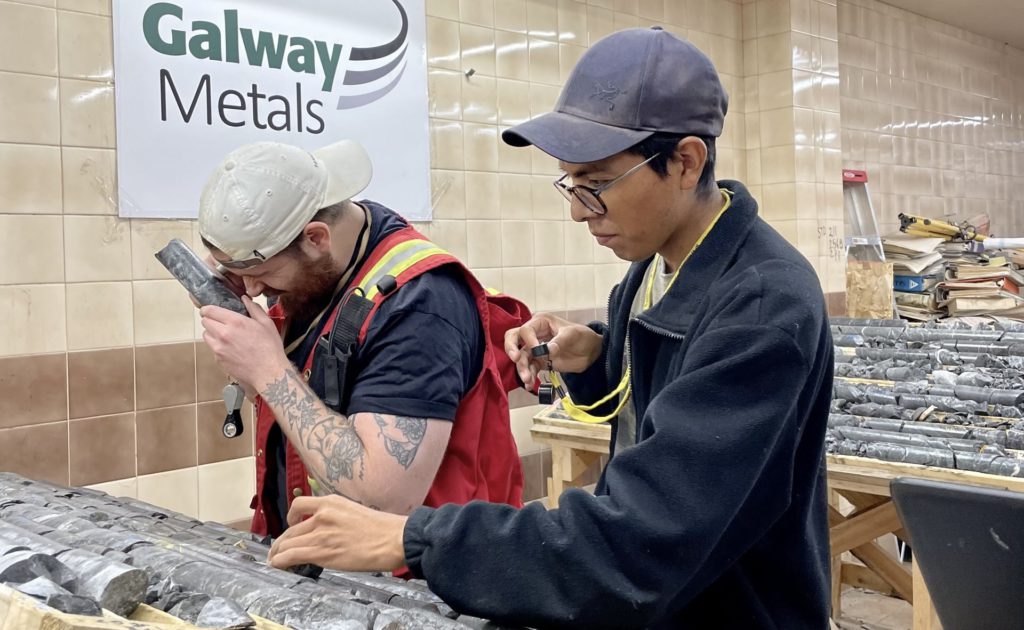
First reported on MINING.com
30 Second Briefing
Galway Metals’ updated resource for the Clarence Stream project in New Brunswick outlines 27.2 million indicated tonnes at 1.62 g/t gold (1.42 million oz) plus 19,500 tonnes of antimony, and 28.5 million inferred tonnes at 1.4 g/t gold (1.29 million oz), but the 2.7 million oz total gold falls short of Red Cloud’s 3 million oz forecast, sending shares down 20% to 41.5¢. About 96% of contained gold is constrained within optimised open pits across the North, South and Southwest deposits, with roughly half of indicated ounces above 3 g/t, supporting potential PEA-level mine design. Four rigs are drilling 40,000 metres in 2026 to expand and upgrade resources and test regional targets.
Technical Brief
- Resource update incorporates 342 additional drillholes totalling ~70,000 m since the 2022 estimate.
- Indicated tonnage more than doubled versus 2022 (27.2 Mt now vs 12.4 Mt previously).
- Average indicated gold grade dropped from 2.31 g/t (2022) to 1.62 g/t due to larger pit shells.
- Inferred tonnage increased from 16 Mt to 28.5 Mt, while inferred gold grade decreased from 2.4 g/t to 1.4 g/t.
- Antimony inventory rose to 19,500 t indicated and 3,100 t inferred, from 9,600 t and 2,100 t respectively.
- About 96% of contained gold is constrained within optimised open pits at North, South and Southwest deposits.
- South and Southwest deposits retain explicit potential for later underground mining beneath the planned pits.
- Current 40,000 m drilling campaign uses four rigs: two on resource expansion/upgrading, two on regional and near-mine targets.
- Clarence Stream sits within a 65 km district-scale land package, leaving substantial untested strike for further discoveries.
- Parallel Estrades PEA outlines a 10.4-year underground Cu-Zn-Au-Ag mine, C$117M capex, C$212M NPV5, 33% IRR, informing Galway’s capital allocation options.
Our Take
With Clarence Stream’s 96% pit-constrained ounces and a 65 km district, Galway Metals is positioning a bulk-tonnage open-pit concept that contrasts with its Estrades underground polymetallic PEA, giving it optionality between a gold-focused Atlantic Canada asset and a Quebec critical-minerals-style play (zinc, copper, silver).
The step-change in indicated tonnage at Clarence Stream since 2022, achieved with 342 additional drill holes and four active rigs, suggests Galway is prioritising de-risking and scale over grade preservation, which typically favours future throughput-driven plant designs rather than selective mining strategies.
In our database of gold and antimony pieces, Clarence Stream’s location in New Brunswick stands out against the more common Latin American and Western US gold project coverage, signalling that Atlantic Canada is quietly building a pipeline of mid-tier gold assets alongside its established base and critical minerals stories.
Prepared by collating external sources, AI-assisted tools, and Geomechanics.io’s proprietary mining database, then reviewed for technical accuracy & edited by our geotechnical team.
Related Articles


Related Industries & Products
Mining
Geotechnical software solutions for mining operations including CMRR analysis, hydrogeological testing, and data management.
Construction
Quality control software for construction companies with material testing, batch tracking, and compliance management.
CMRR-io
Streamline coal mine roof stability assessments with our cloud-based CMRR software featuring automated calculations, multi-scenario analysis, and collaborative workflows.
HYDROGEO-io
Comprehensive hydrogeological testing platform for managing, analysing, and reporting on packer tests, lugeon values, and hydraulic conductivity assessments.
GEODB-io
Centralised geotechnical data management solution for storing, accessing, and analysing all your site investigation and material testing data.