Europe’s rare earth test at Korsnäs: processing and permitting lens for engineers
Reviewed by Tom Sullivan
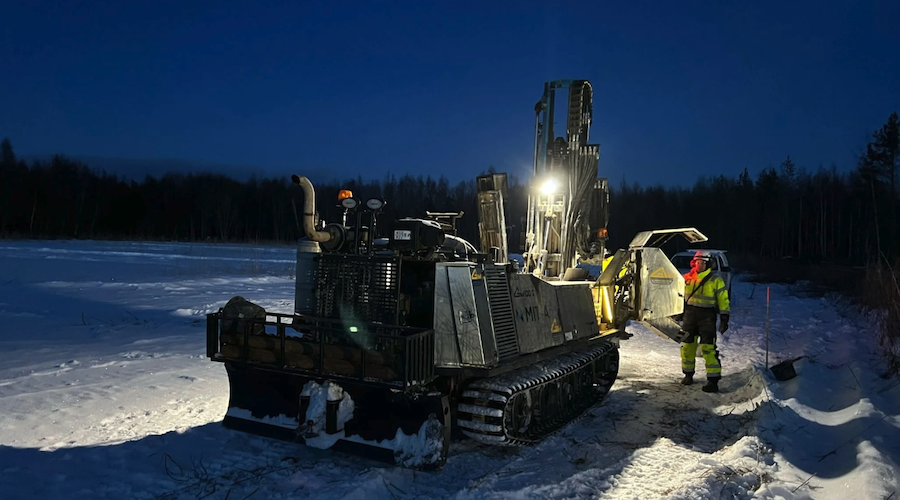
First reported on MINING.com
30 Second Briefing
Finland’s Korsnäs rare earth project has returned its strongest intercept to date for European Resources, with 31.5 metres at 4,902 ppm TREO and an unusually high 28–30% NdPr content, making it particularly relevant for permanent magnet supply chains. Early mineralogical work points to monazite–apatite mineralisation, raising both processing opportunities and tighter residue controls due to potential thorium/uranium, while metallurgical test work with ANSTO is already under way to define separation routes. The op-ed argues Europe’s real bottleneck is not ore discovery but financing and permitting domestic processing and separation capacity to meet EU 2030 Critical Raw Materials Act targets of 10% extraction, 40% processing and 25% recycling.
Technical Brief
- Systematic step-out drilling and 3D resource modelling now become critical to prove lateral and vertical continuity.
- Korsnäs benefits from Finland’s existing mining infrastructure and permitting institutions, reducing greenfield logistics and regulatory risk.
- Monazite–apatite association implies acid bake or similar aggressive leach routes, with complex reagent optimisation.
- Complex separation flowsheets extend construction schedules and permitting timelines, especially under EU environmental scrutiny.
- For other EU rare earth prospects, financing will hinge more on credible processing designs than on headline drill grades.
Our Take
Finland’s Korsnäs rare earth results come as the country has recently slipped behind Nevada in the Fraser Institute’s 2025 policy rankings, suggesting that strong geology alone may not be enough to attract capital without clearer EU-level permitting and policy certainty for critical minerals.
With NdPr making up 28–30% of the rare earth mix at Korsnäs, the project aligns closely with EU decarbonisation priorities around permanent magnets, which in our coverage is where most of the 100 rare-earth-tagged pieces cluster rather than in bulk light rare earths like cerium and lanthanum.
The EU’s 2030 extraction (10%), processing (40%) and recycling (25%) targets for rare earths imply that projects such as Korsnäs and Jokikangas in Finland will be judged not just on grade but on how cleanly they can handle thorium/uranium by-products, an area where ANSTO’s involvement signals likely scrutiny of waste and radiation management routes.
Prepared by collating external sources, AI-assisted tools, and Geomechanics.io’s proprietary mining database, then reviewed for technical accuracy & edited by our geotechnical team.
Related Articles


Related Industries & Products
Mining
Geotechnical software solutions for mining operations including CMRR analysis, hydrogeological testing, and data management.
Construction
Quality control software for construction companies with material testing, batch tracking, and compliance management.
CMRR-io
Streamline coal mine roof stability assessments with our cloud-based CMRR software featuring automated calculations, multi-scenario analysis, and collaborative workflows.
HYDROGEO-io
Comprehensive hydrogeological testing platform for managing, analysing, and reporting on packer tests, lugeon values, and hydraulic conductivity assessments.
GEODB-io
Centralised geotechnical data management solution for storing, accessing, and analysing all your site investigation and material testing data.