Europe’s critical minerals blind spot: policy and midstream lessons for engineers
Reviewed by Joe Ashwell
First reported on MINING.com
30 Second Briefing
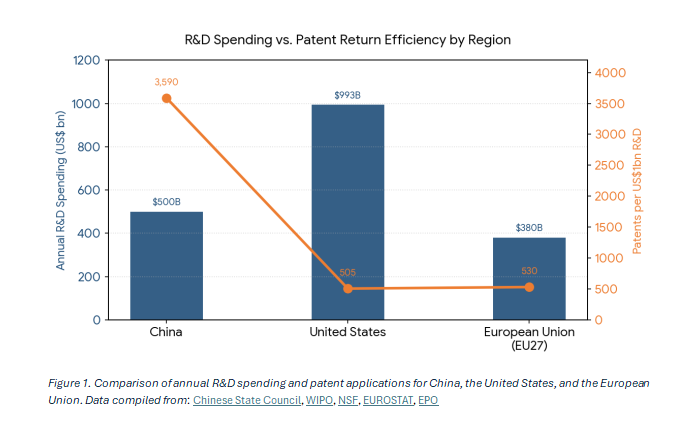
Europe’s critical minerals shortfall is framed by economic geologist Dr Nicholas Vafeas as a policy choice, with the EU funnelling roughly €380 billion per year into tightly scripted, mission-oriented R&D that favours climate and digital themes but leaves little room for speculative processing, refining and separation technologies. On a comparable $500 billion R&D spend, China files about 1.8 million patents—over 3,500 per $1 billion—buying “optionality” in areas like graphite processing, rare earth separation and lithium refining long before they became strategic. For miners and processors, the message is that control over midstream capabilities, not just new deposits, will define Europe’s leverage in future supply chains.
Technical Brief
- European R&D is channelled through tightly predefined missions such as climate, energy efficiency, digital and circularity.
- Mission-oriented calls structurally disfavour speculative flowsheet, separation or refining work not framed as a current policy priority.
- China’s patenting strategy accepts thousands of redundant or low-commercial-probability filings as an explicit industrial cost.
- Patent “noise” (spam journals, low-scrutiny papers) is framed as collateral to securing future processing IP positions.
- Europe has focused innovation on end-use technologies, while China targeted midstream engineering such as separation and refining.
- Capital-intensive process engineering (processing, refining, recycling) is identified as the real lever for supply-chain control, not discovery.
Our Take
The emphasis on graphite, rare earths and lithium in this op-ed aligns with other critical minerals coverage, but most of those 1841 keyword-matched pieces concentrate on project pipelines in Africa, Australia and South America rather than on how European Union research spending translates into industrial capability.
China’s patent productivity advantage in critical minerals-related technologies, as quantified here, suggests that European operators looking at Arctic or African upstream projects may increasingly depend on non-European processing and equipment IP unless EU R&D is more tightly coupled to commercialisation in these supply chains.
Prepared by collating external sources, AI-assisted tools, and Geomechanics.io’s proprietary mining database, then reviewed for technical accuracy & edited by our geotechnical team.
Related Articles

Related Industries & Products
Mining
Geotechnical software solutions for mining operations including CMRR analysis, hydrogeological testing, and data management.
CMRR-io
Streamline coal mine roof stability assessments with our cloud-based CMRR software featuring automated calculations, multi-scenario analysis, and collaborative workflows.
HYDROGEO-io
Comprehensive hydrogeological testing platform for managing, analysing, and reporting on packer tests, lugeon values, and hydraulic conductivity assessments.
GEODB-io
Centralised geotechnical data management solution for storing, accessing, and analysing all your site investigation and material testing data.