Copper supply gap: smelting bottlenecks and process options for mine planners
Reviewed by Tom Sullivan
First reported on MINING.com
30 Second Briefing
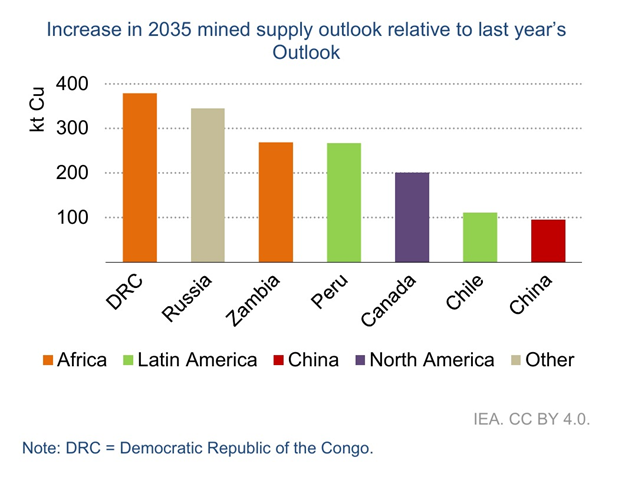
The IEA’s Global Critical Minerals Outlook 2026 trims the projected 2035 copper supply gap from about 30% to roughly 25%, largely by counting expansions and life extensions at existing operations such as Kisanfu, Lumwana, Highland Valley and Antamina rather than new greenfield mines like the stalled Resolution Copper in Arizona. Randy Allen, co-founder and CEO of Still Bright, warns that copper supply is constrained by smelting, with 2026 benchmark treatment charges at US$0/t, spot fees negative since 2024, and non-Chinese smelters running below 70% capacity. Zambia’s repeated suspension of its 10% concentrate export duty on more than 270,000 tonnes due to extended smelter maintenance illustrates the vulnerability, prompting interest in mine-site alternatives such as electrochemical reductive leaching of rougher concentrates to bypass furnaces.
Technical Brief
- Copper ore flowsheet assumed: crushing–grinding–flotation to rougher concentrate, then furnace smelting for matte.
- Most sulphur is rejected at flotation; residual sulphur is oxidised and captured as SO₂ in smelters.
- Many smelters now rely on by‑product credits from gold, silver and sulphuric acid to stay cash‑positive.
- Electrochemical reductive leaching of rougher concentrates is proposed to recover copper without high‑temperature furnaces.
Our Take
The IEA’s cut in the projected 2035 copper supply gap from 30% to 25% contrasts with its more recent warning (16 July 2026 item in our database) that sulphuric acid shortages now threaten over 15% of SxEW output, suggesting that mid‑term ‘relief’ on headline copper balances may mask growing processing‑side constraints.
With China having built 90% of new copper smelting capacity since 2005 and running plants at around 85% utilisation, the zero benchmark processing fee into early 2026 effectively shifts bargaining power away from miners in regions like North America and Africa, particularly where older smelters (40+ years) limit alternative offtake options.
Zambia’s 10% export duty on raw copper concentrate, combined with under‑utilised non‑Chinese smelters at about 70% capacity, creates a structural incentive for more in‑country processing projects, but our broader copper coverage shows few advanced smelter builds in Africa yet moving beyond concept or MOU stage.
Prepared by collating external sources, AI-assisted tools, and Geomechanics.io’s proprietary mining database, then reviewed for technical accuracy & edited by our geotechnical team.
Related Articles


Related Industries & Products
Mining
Geotechnical software solutions for mining operations including CMRR analysis, hydrogeological testing, and data management.
CMRR-io
Streamline coal mine roof stability assessments with our cloud-based CMRR software featuring automated calculations, multi-scenario analysis, and collaborative workflows.
HYDROGEO-io
Comprehensive hydrogeological testing platform for managing, analysing, and reporting on packer tests, lugeon values, and hydraulic conductivity assessments.
GEODB-io
Centralised geotechnical data management solution for storing, accessing, and analysing all your site investigation and material testing data.