Consolidated guidance for cranes near railways: key updates for project teams
Reviewed by Joe Ashwell
First reported on The Construction Index
30 Second Briefing
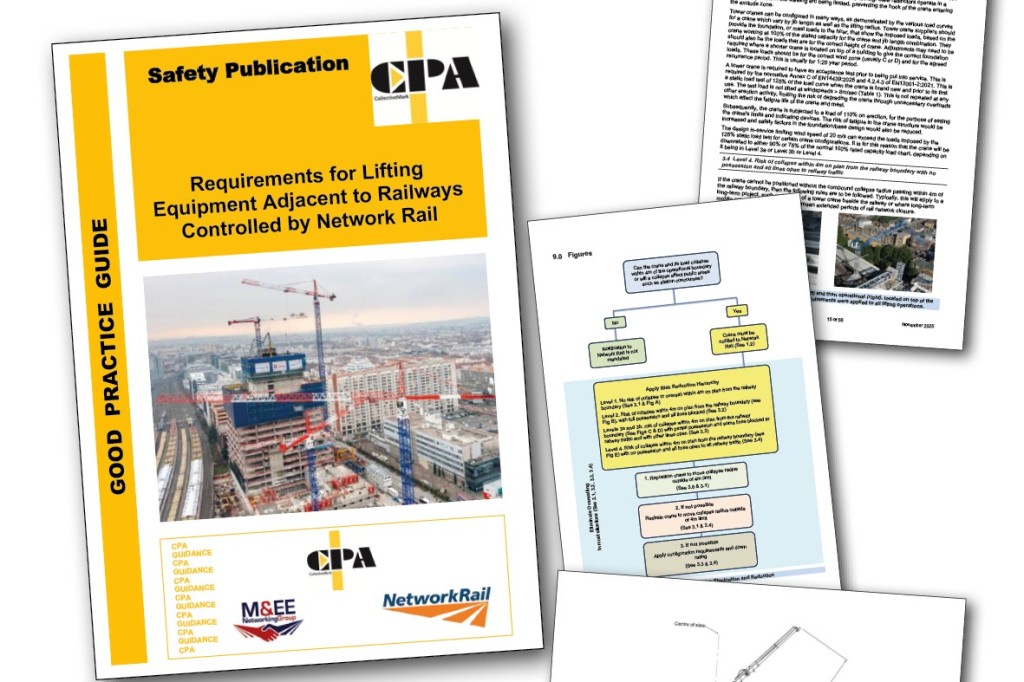
Consolidated guidance for cranes operating near live rail tracks has been issued by the Construction Plant-hire Association’s Crane Interest Group and Tower Crane Interest Group in collaboration with Network Rail, replacing CPA1402 and CPA1801 with a single 58-page document, Requirements for Lifting Equipment Adjacent to Railways Controlled by Network Rail. The guidance is aligned with Network Rail’s CIV0063 (Issue 2), giving contractors and client a shared technical baseline and clearer allocation of responsibilities. Key changes include a defined hierarchy of control, explicit treatment of oversailing and collapse radius, and tighter procedures for working range limitation and notifications.
Technical Brief
- Alignment with Network Rail’s CIV0063 removes parallel rule sets and reduces conflicting instructions on site.
- Clearer oversailing and collapse-radius definitions should tighten exclusion zones adjacent to open rail lines.
- Working range limitation procedures formalise use of slew/height/radius limiting devices near the operational railway.
Our Take
Network Rail’s involvement and explicit reference to CIV0063 (Issue 2) signals that CPA1402 and CPA1801 will likely become the de facto standard for crane operations near rail in the United Kingdom, so contractors can expect these 58 pages to be treated as mandatory in practice on most rail-adjacent jobs.
For UK-based plant-hire firms, the consolidation under the CPA’s Crane Interest Group and Tower Crane Interest Group means internal procedures, lift plans and training materials will need to be harmonised to a single national template, reducing scope for local variations that previously caused friction with Network Rail reviewers.
Within our 84 Infrastructure stories, safety standards are often fragmented by asset type; this unified guidance for lifting equipment near railways stands out as one of the few that explicitly bridges mobile and tower crane practice, which should simplify interface risk management for principal contractors on complex station or rail-overbuild schemes.
Prepared by collating external sources, AI-assisted tools, and Geomechanics.io’s proprietary mining database, then reviewed for technical accuracy & edited by our geotechnical team.


