China’s $120B critical minerals push: project finance signals for mine planners
Reviewed by Tom Sullivan
First reported on MINING.com
30 Second Briefing
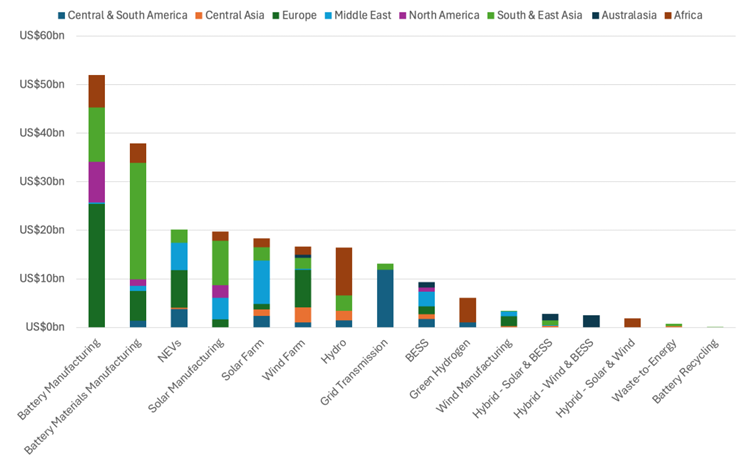
China has deployed more than $120 billion into overseas mining and upstream processing since 2023, targeting lithium, copper, nickel, rare earths and bauxite, alongside over $220 billion into downstream assets such as battery plants, EV manufacturing, grids and solar and wind projects, according to Climate Energy Finance. The strategy gives Beijing control of about 90% of rare earth refining, roughly 60% of lithium processing and more than 70% of cobalt refining, with major positions in DRC copper–cobalt, Indonesian nickel and Zimbabwean lithium. For project developers, this means Chinese capital is increasingly tied to in-country processing, rail, port and power infrastructure in exchange for long-term offtake.
Technical Brief
- CEF attributes the investment surge to a coordinated “green energy statecraft” strategy directed from Beijing.
- Chinese-backed projects in the DRC consolidate copper–cobalt production, tightening control over battery metal feedstocks at mine level.
- In Indonesia, Chinese capital underpins integrated nickel mining–processing hubs, turning the country into the top nickel producer–processor.
- Zimbabwe’s lithium sector is being built around Chinese-funded mines plus adjacent processing plants rather than export of raw ore.
- New deals increasingly bundle mine equity with commitments to build rail, port and grid power infrastructure in host states.
- Long-term supply agreements are typically exchanged for in-country processing and industrial capacity, shifting away from pure “extract-and-export” models.
- Countermeasures cited include the US-led Minerals Security Partnership and the EU Critical Raw Materials Act to rebuild non-Chinese processing.
Our Take
In our mining database, very few of the 333 critical-minerals pieces show any single country approaching China’s >90% share in battery cathode and anode materials, underscoring how unusual this level of midstream concentration is compared with copper or steel supply chains.
The combination of China’s control over more than 60–70% of lithium and cobalt processing with heavy investment in the Democratic Republic of Congo, Indonesia and other Global South jurisdictions typically leaves Western projects in Australia and the United States competing more on ESG, security-of-supply and permitting certainty than on pure cost.
USGS data cited alongside this analysis are increasingly being used in our recent coverage to justify onshoring moves in Tennessee and Alabama, but the scale of China’s rare earth and battery-materials dominance suggests that even aggressive US and EU industrial policies will take most of the 2023–2025 window just to slow, rather than reverse, existing dependencies.
Prepared by collating external sources, AI-assisted tools, and Geomechanics.io’s proprietary mining database, then reviewed for technical accuracy & edited by our geotechnical team.
Related Articles

Related Industries & Products
Mining
Geotechnical software solutions for mining operations including CMRR analysis, hydrogeological testing, and data management.
Construction
Quality control software for construction companies with material testing, batch tracking, and compliance management.
CMRR-io
Streamline coal mine roof stability assessments with our cloud-based CMRR software featuring automated calculations, multi-scenario analysis, and collaborative workflows.
QCDB-io
Comprehensive quality control database for manufacturing, tunnelling, and civil construction with UCS testing, PSD analysis, and grout mix design management.
HYDROGEO-io
Comprehensive hydrogeological testing platform for managing, analysing, and reporting on packer tests, lugeon values, and hydraulic conductivity assessments.