Argentina’s Milei glacier mining reform: water and project risks for engineers
Reviewed by Tom Sullivan
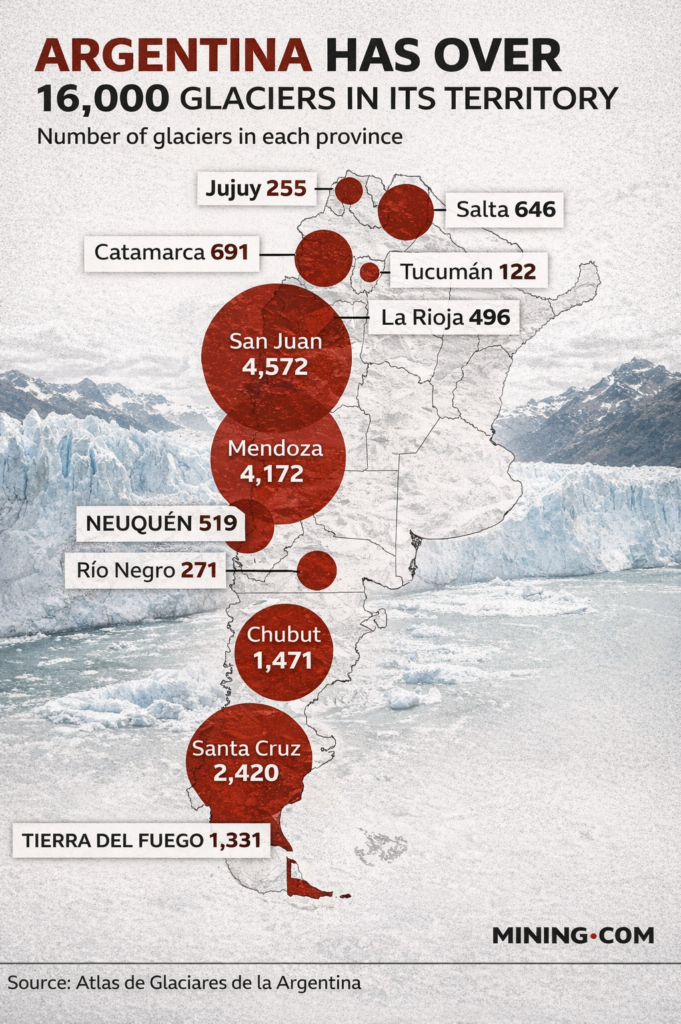
First reported on MINING.com
30 Second Briefing
Argentina’s Congress has approved President Javier Milei’s reform of the 2010 Glacier Law by 137–111, allowing provinces rather than a national scientific body to define which of nearly 17,000 glaciers and 8,484 sq. km of periglacial zones can host mining, including high-altitude copper, lithium and gold projects. Supporters, including provincial leaders in Mendoza, San Juan, Catamarca and Salta, and miners such as Glencore, BHP, Rio Tinto, Lundin Mining and McEwen Mining, see scope to triple exports by 2030 and reach $165 billion by 2035. Environmental lawyers and scientists warn that opening periglacial areas—key to water regulation in arid Andean basins—could threaten supplies relied on by about 70% of Argentinians and introduce fragmented, politically driven permitting standards.
Technical Brief
- Reform passed the lower house 137–111 with three abstentions, following Senate approval in February.
- Glacier inventory currently covers nearly 17,000 ice bodies over 8,484 sq. km of Andean terrain.
- Since 2010, all mining and industrial activity has been legally barred within mapped glacier zones.
- New framework replaces a single national scientific authority with province-level designation of protected glacier/periglacial areas.
- Environmental hearings were tightly constrained, with only 0.3% of >100,000 applicants allowed to speak.
- Legal experts warn 70% of Argentinians depend on water resources linked to these glacier–periglacial systems.
- Analysts flag periglacial mining risks tied to freeze–thaw cycles, water system interactions and monitoring complexity.
Our Take
With Argentina pitching up to $165 billion in potential exports by 2035 from copper, lithium, gold and rare earths, operators such as Glencore, BHP, Rio Tinto and Lundin Mining now face a sharper trade-off between accelerated permitting and heightened legal risk from groups like the Argentinean Association of Environmental Lawyers, especially in water-stressed Andean basins.
Our Policy-category coverage shows relatively few items where national reforms explicitly touch glacier protection, so this move in Argentina is likely to become a regional reference point for Chile and Bolivia when they calibrate their own rules for high-altitude copper and lithium projects in the Andes.
Prepared by collating external sources, AI-assisted tools, and Geomechanics.io’s proprietary mining database, then reviewed for technical accuracy & edited by our geotechnical team.
Related Articles


Related Industries & Products
Mining
Geotechnical software solutions for mining operations including CMRR analysis, hydrogeological testing, and data management.
CMRR-io
Streamline coal mine roof stability assessments with our cloud-based CMRR software featuring automated calculations, multi-scenario analysis, and collaborative workflows.
HYDROGEO-io
Comprehensive hydrogeological testing platform for managing, analysing, and reporting on packer tests, lugeon values, and hydraulic conductivity assessments.
GEODB-io
Centralised geotechnical data management solution for storing, accessing, and analysing all your site investigation and material testing data.