Antimony Resources’ Bald Hill: exploration strategy and supply risk notes for engineers
Reviewed by Tom Sullivan
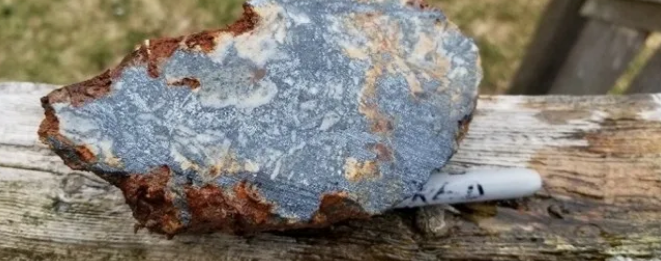
First reported on MINING.com
30 Second Briefing
Antimony Resources Corp has exposed additional “massive” stibnite mineralisation in bedrock at the Marcus West Zone of its Bald Hill project in New Brunswick, and will immediately drill up to six shallow holes to test the zone at 30–50 m depth alongside a 10,000 m definition drilling campaign on the Main Zone. Historic trenching in the Central Zone returned 2.90% Sb over 8.18 m, including 5.79% Sb over 1.75 m and 8.47% Sb over 1.53 m, while ATMY trenching has traced South Zone stibnite over ~150 m. The 2026 programme also includes soil sampling, prospecting, and a potential airborne survey, positioning Bald Hill as a North American antimony target amid Chinese export controls.
Technical Brief
- Field crews are mechanically trenching into bedrock at Marcus West to expose in-situ stibnite.
- Excavator-exposed “bladed” stibnite textures suggest coarse, visually distinguishable mineralisation aiding rapid field logging.
- Sampling of newly exposed Marcus West bedrock is ongoing to extend mineralisation definition along strike.
- Unexplored Central Zone trench data from 2010 provide 2.90% Sb over 8.18 m as a key follow-up target.
- South Zone trenching by ATMY has already mapped surface stibnite continuity over roughly 150 m.
- A second drill rig has been mobilised to accelerate Main Zone definition drilling progress.
- 2026 work programme integrates trenching, drilling, soil sampling, prospecting and potential airborne geophysics for 3D targeting.
- China’s September 2024 antimony export controls are driving renewed Canadian and US exploration focus on Sb deposits.
Our Take
Antimony appears in only a small subset of our 1,090 Mining stories, so Bald Hill in New Brunswick stands out as one of relatively few advanced antimony–stibnite plays in North America at a time when China’s September 2024 export controls are tightening supply options.
The combination of antimony with rare earth elements such as neodymium and praseodymium at the Bald Hill property aligns with other critical-mineral stories in our database where multi-commodity critical metal packages are being favoured by North American policymakers and potential strategic investors.
Historic trench grades above 5% Sb over metre-scale intervals at the Central Zone suggest that, if continuity is confirmed by the planned 30–50 m drilling at Marcus West, Bald Hill could be evaluated as a relatively small-footprint, high-grade underground or selective open-pit operation, which is typically easier to permit in Canada’s Atlantic provinces than large bulk-tonnage projects.
Prepared by collating external sources, AI-assisted tools, and Geomechanics.io’s proprietary mining database, then reviewed for technical accuracy & edited by our geotechnical team.
Related Articles


Related Industries & Products
Mining
Geotechnical software solutions for mining operations including CMRR analysis, hydrogeological testing, and data management.
Tunnelling
Specialised solutions for tunnelling projects including grout mix design, hydrogeological analysis, and quality control.
CMRR-io
Streamline coal mine roof stability assessments with our cloud-based CMRR software featuring automated calculations, multi-scenario analysis, and collaborative workflows.
HYDROGEO-io
Comprehensive hydrogeological testing platform for managing, analysing, and reporting on packer tests, lugeon values, and hydraulic conductivity assessments.
GEODB-io
Centralised geotechnical data management solution for storing, accessing, and analysing all your site investigation and material testing data.