Geomechanics.io

  • Free Tools
Sign UpLog In

Geomechanics.io

Geomechanics, Streamlined.

© 2026 Geomechanics.io. All rights reserved.

Geomechanics.io

CMRR-ioGEODB-ioHYDROGEO-ioQCDB-ioFree Tools & CalculatorsBlogLatest Industry News

Industries

MiningConstructionTunnelling

Company

Terms of UsePrivacy PolicyLinkedIn
    AllGeotechnicalMiningInfrastructureMaterialsHazardsEnvironmentalSoftwarePolicy
    Projects

    AI boom and uranium demand in 2026: supply, price and project signals for miners

    December 26, 2025|

    Reviewed by Tom Sullivan

    AI boom and uranium demand in 2026: supply, price and project signals for miners

    First reported on MINING.com

    30 Second Briefing

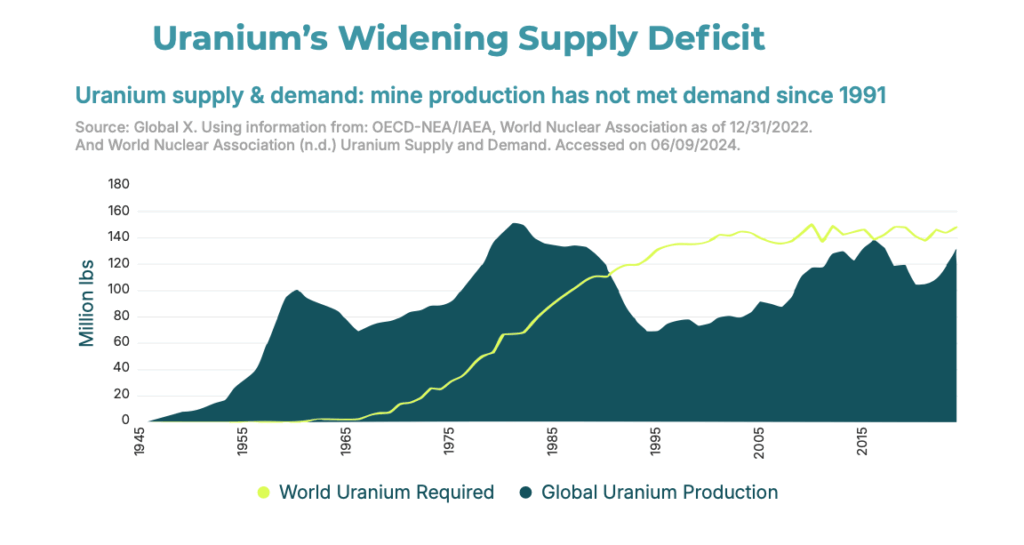
    Artificial intelligence–driven power demand from hyperscale data centres is emerging as a structural load on grids, with a Uranium.io survey of 600+ investors showing over 63% expect AI consumption to become a material factor in nuclear planning within a decade. More than 85% of respondents see uranium prices rising into 2026, many citing a US$100–120/lb range and potential spikes to US$135/lb as mined supply is forecast to cover under 75% of future reactor needs. Sprott Asset Management expects a widening supply deficit, with higher long-term contract prices needed to restart idled mines and advance greenfield uranium projects.

    Technical Brief

    • Sprott Asset Management characterises uranium as a “two-speed” market: short-term volatility over bullish fundamentals.
    • Utility term contracting is currently below replacement levels, increasing future catch-up procurement risk for fuel buyers.
    • Long-term uranium contract prices are already drifting higher while spot prices remain comparatively contained.
    • Sprott expects utilities’ ability to defer contracting to be time-limited, forcing a concentrated return to the market.
    • Uranium.io survey respondents cite years of underinvestment, lengthy permitting and shrinking secondary supplies as key constraints.

    Our Take

    Uranium appears alongside copper, lithium and rare earths in our broader mining coverage, but only a subset of those 451 Mining stories explicitly link it to AI or data-centre power demand, suggesting this AI-driven demand thesis is still relatively new in mainstream project planning.

    If more than three-quarters of future reactor requirements are expected to be unmet by mined uranium, North American and Asian utilities in countries like the US, Canada, China and South Korea are likely to lean harder on long-term contracting and inventory build, which tends to favour established producers over greenfield projects in the near term.

    The 2026 price expectations in the US$100–120/lb range, with upside to US$135/lb if supply lags, would put many higher-cost or previously shelved uranium projects back into the money, but permitting and build timelines mean any new greenfield capacity will struggle to respond within the ‘next decade’ window investors are focused on.

    Geotechnical Software for Modern Teams

    Centralise site data, logs, and lab results with GEODB-io, CMRR-io, and HYDROGEO-io.

    No credit card required.

    • Save and export unlimited calculations
    • Advanced data visualisation
    • Generate professional PDF reports
    • Cloud storage for all your projects

    Prepared by collating external sources, AI-assisted tools, and Geomechanics.io’s proprietary mining database, then reviewed for technical accuracy & edited by our geotechnical team.

    Related Articles

    Permanent magnets in the critical minerals chain: flowsheet lessons for mine planners
    Mining
    about 16 hours ago

    Permanent magnets in the critical minerals chain: flowsheet lessons for mine planners

    Project Vault, a new $12 billion US government stockpile, targets critical minerals but leaves permanent magnet manufacturing—especially neodymium-based and other rare earth magnets—as the key unresolved vulnerability in decoupling from Chinese supply. Wade Senti, CEO of Advanced Magnet Lab, argues for a market-led, innovation-first strategy that diversifies rare earth feedstocks and sources while backing alternative magnet chemistries such as Samarium Iron Nitride (SmFeN) and Manganese Bismuth (MnBi). For mining and processing projects, this implies demand for flexible mine-to-magnet flowsheets, equipment-intensive magnet plants, and closer integration with downstream OEMs.

    Hecla nearly doubles exploration budget: reserve replacement lens for mine planners
    Mining
    about 20 hours ago

    Hecla nearly doubles exploration budget: reserve replacement lens for mine planners

    Hecla Mining is nearly doubling 2026 spend on exploration and pre-development to US$55 million, targeting Nevada projects and producing assets Greens Creek (Alaska), Keno Hill (Yukon) and Lucky Friday (Idaho) to at least offset annual reserve depletion. The company reports 231 million oz silver and 2 million oz gold in reserves after 2025 output of 17 million oz silver, including a record 5.3 million oz from Lucky Friday and roughly half of total silver from Greens Creek. Drilling is focused on converting Inferred resources, extending reserve envelopes and testing high-grade targets at the historic Midas mine, which has produced 27 million oz silver and 2.2 million oz gold.

    Lundin copper-gold systems in Ecuador: district-scale mine cues for planners
    Mining
    about 21 hours ago

    Lundin copper-gold systems in Ecuador: district-scale mine cues for planners

    Lundin Gold has outlined a large intrusive complex with multiple shallow copper-gold porphyry systems near its Fruta del Norte mine in Ecuador, including Sandia hole SND-2025-383 with 603 m at 0.68% Cu, 0.1 g/t Au, 2.85 g/t Ag and 16.32 ppm Mo from 27 m. A newly identified fifth porphyry centre, Chontas, 7 km south of the main deposit, extends the porphyry corridor to at least 10 km, while Trancaloma hole TRL-2025-340 returned 945 m at 0.33% Cu from 152 m. Lundin plans 133,000 m of drilling in 2026 at Fruta del Norte, budgeted at $85 million, to support a potential south-zone mine decision and district-scale copper-gold evaluation.

    Related Industries & Products

    Mining

    Geotechnical software solutions for mining operations including CMRR analysis, hydrogeological testing, and data management.

    CMRR-io

    Streamline coal mine roof stability assessments with our cloud-based CMRR software featuring automated calculations, multi-scenario analysis, and collaborative workflows.

    HYDROGEO-io

    Comprehensive hydrogeological testing platform for managing, analysing, and reporting on packer tests, lugeon values, and hydraulic conductivity assessments.

    GEODB-io

    Centralised geotechnical data management solution for storing, accessing, and analysing all your site investigation and material testing data.