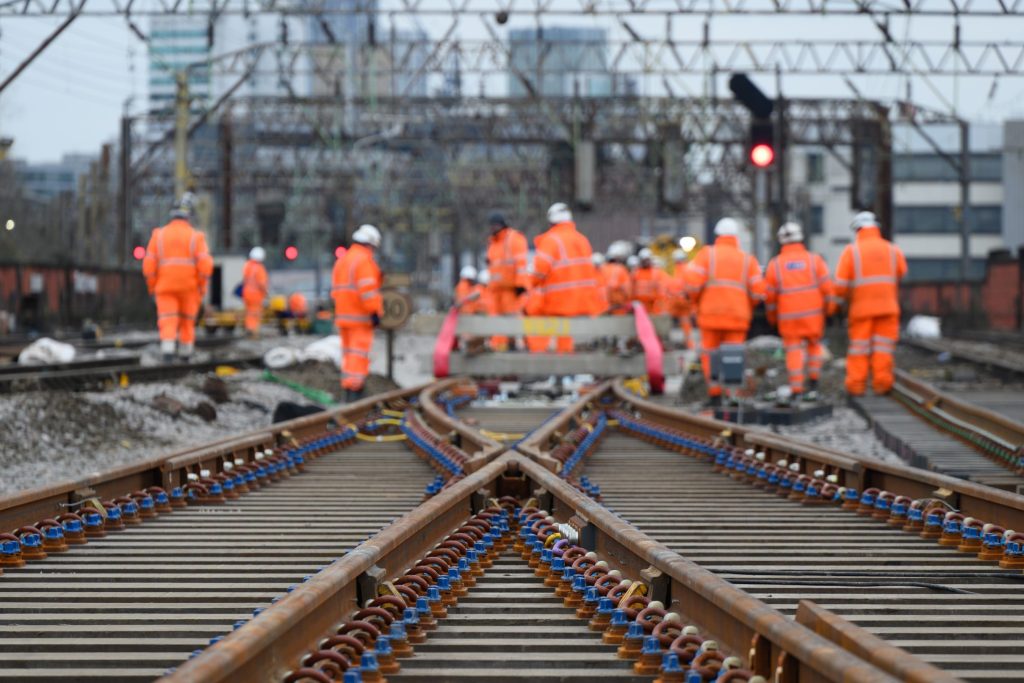
£7.9M Manchester Piccadilly track upgrades: blockade delivery lessons for engineers
Reviewed by Joe Ashwell
First reported on New Civil Engineer
30 Second Briefing
A £7.9M upgrade of track and signalling on the southern approach to Manchester Piccadilly has been completed within a planned intensive nine‑day blockade, allowing full passenger services to resume on Monday. Network Rail engineers renewed key track components and signalling assets under continuous possession, avoiding multiple weekend closures on this heavily trafficked corridor. The concentrated works window reduces long‑term maintenance access needs and should improve asset reliability and operational resilience on one of the North West’s busiest station approaches.
Technical Brief
- Nine-day continuous possession enabled heavy track and signalling interventions without daily handback constraints.
- Intensive blockade approach typically allows longer welded rail panels and S&C units to be installed in single lifts.
- Similar blockade strategies at other hub stations could rationalise maintenance regimes where midweek access is severely constrained.
Our Take
Within the 734 Infrastructure stories in our database, only a small subset involve UK rail possessions longer than a weekend, so a 9‑day closure at a hub like Manchester Piccadilly signals Network Rail’s willingness to bundle multiple high‑disruption tasks into single blockades rather than spread them over years of overnight works.
A £7.9M package is modest compared with major UK station remodellings, suggesting this is a targeted reliability and signalling intervention that can unlock timetable resilience benefits without triggering the planning and political complexity associated with full capacity enhancement schemes.
For contractors, intensive closures of under two weeks in the United Kingdom have increasingly been used as trial grounds for off‑site fabrication and modular track or signalling assemblies, so this Piccadilly blockade is likely to feed into future procurement and possession strategies on other constrained city‑centre nodes.
Prepared by collating external sources, AI-assisted tools, and Geomechanics.io’s proprietary mining database, then reviewed for technical accuracy & edited by our geotechnical team.
Related Articles


Related Industries & Products
Construction
Quality control software for construction companies with material testing, batch tracking, and compliance management.
CMRR-io
Streamline coal mine roof stability assessments with our cloud-based CMRR software featuring automated calculations, multi-scenario analysis, and collaborative workflows.
HYDROGEO-io
Comprehensive hydrogeological testing platform for managing, analysing, and reporting on packer tests, lugeon values, and hydraulic conductivity assessments.
GEODB-io
Centralised geotechnical data management solution for storing, accessing, and analysing all your site investigation and material testing data.