Geomechanics.io

  • Free Tools
Sign UpLog In

Geomechanics.io

Geomechanics, Streamlined.

© 2026 Geomechanics.io. All rights reserved.

Geomechanics.io

CMRR-ioGEODB-ioHYDROGEO-ioQCDB-ioFree Tools & CalculatorsBlogLatest Industry News

Industries

MiningConstructionTunnelling

Company

Terms of UsePrivacy PolicyLinkedIn
    AllGeotechnicalMiningInfrastructureMaterialsHazardsEnvironmentalSoftwarePolicy
    Projects

    2026 Winter Olympics medals: metals value and supply lens for mining teams

    February 3, 2026|

    Reviewed by Joe Ashwell

    2026 Winter Olympics medals: metals value and supply lens for mining teams

    First reported on MINING.com

    30 Second Briefing

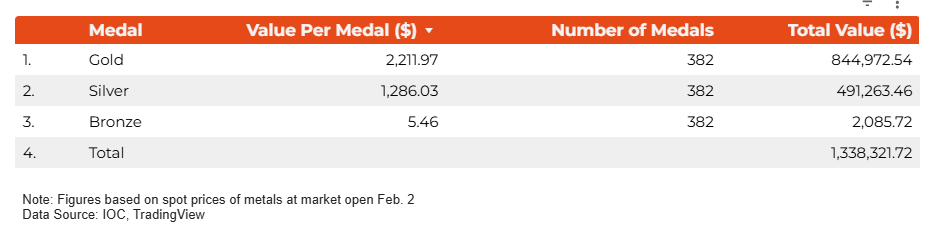
    Metals price rallies have pushed the intrinsic value of the 1,146 medals to be awarded at Milano Cortina 2026 above $1.3 million, with each gold medal now worth about $2,212 in metal content versus roughly $736 at Beijing 2022. Design specifications show each gold medal contains about 500 g of .999 silver and 6 g of .9999 gold, silver medals contain the same 500 g of silver, and bronze medals use roughly 410 g of copper. Using current prices of ~$4,800/oz gold, $80/oz silver and $13,000/t copper, a silver medal is valued at ~$1,286 and a bronze at just $5.46.

    Technical Brief

    • Medal fabrication is by the Italian State Mint using recycled feedstock and renewable power.
    • Milano Cortina 2026 medals adopt a split geometry symbolising dual host cities Milan and Cortina d’Ampezzo.
    • Fine silver in gold and silver medals is specified at .999 purity; gold at .9999.
    • Bronze medals are effectively high‑copper alloys, with c.410 g copper per unit dominating composition.
    • Total output is 735 Olympic plus 411 Paralympic medals, giving 1,146 units manufactured.
    • Design specifications are published by the International Olympic Committee, enabling precise metal mass and value calculations.
    • Metals pricing context: current gold, silver and copper levels exceed all previous Winter Games benchmarks.

    Our Take

    The same gold and silver rally that has lifted the intrinsic value of Milano Cortina medals is also underpinning record valuations in the MINING.COM Top 50 rankings, where a recent piece noted gold edging towards $5,000/oz and record copper prices driving a $2 trillion combined market cap.

    With silver now around $80/oz versus roughly $23/oz at Beijing 2022, the medal-value jump mirrors what our broader coverage has highlighted: silver-heavy producers such as Aya Gold & Silver and other precious-focused names have moved up recent Global Mining Power Rankings on the back of stronger price decks.

    Copper’s role in the bronze medals aligns with multiple recent items in our database that flag copper as a key beneficiary of the current metals rally, suggesting that even symbolic uses like Olympic medals are being repriced in line with tight physical markets and bullish long-term demand expectations.

    Geotechnical Software for Modern Teams

    Centralise site data, logs, and lab results with GEODB-io, CMRR-io, and HYDROGEO-io.

    No credit card required.

    • Save and export unlimited calculations
    • Advanced data visualisation
    • Generate professional PDF reports
    • Cloud storage for all your projects

    Prepared by collating external sources, AI-assisted tools, and Geomechanics.io’s proprietary mining database, then reviewed for technical accuracy & edited by our geotechnical team.

    Related Articles

    Rio–Glencore merger talks: portfolio planning implications for mine engineers
    Mining
    about 9 hours ago

    Rio–Glencore merger talks: portfolio planning implications for mine engineers

    Rio Tinto has strengthened its share structure as major institutional investors signal support for a potential merger with Glencore, positioning the combined group as a dominant player in iron ore, copper and aluminium. A deal would consolidate Rio’s Pilbara iron ore system and Oyu Tolgoi copper interests with Glencore’s large thermal coal, cobalt and zinc portfolios, concentrating ownership of several Tier 1 orebodies. For geotechnical and mining engineers, such consolidation could accelerate portfolio-level decisions on mine life extensions, brownfield expansions and closure schedules across multiple continents.

    Victoria’s critical jewel: design and geotechnical takeaways for mine planners
    Mining
    about 10 hours ago

    Victoria’s critical jewel: design and geotechnical takeaways for mine planners

    Gold built Victoria’s mining legacy, but the state is now targeting a new wave of critical minerals including rare earths, lithium and high‑purity alumina alongside its established gold sector. Exploration is intensifying in the Bendigo and Stawell zones, with juniors and majors using deeper diamond drilling and modern geophysics to chase structurally controlled deposits beneath historic workings. For geotechs and mine planners, the shift means more complex underground designs in highly altered host rocks and greater emphasis on tailings reprocessing, acid‑forming potential and multi‑commodity processing flowsheets.

    Mining tyre management: design and planning takeaways for open-pit engineers
    Mining
    about 10 hours ago

    Mining tyre management: design and planning takeaways for open-pit engineers

    Leveraging mining tyre management for cost and emissions gains, Kal Tire argues that optimising haul truck tyres can materially cut both fuel burn and tyre spend in open-pit operations where loading and haulage already account for roughly 50–60 per cent of operating costs. The company points to better inflation control, haul-road maintenance and tyre selection for specific pit profiles as levers to reduce rolling resistance and extend tyre life on 200–400 t class trucks. For engineers, the message is that tyre data, road design and maintenance planning should be integrated into mine planning, not treated as a consumables issue.

    Related Industries & Products

    Mining

    Geotechnical software solutions for mining operations including CMRR analysis, hydrogeological testing, and data management.

    CMRR-io

    Streamline coal mine roof stability assessments with our cloud-based CMRR software featuring automated calculations, multi-scenario analysis, and collaborative workflows.

    HYDROGEO-io

    Comprehensive hydrogeological testing platform for managing, analysing, and reporting on packer tests, lugeon values, and hydraulic conductivity assessments.

    GEODB-io

    Centralised geotechnical data management solution for storing, accessing, and analysing all your site investigation and material testing data.