Geomechanics, Streamlined.
© 2026 Geomechanics.io. All rights reserved.
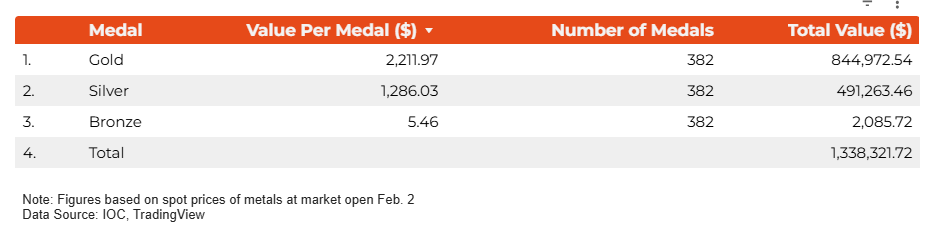
Metals price rallies have pushed the intrinsic value of the 1,146 medals to be awarded at Milano Cortina 2026 above $1.3 million, with each gold medal now worth about $2,212 in metal content versus roughly $736 at Beijing 2022. Design specifications show each gold medal contains about 500 g of .999 silver and 6 g of .9999 gold, silver medals contain the same 500 g of silver, and bronze medals use roughly 410 g of copper. Using current prices of ~$4,800/oz gold, $80/oz silver and $13,000/t copper, a silver medal is valued at ~$1,286 and a bronze at just $5.46.
Regis Resources has moved to revive the stalled McPhillamys gold project in New South Wales by proposing an “integrated waste landform” that co-disposes tailings and waste rock along the eastern and southern margins of the pit, avoiding the previously rejected tailings dam near the Belubula River headwaters. The company is seeking Environment Department approval without reopening the full approvals process, while simultaneously challenging former minister Tanya Plibersek’s heritage declaration in court over alleged procedural unfairness and blue-banded bee evidence. Regis has also lodged plans for a new 90 km water pipeline from EnergyAustralia’s Mt Piper power station near Lithgow and a replacement power line to support the 2.26-million-ounce deposit.
Aqua Metals and American Battery Factory have signed a non-binding MOU to evaluate co-locating an Aqua Metals lithium-ion recycling plant next to ABF’s planned LFP cell gigafactory in Tucson, Arizona, creating a closed-loop route for manufacturing scrap. The proposed commercial facility would process up to 10,000 tonnes per year of lithium-ion materials and return battery-grade lithium carbonate directly into ABF’s supply chain or to designated offtakers, using Aqua Metals’ electricity-powered AquaRefining system instead of conventional pyrometallurgy or hydrometallurgy. Aqua Metals is already targeting 2027 supply of up to 1,000 tonnes per year of recycled nickel carbonate to Westwin Elements under a separate LOI.
VoltVision, a high-voltage electrical data analytics specialist, is entering 2026 after joining ABB’s SynerLeap innovation hub and securing new Tier 1 mining clients alongside flagship deployments across Africa and the Middle East. Its platform ingests real-time data from existing HV switchgear and substations to optimise load profiles, detect power quality issues and reduce unplanned outages without major hardware retrofits. For mine operators, this positions digital power monitoring as a core tool for managing energy costs, grid instability and equipment life on remote, power‑intensive sites.
The Association for Consultancy & Engineering has appointed Milda Manomaityte as chief executive from 2 March 2026, making her the fifth CEO in eight years after the long 14.5‑year tenure of Nelson Ogunshakin ended in 2018. Manomaityte, currently chief operating officer at the Railway Industry Association and formerly a trade journalist in Lithuania and the UK, succeeds Kate Jennings, who is leaving after two years in post. She will be tasked with delivering ACE Group’s three‑year business plan and maintaining its role as a “trusted, influential voice” for infrastructure, including through the Environmental Industries Commission.
SHED 5 has appointed 27 suppliers to Procurement for Housing’s fifth-generation Social Housing Emerging Disruptors framework, a £500m, three-year vehicle quadrupling the previous iteration’s £100m value as contract awards in 2025 surged versus 2024. Targeting early-stage tech that does not fit standard OJEU-style routes, the SME-focused process uses a rapid desk-based selection to let councils and housing associations procure solutions such as recycled-glass modular panels, self-testing fire doors, anti-mould coatings and smart heat schedulers. The framework aligns with UK procurement reforms aimed at simpler, more flexible, SME-accessible public purchasing.
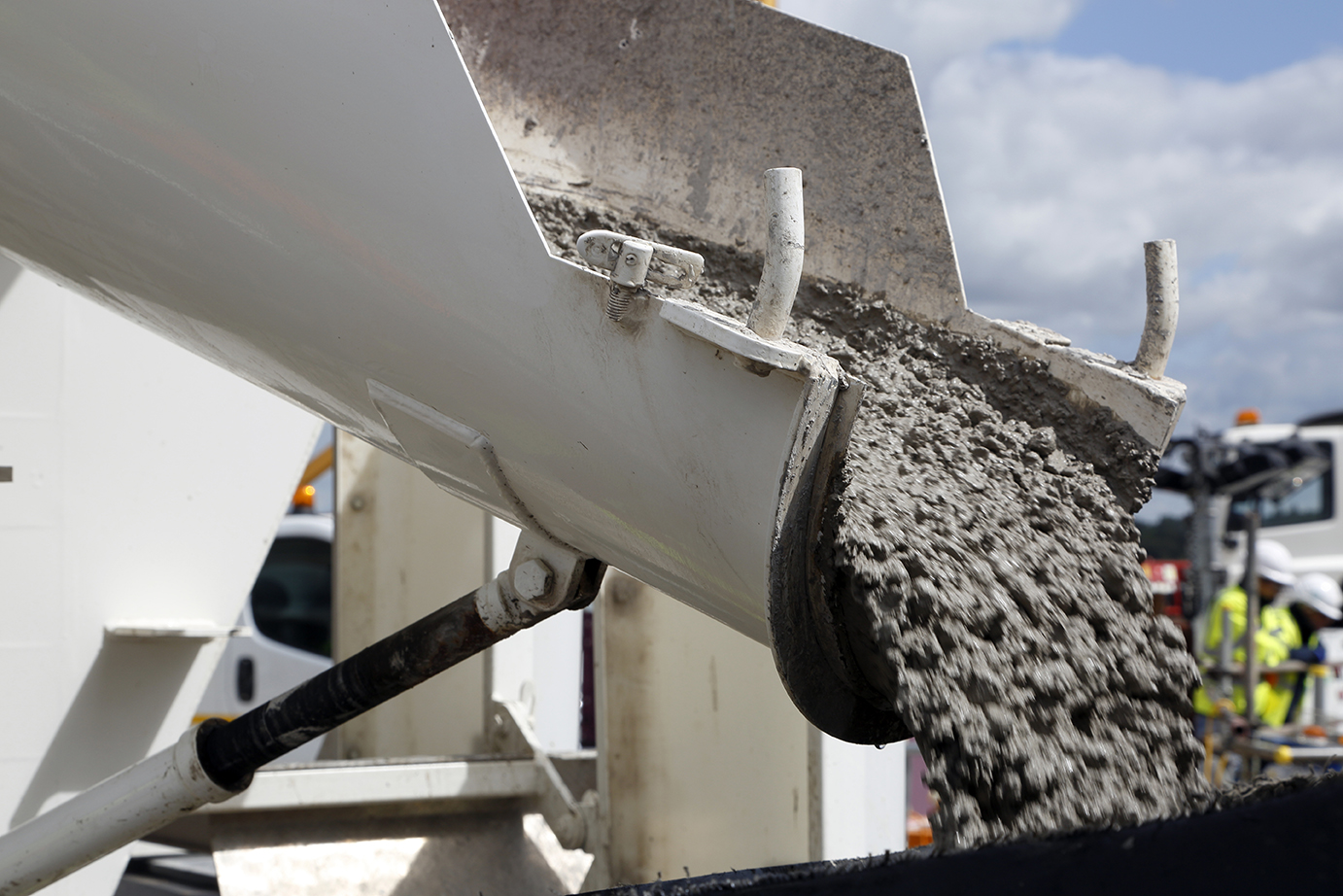
Concrete demand in the UK fell 9.9% in 2025 to its lowest level since the early 1950s, with aggregates down 1.6% and asphalt 1.1%, while mortar rose 5.2% but lost momentum in the second half, according to Mineral Products Association data. Ready-mixed concrete sales in London dropped 27% in 2025 and now sit 39% below 2023 levels, hit by stalled residential and commercial schemes and Building Safety Regulator-related planning delays. MPA warns that mothballed sites, deferred investment and job risks threaten long-term domestic supply capacity, with no market upturn expected in 2026.
Deloitte’s 2025 Regional Crane Surveys report more project starts across the four surveyed UK cities, but a fall in both the number of units and total floorspace currently under construction. The data point to schemes being broken into smaller phases or shifted towards lower-density developments, despite cranes indicating active sites. For contractors, consultants and materials suppliers, this suggests pipeline visibility may look healthy on paper while actual concrete, steel and labour demand per site is softening.
Willmott Dixon has promoted Judy Hegarty to managing director of Fortem, its social housing repair and maintenance arm, where she will work alongside chief operating officer Chris Tredget on the next phase of growth in that sector. Simon Ramage becomes managing director for Willmott Dixon Construction’s London & East region, following Stewart Brundell’s move to chief operating officer, while Adam Worrall steps up to managing director of Willmott Dixon Interiors, the fit-out business. All three previously served as deputy managing directors, signalling a clear internal succession path for leadership across repairs, regional construction delivery and interiors.
Government officials working on UK Nationally Significant Infrastructure Projects (NSIPs) are detailing how a revised consenting regime is intended to tackle long-standing issues such as multi-year Development Consent Order delays and repeated statutory consultation rounds. The new rules focus on streamlining approvals for large schemes like nationally significant road corridors, offshore wind arrays and strategic water resources by tightening examination timetables and clarifying requirements for environmental impact assessments. For civil and geotechnical teams, the changes signal earlier certainty on design envelopes, land acquisition and ground investigation phasing, but also less tolerance for late design changes or incomplete baseline data.
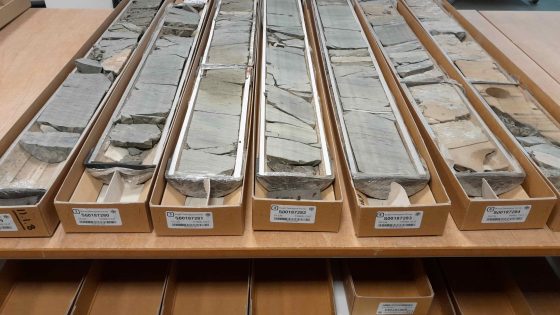
The British Geological Survey has launched a multi-year programme to map and assess CO₂ storage potential in Triassic and Jurassic sandstone formations beneath the Central North Sea, using legacy hydrocarbon well logs and 3D seismic data. Geoscientists will evaluate porosity–permeability distributions, caprock integrity and pressure limits to define storage units suitable for multi-million-tonne injection linked to UK industrial clusters. Results are expected to guide site selection, well design and monitoring strategies for future offshore carbon storage licences.
More than 2,000 people are now working daily on the Sizewell C nuclear power station site in Suffolk, double the on‑site workforce of a year ago as major civils ramp up. The project, based on the EPR design used at Hinkley Point C, is progressing early works including bulk earthworks, deep excavations for nuclear island foundations and marine infrastructure preparation on the North Sea coast. Contractors are scaling temporary works, logistics compounds and welfare facilities to support the expanded workforce ahead of peak concrete and reinforcement operations.
XCMG has completed two ultra-class battery electric machines for Fortescue, the XC9260BEWL wheel loader and XC9260BEWD wheeled dozer, at its Xuzhou manufacturing base in China. Both units will be shipped to Fortescue’s iron ore operations in the Pilbara, targeting diesel replacement on large load-and-carry and dozing duties. The deployment will test high-capacity battery systems and charging logistics in a remote, high-temperature mining environment, with direct implications for pit power infrastructure and haulage fleet decarbonisation strategies.
The Federal Government will invest $75 million in Alpha HPA to build a high-purity alumina production facility in Gladstone, described as the world’s largest of its type and focused on supplying LED and lithium-ion battery markets. The plant will use Alpha’s proprietary solvent extraction process to refine aluminium-containing industrial feedstocks into 4N+ purity alumina and related high-purity aluminium salts. For process engineers and materials specialists, the project signals growing domestic capacity in battery and electronics-grade alumina, with associated demand for reliable reagents, utilities, and port-side logistics.
Mining industry bodies including the Minerals Council of Australia are pushing back against a proposed cut to the federal Diesel Fuel Tax Credit scheme, which currently rebates most of the 48.8c/L fuel excise for off‑road uses such as haul trucks and mine power generation. They argue removing or reducing the credit would sharply increase operating costs for remote open‑cut and underground sites reliant on high‑horsepower diesel fleets and off‑grid generators. Industry groups warn this could accelerate mine closures, defer brownfield expansions and undermine investment in new projects.
Brightstar Resources has secured $180 million in new funding to fully finance development of its Goldfields project in Western Australia and accelerate work on the nearby Sandstone gold project. The capital raise is structured to cover mine development, processing plant upgrades and associated infrastructure, reducing reliance on debt and enabling a faster construction schedule. For contractors and consultants, the funding signals imminent demand for open-pit and underground works, tailings and water management design, and brownfield plant optimisation in the Goldfields region.
Ora Banda Mining has identified a large-scale gold mineralisation system at the Round Dam prospect, only 3.5km from its 1.2Mtpa Davyhurst processing plant in Western Australia. Drilling has defined a broad, near-surface mineralised corridor interpreted as a new gold system rather than an extension of existing deposits, improving the case for low‑haul, open‑pit feed to Davyhurst. The proximity to established crushing, grinding and CIL infrastructure materially reduces capital intensity for bringing any future Round Dam resource into production.
The US Government has launched a US$12 billion strategic critical minerals reserve, mirroring Australia’s national stockpile approach to secure supplies of lithium, rare earths and other battery and defence inputs. Funding will support long-term offtake contracts, stockpiling and processing capacity within US borders, reducing exposure to Chinese-controlled refining and midstream bottlenecks. For Australian miners, particularly in spodumene, nickel and rare earth projects, the move signals stronger demand for US-aligned supply with potential for co-funded downstream processing and joint venture refineries.
British Columbia will from 1 April process mineral exploration permits within 40–140 days, with any files breaching the service standard escalated to the chief permitting officer for a decision within 14 days, after exploration spending reached a record C$751 million in 2025. The province is allocating C$3 million, including C$1 million to increase permitting capacity and C$2 million to improve the Mineral Claims Consultation Framework, which has been a key bottleneck. Minister Jagrup Brar cited recent approvals at Skeena’s C$713-million Eskay Creek restart and Centerra’s Mt. Milligan expansion to 2035 as proof the system can move faster while maintaining First Nations consultation.
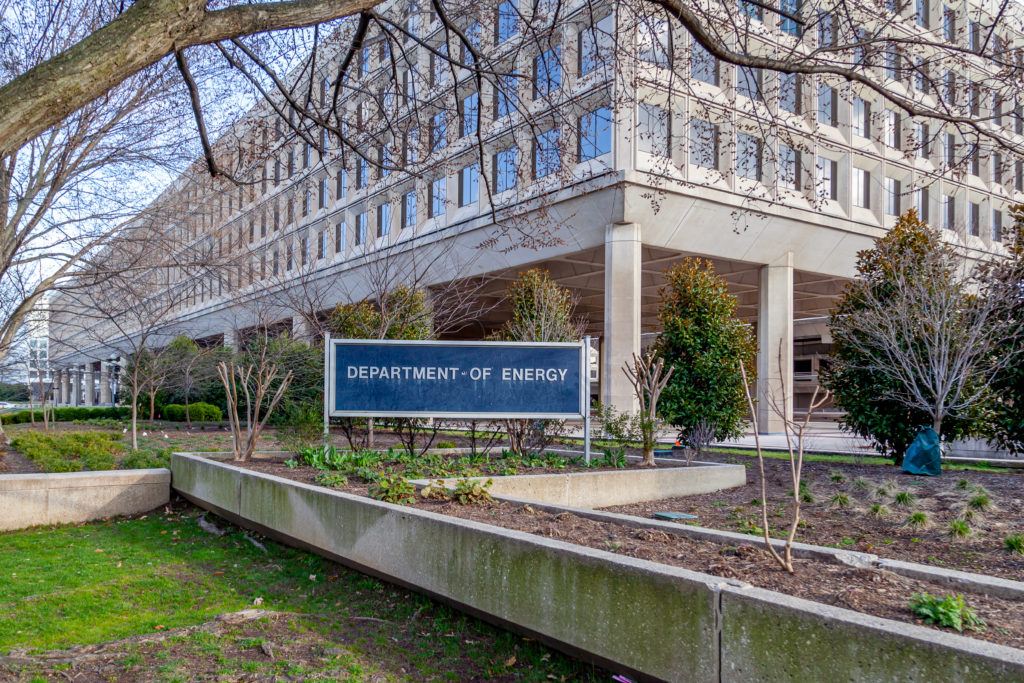
US Department of Energy has issued a Request for Information inviting US states to host Nuclear Lifecycle Innovation Campuses covering fuel fabrication, enrichment, used-fuel reprocessing and waste disposition across the full nuclear fuel cycle. Depending on regional capabilities, campuses could also integrate advanced reactor deployment, power generation, advanced manufacturing and co-located data centres, with states asked to specify priorities such as workforce development, infrastructure investment and economic diversification. Responses, including proposed funding structures, risk-sharing mechanisms and federal partnership models, are due by 1 April 2026.
Eldorado Gold is acquiring Foran Mining in a C$3.8 billion deal to combine the fully financed Skouries gold-copper project in Greece with Foran’s McIlvenna Bay volcanogenic massive sulphide project in Saskatchewan’s Flin Flon Greenstone Belt. The combined company will control two advanced underground developments with planned long-life, low-cost production profiles and significant copper exposure alongside gold. For project engineers, the transaction signals continued capital support for complex underground bulk-tonnage builds in both EU and Canadian regulatory environments.
Flender’s Flender One platform has been expanded to cover all major industrial gearbox applications, promising full customisation of gear ratios, torque ratings and mounting interfaces while still using a modular manufacturing approach. The system is configured digitally in minutes, with application-specific designs generated from operating data such as load spectra, duty cycles and ambient conditions, then translated directly into production. For mining operators, this points to faster delivery of mill, conveyor and crusher drives with closer alignment to site-specific mechanical and thermal requirements than traditional catalogue gear units.
ABB has launched its Automation Extended programme as a strategic evolution of its distributed control systems, aiming to let mines introduce new automation capabilities progressively while preserving existing DCS investments and control logic. The approach is pitched at brownfield process plants with ABB’s large installed DCS base, where operators want to add advanced process control, data integration and remote operations without major shutdowns or rip-and-replace projects. For mining engineers, this signals a stronger focus on staged upgrades of concentrators, smelters and material handling systems rather than full control system overhauls.
Electrification of mobile fleets is emerging as the key performance differentiator for Canadian mines, with an EY report linking early adoption of battery-electric haul trucks and loaders to lower operating costs and access to federal GHG-reduction incentives. The report points to Canada’s grid mix and federal tax credits for zero-emission equipment as structural advantages over jurisdictions reliant on diesel power. EY flags grid capacity, on-site charging infrastructure and mine power distribution upgrades as immediate engineering constraints that will shape project timelines and capital allocation.