Geomechanics, Streamlined.
© 2026 Geomechanics.io. All rights reserved.
Bridgestone Americas will debut three new off-the-road tyres at CONEXPO-CON/AGG in Las Vegas next week: the 27.00R49 Bridgestone MasterCore V-Steel M-Traction Deep (VMTD), the 24.00R35 Bridgestone V-Steel Rock Deep Ultra (VRDU), and the Firestone Multi Block T. The 27.00R49 and 24.00R35 sizes target large haul trucks and rigid dump trucks in hard-rock mining and quarrying, while Firestone Multi Block T is aimed at smaller quarry and construction fleets. For operators, the key decision points will be matching tyre selection to haul profile, underfoot conditions, and rim inventory.
BQE Water has signed a contract with Hudbay Minerals to advance engineering of a SART (sulphidisation, acidification, recycling and thickening) plant to IFC stage for integration into Hudbay’s Snow Lake mill in Manitoba, marking the first SART installation in Canada. The plant will treat metallurgical bleed streams and cyanide-bearing mine water, enabling cyanide recovery and copper sulphide precipitation rather than conventional lime neutralisation. For operators, this signals growing interest in reagent recovery and metal by-product capture as part of mill flowsheet design in cold-climate Canadian operations.
Construction has finished on the 170‑kilometre Stockinbingal to Parkes section of Inland Rail in New South Wales, one of 12 segments of the planned 1600‑kilometre Melbourne–Brisbane fast freight corridor. The package involved upgrading existing rail to accommodate double-stacked freight trains and higher axle loads, improving clearances and formation to support long-haul intermodal traffic. Completion of this link enables continuous inland freight movements through central NSW, reducing reliance on coastal routes and easing pressure on road freight networks.
Kutter is deploying a full Wirtgen Group train – including the MOBISCREEN MSS 502 EVO screening plant, MR 100 NEO impact crusher and MOBIBELT MBT 20 stacker – to mill, crush and recycle reclaimed asphalt directly on road projects. By treating RAP as a fully reusable raw material and processing it on site, the contractor cuts truck movements, fuel use and CO₂ emissions while feeding its own asphalt plants with controlled, consistent recycled aggregate. The setup supports high recycling rates without compromising layer thickness control or surface performance on rehabilitation works.
SAMI Bitumen Technologies has opened a new technical centre to expand research and development of bitumen additives and performance enhancers for Australian road construction and maintenance. The facility centralises laboratory testing, product formulation and quality control for polymer-modified binders, emulsions and warm-mix technologies, improving collaboration between SAMI’s technical teams and its large-scale production network. For pavement designers and asset owners, the centre signals faster validation of high-performance binders and more consistent field performance data for heavily trafficked highways and sprayed-seal networks.
Ballard Mining’s Baldock gold project in Western Australia has lifted its combined indicated and inferred mineral resource to 1 million ounces, signalling a substantial scale-up of the greenfields discovery. The resource growth follows recent drilling along the main shear-hosted lode system, with mineralisation defined over several kilometres of strike and to depths typical of Archaean orogenic gold camps in the Yilgarn. For mine planners and geotechs, the larger inventory strengthens the case for a standalone open pit transitioning to underground, with corresponding demands on pit slope design, dewatering and paste backfill options.
Power solutions provider Genus is pushing miners to address electrification and connectivity at concept stage, using integrated power and digital networks rather than bolt‑on systems. The company is working with delivery partners to design mine power architectures that can accommodate trolley assist, battery‑electric haul trucks and high‑bandwidth OT networks without major rework. For geotechnical and civil teams, this means earlier coordination on substation footprints, cable corridors and high‑load foundations for modular power assets planned for 2026 projects.
True North Copper has secured $5 million in Queensland Government funding to restart exploration at the legacy Cloncurry copper project, targeting extensions to historical high-grade lodes using modern geophysics and deeper diamond drilling. Aureka is ramping up RC and diamond drilling across its Western Australian gold tenements, focusing on structurally controlled shear-hosted mineralisation near existing 1–2Mtpa processing hubs to fast-track potential toll treatment. Rincon is expanding silver and base metal exploration in South Australia with step-out drilling around known vein systems and updated 3D geological modelling to refine resource targets.
Boss Energy is pursuing a new development pathway for the Honeymoon uranium operation in South Australia based on an alternative wide-spaced in-situ recovery wellfield layout. The concept aims to reduce drilling density and capital per pound of U₃O₈ while maintaining flow rates and leach contact, potentially cutting operating costs across the existing plant and satellite wellfields. For geotechnical and hydrogeological teams, the approach will hinge on demonstrating sufficient hydraulic connectivity, containment within the mineralised aquifer and reliable long-term recovery under the wider spacing.
A breakthrough electrochemical processing technology for low‑grade copper ores has secured $5 million in Federal Government funding in Australia. The process targets previously uneconomic resources, aiming to recover copper from low‑grade and complex deposits that conventional flotation and smelting struggle to treat. If scaled, the technology could materially change project cut‑off grades, extend mine lives at existing operations, and open new deposits in underexplored Australian copper provinces.
Chile’s mining ministry will send five new Special Lithium Operation Contracts (CEOLs) for salars including Ascotán, Piedra Parada and Agua Amarga to the national comptroller in March, while advancing direct-award deals at Ollague and Laguna Verde before President Gabriel Boric leaves office. Regulators recently blocked CEOLs for Quillagua Norte and Quillagua Este over “legal deficiencies”, sharpening the distinction between private CEOL tenders and state–private JVs such as Codelco–SQM’s Nova Andino Litio and Codelco–Rio Tinto’s Maricunga project. Chile targets lifting lithium output from 280,000 t/y in 2024 to about 430,000 t/y by 2034.
MP Materials will build its $1.25 billion “10X” rare earth magnet manufacturing campus on a 120-acre site in Northlake, Texas, less than 10 miles from its existing Fort Worth plant, targeting commissioning in 2028. The fully integrated platform, supplied with feedstock from the Mountain Pass mine in California, is expected to support total output of about 10,000 tonnes per year of NdFeB magnets and include mining, refining, metallisation, alloying, sintering and closed‑loop recycling. Funding includes a $1 billion JPMorgan/Goldman facility, a $150 million Pentagon loan and $200 million in state and local incentives.
Panama’s business lobby Sindicato de Industriales de Panama warns that reopening First Quantum’s Cobre Panama open-pit mine, which once supported over 40,000 direct and indirect jobs and supplied nearly 2% of global copper, is central to lifting GDP growth from 4% in 2025 to a projected 6% by 2027. If the mine remains shut, SIP sees 2027 growth slipping to 3.7%, with weaker diversification as copper exports are replaced by primary goods like shrimp, fish and bananas. President José Raúl Mulino plans a June decision on a restart, while First Quantum says it could produce about 70,000 tonnes of copper in a year by processing existing ore stockpiles.
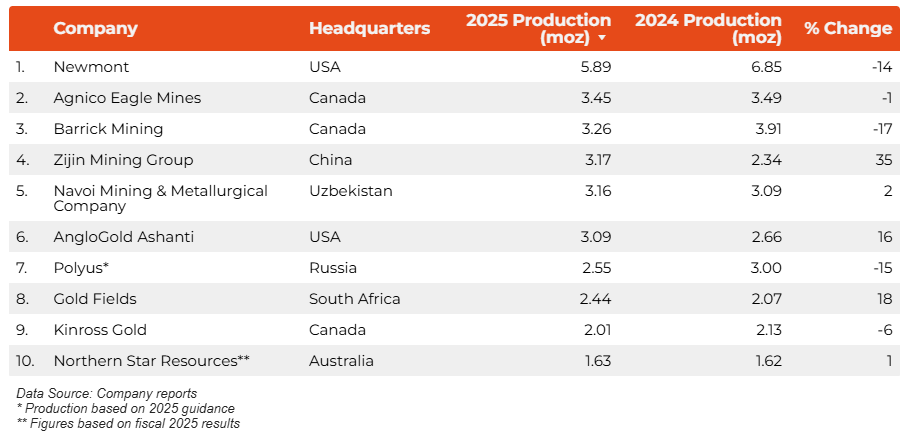
Gold’s 40% price surge in 2025 and a 155% jump in the VanEck Gold Miners ETF reshaped the producer rankings, with Newmont still number one despite a 14% output drop and asset sales, and Agnico Eagle moving into second after exceeding its production guidance and acquiring O3 Mining. Barrick’s volumes slumped after the Loulo-Gounkoto complex in Mali was suspended and only restarted in December, while Zijin boosted output 35% with acquisitions including Akyem in Ghana and Raygorodok in Kazakhstan. Northern Star hit guidance and closed a A$5 billion De Grey takeover targeting up to 3 Moz/y, but has already cut its fiscal 2026 outlook.
Nevada has overtaken Finland as the world’s top mining investment jurisdiction in the Fraser Institute’s 2025 Annual Survey of Mining Companies, with the highest policy perception index score driven by stable permitting, taxation and regulatory clarity for gold, silver and critical minerals. Ontario jumped from 15th to the global top three after October rule changes aimed at cutting mine approval times by half, while Saskatchewan rose from 7th on the strength of its uranium and potash districts. China, Burkina Faso and Egypt sit at the bottom of the 68‑jurisdiction Investment Attractiveness Index, with executives reporting that policy factors drive about 40% of investment decisions.
Global Atomic is facing a proposed securities class action in the Ontario Superior Court alleging “misrepresentations” by the company and CEO Stephen Roman in public disclosures between 10 November 2023 and 23 January 2025, with no damages figure yet specified and no court certification or leave under Section 138.8 obtained. The claim centres on a potential US$295 million debt facility from the US International Development Finance Corporation intended to fund 60% of capex for the Dasa uranium project in Niger, described as Africa’s highest-grade uranium deposit. Law firm Berger Montague alleges Global Atomic did not fully disclose loan pre-conditions and geopolitical risks, including deteriorating US–Niger relations and the junta’s mining-sector overhaul.
Work has officially started on the $4.1 billion Melbourne Airport Rail Link, a joint Federal–Victorian project that will route airport services through the existing Metro Tunnel. Early works focus on untangling the constrained multi-line rail junction at Sunshine, creating additional track capacity and segregation to accommodate dedicated airport services. For civil and rail engineers, key tasks will centre on complex brownfield staging, maintaining live suburban and regional operations, and integrating new MARL track geometry, signalling and power within the Metro Tunnel system.
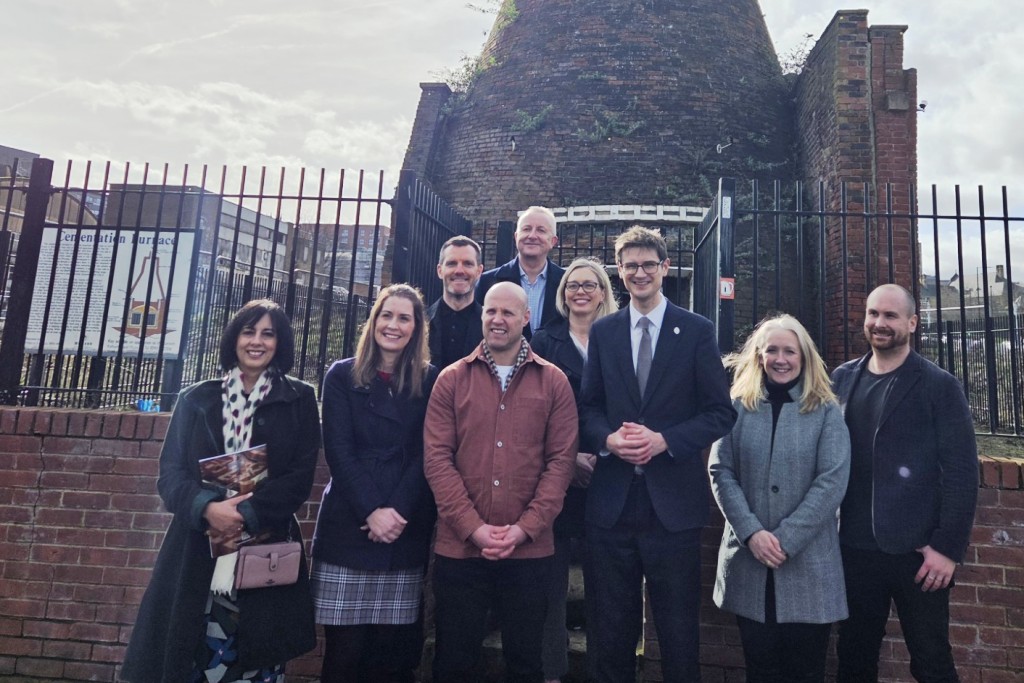
Developers have been appointed to convert two former industrial sites at Furnace Hill and Neepsend in Sheffield into roughly 1,180 homes across 5 hectares of brownfield land, backed by nearly £70m of government funding for land assembly and infrastructure. Furnace Hill will see about 750 units delivered by a Capital&Centric/Great Places joint venture, split evenly between affordable, home ownership and build-to-rent tenures. Igloo Regeneration will deliver around 430 homes at Neepsend, with roughly 20% affordable and 10% later-living units, both schemes designed to connect into the city’s tram network.
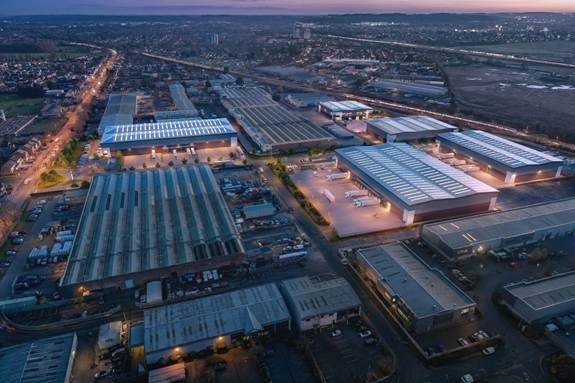
Glencar has been appointed to deliver Hillwood Park Luton, a 16‑acre, 284,575 sq ft speculative multi‑unit industrial and logistics scheme on Sundon Park Industrial Estate, providing warehouse units from 14,000 to 80,000 sq ft. The project targets BREEAM Excellent and EPC A, with Glencar engaged from pre‑construction to drive buildability, programme certainty and low‑carbon design. Practical completion is scheduled for Q4 2026, with units available for occupation from December 2026, following Glencar’s recent Crewe 335 and Martland Park projects for Hillwood.
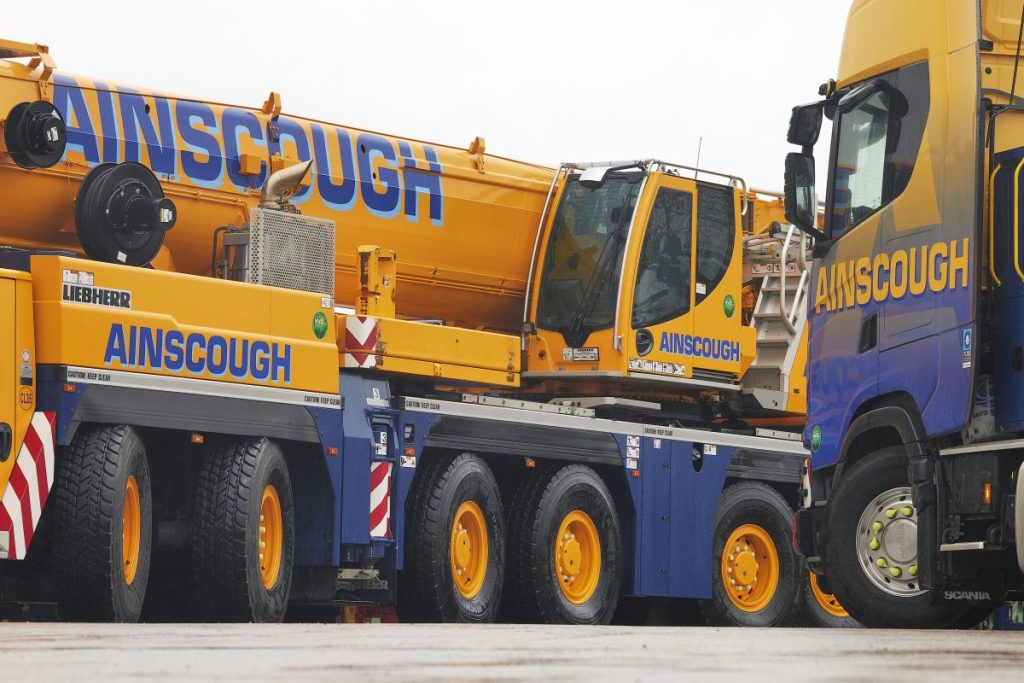
Ainscough Crane Hire has expanded its contract with Michelin Connected Solutions to manage all tyre requirements across 30 UK depots, covering more than 350 Liebherr mobile cranes (including 16‑wheelers), 135 trucks and trailers with 40 Scania HGVs, and 199 Mercedes‑Benz service vans. Benchmarking shows Michelin X Multi truck tyres delivering three times the life of a rival premium brand, while new 445/95 R25 Michelin X Crane 2 tyres offer an extra 800kg load per tyre at 80km/h, around 20% shorter braking distances and £130 fuel savings per 10,000km. Tyres are regrooved at 3–4mm and then retreaded at Michelin’s Remix plant in Stoke, with full casing traceability and cost forecasting to maximise crane uptime.
EDF Energy has been served an improvement notice by the Office for Nuclear Regulation after 415V electrical cabling was deployed unsafely during work on cooling water valves at the Hunterston B nuclear power station in Ayrshire in November 2025, creating a significant potential risk to workers. The notice compels EDF to review, revise and implement arrangements for the construction, maintenance, testing and control of all 415V portable equipment, and to strengthen risk assessments and procedures for electrical work. Compliance is required by 20 March 2026 under Section 2 of the Health and Safety at Work Act 1974 and multiple Electricity at Work Regulations, including Regulations 4, 7, 10 and 14.
Galliford Try has begun a £21m fit-out for the Birmingham Centre for Anatomy, Surgical & Clinical Skills, occupying two and a half floors within a new seven-storey, £210m building on the Birmingham Health Innovation Campus. The three-storey training centre will include mock hospital wards, a simulated operating theatre, consulting rooms, a mortuary and embalming room, plus immersive VR-based learning zones with simulated patients and home-care scenarios. Developed by the University of Birmingham with Bruntwood SciTech, the scheme is one phase of a six-phase masterplan delivering 657,000 sq ft of life sciences space over the next decade.
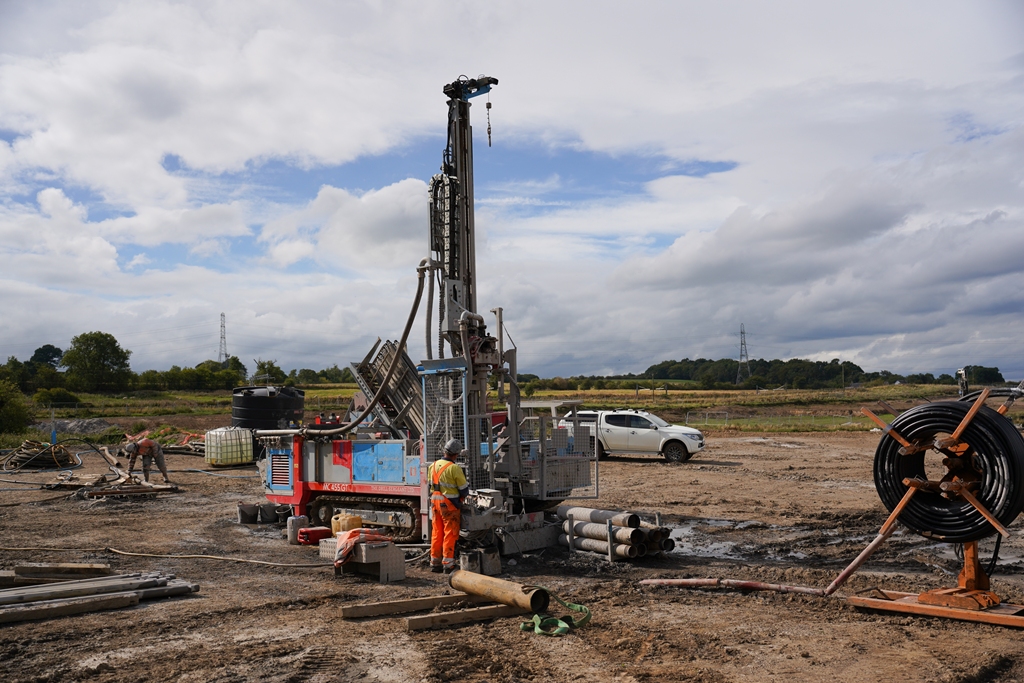
Wates Residential has appointed UK Power Solutions and subcontractor Rendesco to install a centralised ground source heat network with 47 geothermal boreholes serving 235 homes on the 27‑acre former Michaelston Community College site in Cardiff. The system, to be adopted and operated by Last Mile Heat, uses individual heat interface units and is projected to cut carbon emissions by up to 80% versus gas boilers and 54% versus air source heat pumps, while lowering residents’ running costs. Wates will recover nearly half of the network’s capital cost via forward‑funded rebate payments, easing upfront financing constraints on low‑emission heat infrastructure.
John Lewis Partnership has scrapped its £500m build-to-rent joint venture with Abrdn, abandoning plans for 10,000 rental homes by 2033 after higher interest rates, inflationary build costs and a weaker property market pushed the model outside its investment criteria. Three mixed-use schemes around John Lewis stores in Bromley, West Ealing and a vacant warehouse conversion in Reading, all with planning consent for around 1,000 homes in total, will be sold to other developers. John Lewis will continue managing four existing BTR sites in Leeds, Leicester, Birmingham and Stratford until new operators are appointed, with the Association for Rental Living warning that the decision signals worsening economics for institutional rental housing.