Geomechanics, Streamlined.
© 2026 Geomechanics.io. All rights reserved.
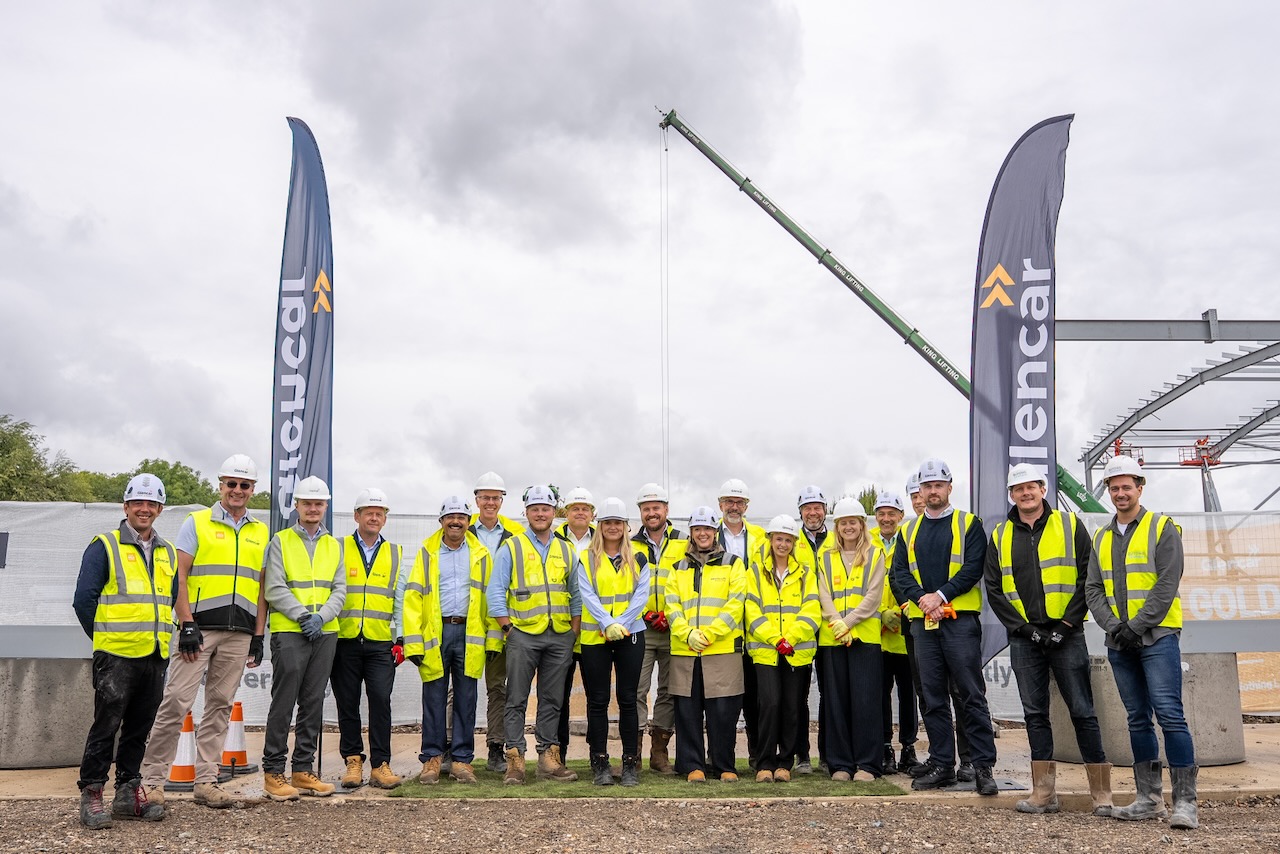
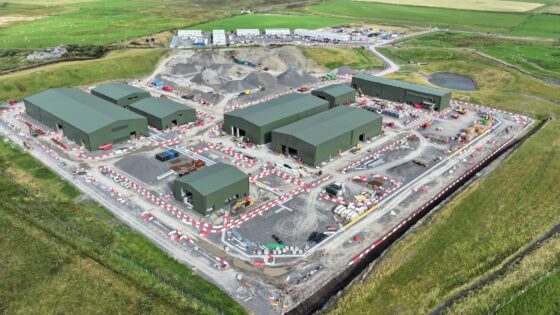
Steel erection is advancing at Link, Aylesbury, where Glencar is constructing a 192,000 sq ft industrial and logistics scheme of five Grade A units at Gatehouse Close for Newlands Developments. Steelwork began on Units 1 and 2 in July, moved to Unit 3 in August, and will extend to Units 4 and 5 later this month as the main construction programme accelerates towards an April 2027 completion. The site targets BREEAM Excellent and EPC A, with EV charging infrastructure and energy‑efficient design, and sits about 0.5 miles from Aylesbury town centre with direct A41/A418 access.
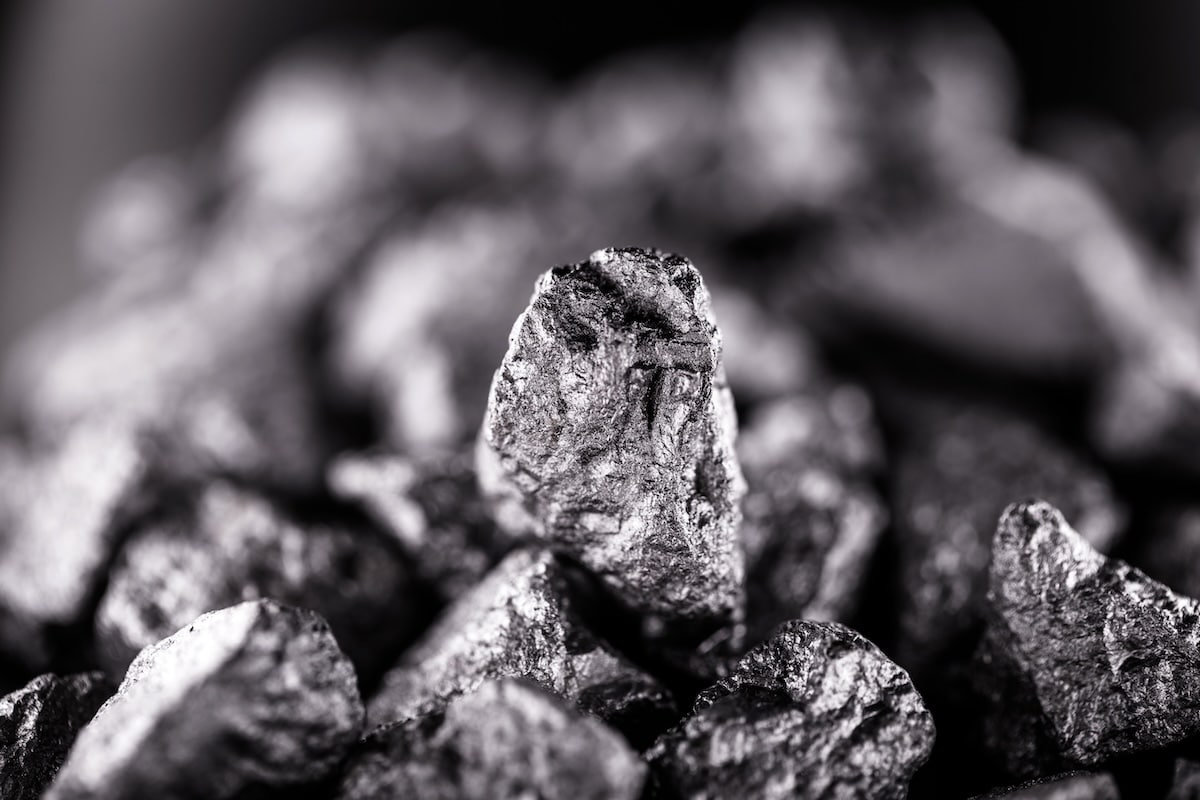
Almonty Industries has signed a long-term tungsten concentrate supply agreement with Sandvik subsidiary Wolfram Bergbau und Hütten AG for retreatment of the existing tailings stockpile at the Los Santos Mine in western Spain. The contract covers a minimum of about 1,720 t of contained WO₃ recovered from historical tailings, shifting the operation from primary ore mining to secondary extraction. For process engineers and tailings specialists, the deal signals continued commercial appetite for reprocessing fine-grained tungsten residues where grades and volumes justify dedicated retreatment circuits.
Auckland’s City Rail Link has opened as New Zealand’s first underground railway, creating a new cross-city spine beneath the CBD and linking Britomart with the Western Line via twin bored tunnels. The CRL adds two new underground stations and converts Britomart from a terminus into a through-station, enabling more frequent EMU services and shorter travel times across the regional network. For civil and geotechnical teams, the project sets a national precedent for urban tunnelling under existing high-rise foundations and utilities in soft, seismically active ground.
The winners of the 2026 Inspiring Women in Construction and Engineering Awards were announced in London on 16 September, recognising female leaders across contracting, consulting, client bodies and supply chains. Categories typically span project delivery, digital innovation, site management and early-career professionals, with entrants drawn from major UK infrastructure programmes and tier-one contractors. For geotechnical, civil and materials specialists, the awards signal continued client and contractor emphasis on diverse leadership teams for complex projects such as major rail, highways and water schemes.
Gina Rinehart’s Hancock Prospecting has executed nine disclosed deals in about a year, including an A$8.77 million placement into White Cliff Minerals at A$0.017 per share for a 13.5% stake and exposure to the Rae copper project in Nunavut, plus A$125 million into Arafura Rare Earths’ Nolans project and A$22.5 million for 6.24% of St George Mining’s Araxá rare earths–niobium project. Hancock now holds 6.26% of Rare Earths Americas, has increased its Hudbay Minerals position by about 10%, exited SQM, and committed A$7.95 million to G50 Corp. for gallium-focused drilling and metallurgical testing at Golconda in Arizona. The portfolio, which also includes stakes in MP Materials, Lynas and an 8‑million‑share, roughly $1.37‑billion position in SpaceX, signals a deliberate shift from pure Australian iron ore into rare earths, copper, gallium, defence-linked metals and potential off‑Earth resource plays across Australia, the Americas and Brazil.
MMG’s proposed $500 million acquisition of Anglo American’s Barro Alto and Codemin ferronickel operations in Brazil, which produce about 40,000 tonnes per year of nickel in ferronickel, is facing EU scrutiny over fears low-carbon feedstock could be diverted from European stainless steel mills. The European Commission warned that reduced access to this specific low-carbon ferronickel could raise input costs given limited alternative sources, despite Anglo citing recent supply growth from Latin America, New Caledonia, South Korea, Indonesia and Japan. MMG has pledged contractual guarantees to maintain at least current European volumes, with scope to increase, as Brussels works towards a 30 November decision.
Almonty Industries has signed a long-term take-or-pay deal to supply Sandvik’s Wolfram Bergbau und Hütten AG with tungsten concentrate recovered from tailings at the shuttered Los Santos mine in Spain, offering delivery lead times shorter than developing a new mine. Almonty will deploy proprietary tailings-processing technology to treat low-grade waste made economic by post-2025 price rises following China’s tighter export controls, which affect roughly 80% of global tungsten output. The agreement adds a European tungsten source alongside Almonty’s Panasqueira (Portugal) and restarted Sangdong (South Korea) operations, aligning with the EU’s Critical Raw Materials Act push for regional extraction and recycling.
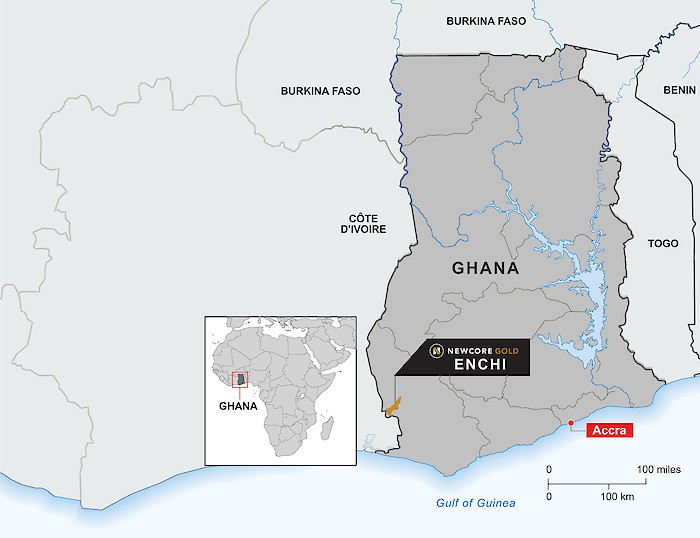
Newcore Gold has reported one of its widest, highest-grade intercepts at the Boin deposit on the Enchi project in Ghana, with reverse-circulation hole KBRC411 cutting 69 m at 2.59 g/t Au from 58 m depth, including 24 m at 6.41 g/t from 59 m, and KBRC414 returning 32 m at 0.83 g/t from 70 m, including 6 m at 3.37 g/t. The seven new RC holes, totalling 960 m over 1.9 km of strike and drilled to a maximum vertical depth of 125 m, all intersected mineralisation and target conversion of Boin’s 15.9 Mt probable reserve at 0.84 g/t and 23.5 Mt indicated at 0.73 g/t. These results, largely outside the June PFS resource that underpins a planned 5.5 Mt/y open-pit and mill producing 953,000 oz over 9.3 years, point to scope for higher-grade feed and mine plan optimisation as Newcore advances an 80,000 m programme and prepares a mining lease application.
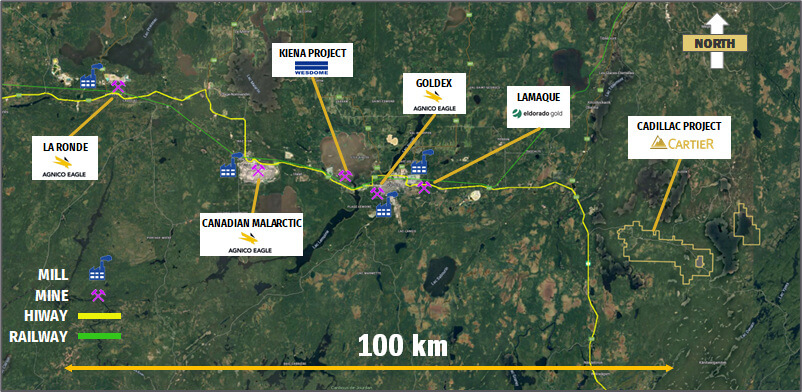
Cartier Resources has reworked its Cadillac gold project in Quebec’s Cadillac Fault, cutting initial capex to about $198 million by staging processing with 3,000 t/d toll milling in year one and an on-site plant ramping to 4,300 t/d from year five. The fully underground mine is now planned to produce 100,000 oz/y over 16.2 years, recovering 1.61 million oz at 95% recovery from 23.1 million tonnes grading 2.28 g/t, with AISC of $2,137/oz. At a $3,600/oz gold price, the PEA shows a 27% after-tax IRR, $1 billion NPV and C$2.77 billion free cash flow, backed by Agnico Eagle’s 27% equity stake.
Luca Mining is acquiring Agnico Eagle’s 320-sq.-km El Barqueño gold-silver-copper project in Jalisco for up to $60 million, structured as $10 million in shares on closing, $30 million in deferred drilling/production payments and a further $20 million linked to output, plus a 2% NSR royalty that can be cut to 1% for $12.5 million. The property hosts historical indicated resources of 8.43 million tonnes at 1.24 g/t Au, 5.15 g/t Ag and 0.21% Cu, based on roughly 300,000 metres of past drilling. Key technical risk is regulatory: no exploration drilling permits are currently in place due to Jalisco’s ecological territorial planning rules, with a legal challenge under way to restore exploration and unlock potential open-pit and underground development options.
IperionX has validated continuous operation of its GenX hydrogen magnesiothermic reduction (HAMR) titanium furnace at its Virginia R&D facility, achieving a sixfold increase in throughput and a 75% cut in energy intensity versus its previous batch process. The commercial-scale system processed over 500 kg of recycled titanium powder in four continuous runs over 41 hours at roughly 12 kg/h, with all samples meeting oxygen specifications and showing substantially lower magnesium, hydrogen and power consumption at steady state. A second US Army SBIR contract allows project-specific defence orders up to a collective US$99 million, supporting scale-up of domestic titanium powder-to-part capacity in a market that currently has no US titanium sponge production despite aerospace demand above 31,000 t/y.
Canada could add up to C$98 billion a year to GDP by 2035 if it shifts from exporting raw critical minerals to more complex products, Export Development Canada says, citing rare earths, graphite, lithium, copper and uranium as priority value chains. The report points to moving beyond ore into nuclear fuel and reactor components for uranium, and into specialty conductors, transformer components and AI‑grade power grid equipment for copper, building on assets such as Glencore’s Horne copper smelter. Key constraints are long-term risk capital, skilled labour, commercialisation capacity and trade infrastructure still geared to bulk exports.
West Africa’s collective gold output now exceeds China’s, and Fortuna Mining CEO Jorge Ganoza says the region’s mineral endowment and rapid permitting and development timelines make it central to any growth strategy in precious metals despite higher geopolitical risk. Fortuna, which runs two mines in West Africa and two in Latin America, is tactically shifting capital between jurisdictions and has already started ordering critical power generators and other equipment for its newly acquired Bambadji project before securing an exploitation permit. Ganoza notes that competition from global data centres is constraining generator supply, limiting miners’ ability to secure units even with higher bids.
BHP is running battery-electric haul truck trials at the Jimblebar iron ore mine in the Pilbara using two Caterpillar 793 XE Early Learner units, in a joint programme with Caterpillar and Rio Tinto. The focus is on quantifying productivity impacts of static charging, including effects on haul cycle times, truck availability and fleet scheduling compared with diesel 793s. Outcomes will directly inform future pit design, charging bay layout and power infrastructure planning for large-scale BEV deployment on similar ultra-class truck fleets.
RIEGL has launched the miniVZ-500 compact 3D LiDAR sensor at INTERGEO 2026 in Munich, targeting industrial automation, process optimisation, and continuous surveillance and monitoring in mining and other heavy industries. The unit combines high measurement rates with precise signal processing and new dynamic scanning modes, allowing flexible control of scan patterns for moving plant, conveyor lines, and stockpile faces. For mine operators, the compact, lightweight form factor and continuous monitoring capability point to tighter process control and earlier detection of structural or operational anomalies.
Syntax has launched its Syntax Maintenance Cost Budgeting tool for mining operators, integrating directly with SAP Cloud ERP to give finance and maintenance teams site-, cost-centre- and asset-level visibility of maintenance expenditure. The system replaces spreadsheet-based workflows with automated data consolidation and predictive budgeting, enabling forward-looking control of major cost drivers such as mobile fleets, fixed plant and critical spares. For engineers, this supports more defensible life-of-mine maintenance plans, tighter cost tracking across multiple operations and faster budget revisions when production or asset strategies change.
Lower Thames Crossing has ordered a 16.4m-diameter Herrenknecht TBM, the largest ever used in Europe, to drive twin 4.2km tunnels under the Thames from 2028 as part of the £11bn scheme. Early works include complex ground investigation and utility diversions in soft alluvium and Chalk, with strict limits on spoil disposal and construction emissions to meet “UK’s greenest road” targets. Key design choices include cut-and-cover approaches, low-carbon concrete and extensive off-site fabrication to reduce on-site plant hours and traffic disruption.
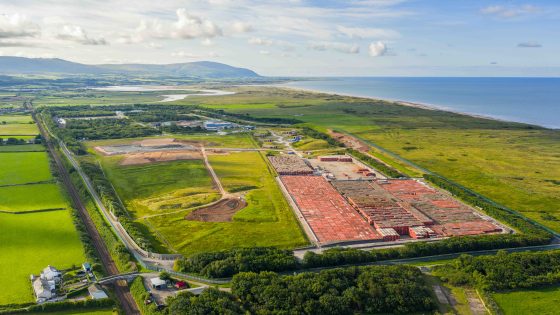
SSEN Transmission’s £1bn Orkney link project will connect the islands to the GB electricity transmission network for the first time via a new subsea high-voltage link and two purpose-built substations. The remote location is driving offsite fabrication, modular substation construction and complex marine logistics for cable installation in challenging North Atlantic conditions. For civil and geotechnical teams, key issues include foundation design on variable island geology, heavy plant access in constrained coastal sites and durability detailing for aggressive marine exposure.
Nuclear Waste Services has issued a prior information notice to test market interest in a future £42M framework for independent assurance services across its UK radioactive waste management and disposal programmes. The contract is expected to cover multi‑year technical assurance on safety cases, design verification and construction quality for facilities such as interim storage, packaging plants and long‑term geological disposal infrastructure. Potential bidders should anticipate requirements for nuclear‑grade quality management systems, independence from existing NWS delivery partners, and capability to audit complex civil, structural and geotechnical designs.
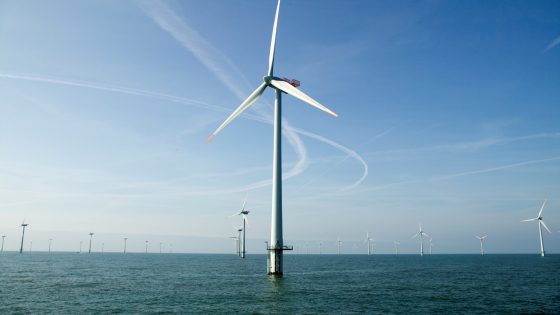
The House of Lords has launched an inquiry into “dunkelflaute” – multi-day periods of low wind and solar output – as the UK grid takes a larger share of variable renewables. Peers will examine how National Grid ESO plans to maintain security of supply during extended calm, overcast conditions, including the roles of long-duration storage, interconnectors and dispatchable plant. Civil and electrical engineers can expect scrutiny of network resilience assumptions, capacity adequacy margins and the cost–risk balance for backup infrastructure.
Rail for London Infrastructure is preparing a £19M contract for planned maintenance and repairs to the tunnel ventilation and controls system on the central section of the Elizabeth line between Paddington and Abbey Wood. The package will cover axial fans, dampers, smoke extraction controls and associated SCADA systems that manage airflows and emergency smoke clearance in the deep-level running tunnels and platform tunnels. Contractors will need strong capability in rail systems integration and working within live underground assets with tight access windows and stringent fire and life-safety requirements.
Encounter Resources has recorded its highest-grade niobium hit at the Green deposit in WA’s West Arunta, with aircore hole EAL1513 returning 51m at 5.0 per cent Nb₂O₅ from 63m downhole at the Aileron project. The intersection sits entirely outside the current inferred resource boundary, indicating potential to expand Green’s niobium inventory and reframe drilling priorities. For mine planners and metallurgists, a continuous 5 per cent Nb₂O₅ interval at shallow depth suggests attractive open-pit potential and strong feed grades for downstream processing studies.
CMEWA economic modelling estimates Western Australia holds $8.1 trillion in remaining saleable mineral and energy products across 27 commodities, with iron ore and gold dominating the value. The analysis aggregates known resources and reserves under current technology and price assumptions, signalling very long mine-life potential for Pilbara iron ore hubs and major goldfields. For planners and geotechs, the scale points to sustained demand for large open pits, waste dumps and tailings storage, and long-horizon investment in rail, port and energy infrastructure.
BHP has quantified the productivity hit from static charging of battery-electric haul trucks, estimating a loss of about 1000 operating hours per truck per year compared with diesel units in its September 16 ESG roundtable presentation. The miner is therefore prioritising dynamic charging concepts such as trolley-assist and in-pit charging to keep ultra-class fleets closer to current utilisation levels. For mine planners and engineers, the figure frames trade-offs between decarbonisation, fleet size, and potential redesign of haul profiles and power infrastructure.