Geomechanics, Streamlined.
© 2026 Geomechanics.io. All rights reserved.
Surge Battery Metals’ updated prefeasibility study for the Nevada North lithium project in Nevada lifts the after-tax NPV to US$9.81 billion and IRR to 24% at US$24,000/t LCE, while cutting initial stage-one capex to US$2.77 billion and trimming operating costs by about 10% from US$5,243/t. The 42-year, conventional open-pit claystone mine, held 68/32 with Evolution Mining, is designed for non-blasting extraction and on-site production of battery-grade lithium carbonate, averaging 92,250 t/y and peaking at about 111,400 t in year seven. Proven and probable reserves of 218.3 Mt at 3,928 ppm Li (4.56 Mt LCE) underpin a two-stage plant ramping from 55,900 t/y to double capacity, with first production targeted for H2 2031.
Greenland’s government has approved Critical Metals’ mining and closure plans for the Tanbreez heavy rare earths project in southern Greenland, covering mine, processing plants, port and supporting infrastructure through to September 2050 but still requiring separate environmental, marine transport, health and safety and export approvals before construction can begin. The PEA pegs Tanbreez at an after-tax NPV of US$2.1 billion with US$290 million initial capex, initial output of about 85,000 tonnes per year and modular expansion potential to 425,000 tonnes, from a 45-million-tonne resource grading 0.4% TREO. Critical Metals targets first ore in late 2028 or early 2029, has a 15-year offtake for 15% of initial production with REalloys and a US$120-million EXIM Bank financing letter of interest, and is moving to 100% ownership via acquisition of European Lithium’s 7.5% stake.
Rising inventories in London, CME and Shanghai and falling industrial use could flip the silver market from last year’s physical shortage to surplus as early as 2027, with Deutsche Bank’s Daniel Ghali forecasting average prices of about $70/oz in Q2 2027 versus a $120/oz spike at the start of 2026. More than 914 million oz sit in London vaults, including over 300 million oz freely available, up 70% since October 2025, while Deutsche expects solar-sector silver consumption to drop over 20% this year and per-cell use to fall 17% in 2026.
LaFleur Minerals’ latest drilling at the 19,214-hectare Swanson Gold project in Quebec’s Abitibi Belt yielded a standout intercept of 6.05 g/t gold over 8 m in hole SW-26-124 at the Bartec target, the first modern hole there since 1987, but overall continuity across Bartec, Jackson and Jolin remains weak. Jackson returned 1.45 g/t over 7.70 m in SW-26-111 along a 1,200 m mineralised corridor, while Jolin’s SW-26-103 cut 1.77 g/t over 6.45 m. Despite a March 2026 PEA giving Swanson a US$70.8 million NPV and 65% after-tax IRR, LaFleur’s share price has fallen over 18% since 22 September, with Bartec now prioritised for follow-up drilling.
Tanzania has renewed Barrick’s two special mining licences for the North Mara gold mine for 15 years, securing tenure for the combined open-pit/underground operation that produced 249,000 attributable oz. last year and holds 43 Mt of proven and probable reserves at 2.32 g/t for 3.2 Moz. Barrick must lift output from 68,000 oz. in H1 to 132,000–162,000 oz. in H2 to meet 2026 guidance of 200,000–230,000 oz. at targeted AISC of US$1,520–US$1,680/oz., while studying debottlenecking and expansion of the North Mara–Bulyanhulu complex.
Cambria Gold Mines plans to recommission the 2,500 t/d Premier mill in northern British Columbia in Q4 2027, drawing initial underground feed from the Premier, Silver Coin and Big Missouri deposits before adding Red Mountain ore trucked roughly 50 km via Stewart and Hyder. The company has spent C$538 million on the complex since 2021, is drilling Premier on 12.5 m centres, and will install a new crusher, pre-leach thickener, fine-grinding mill and second cyanide-detox tank ahead of Red Mountain processing. A Fisheries Act authorisation now allows reconstruction of the Red Mountain access road along Bitter Creek, while Premier’s water-treatment plant still needs upgrades to consistently meet zinc-discharge limits.
Gold’s recent price rally is being driven mainly by central banks buying on dips as they diversify away from the U.S. dollar, with retail investors still largely absent, veteran mining financier Frank Giustra told The Northern Miner at the Precious Metals Summit in Colorado. Giustra, founder and CEO of Vancouver-based Fiore Group, said a major geopolitical or financial shock could pull ordinary investors into the market, fuelling a further leg up. He also expects copper prices to spike before new mine supply arrives and flagged Copper Giant Resources (TSXV: CGNT; US-OTC: CGNRF), where he is a major shareholder.
Westwin Elements will invest $502 million over five years to build a commercial-scale Class 1 nickel refinery at the Belwood Industrial Site in Natchez, Mississippi, targeting 18,000 tonnes per year of output in its first phase with commissioning in 2029. The plant will scale up nickel carbonyl refining technology proven at Westwin’s 20 t/y Lawton, Oklahoma demonstration facility, with a completed Bankable Feasibility Study, a long-term site lease, and binding feedstock and offtake agreements already secured. Located adjacent to Natchez’s inland port and regional transport links, the project is expected to create 134 full-time jobs at an average salary of about $84,000.
Investors in gold and silver miners are being urged by Feneck Consulting Group CEO John Feneck to abandon broad ETFs and funds in favour of a “rifle approach”, targeting individual projects with strong management, favourable jurisdictions and proven drill results. Feneck, a 26‑year silver investor who calls it his largest position, says he will only re‑enter aggressively if silver corrects to around $50/oz, stressing strict respect for resistance levels and profit‑taking discipline. He argues current macro conditions for precious metals will only fully play out once US Federal Reserve policy, ongoing wars and US elections stabilise.
Advanced Navigation America is expanding manufacturing in Huntsville, Alabama, to build a Positioning, Navigation, and Timing (PNT) Centre of Excellence for high‑precision mining navigation, funded by a US$110 million Series C round. The facility will develop and produce deep‑tech systems including fibre‑optic and MEMS inertial sensors, laser and photonic navigation, vision‑based systems, AI, and quantum sensing for autonomous equipment operating in deep, dark, GPS‑denied mines. A trilateral production footprint across the US, Australia and the UK is intended to improve supply chain redundancy and shorten lead times for North American mining projects.
Macmahon Underground Pty Ltd has secured a two-year extension from Vault Minerals to continue providing underground mining services at the Daisy Milano gold mine in Western Australia’s Kalgoorlie region. The scope covers ongoing mine development and production activities, maintaining contractor continuity at a site where Macmahon has been operating since 2024. For geotechnical and production teams, the extension signals stable planning horizons for development drilling, ground support regimes and scheduling of stoping sequences over the next two years.
South32’s Hermosa project in Arizona has received the 2025 Sentinels of Safety Award in the Underground Metal Group from the US National Mining Association, recognising its leading national performance on mine safety. The award focuses on fatality and serious injury prevention, signalling that Hermosa’s underground development and operating practices have achieved a sustained record of zero or very low recordable incidents. For mine operators, Hermosa’s recognition reinforces the value of rigorous controls around underground ground support, ventilation, and procedural discipline in meeting top-tier US safety benchmarks.
EACON and Tonly have unveiled the EQ100E, a purpose-built, cabless, battery-electric autonomous mining truck that integrates Tonly’s chassis and powertrain engineering with EACON’s drive‑by‑wire and autonomy stack. Designed from the outset for driverless haulage rather than retrofit, the EQ100E removes the operator compartment entirely, simplifying layout for high‑capacity battery packs, sensor arrays and redundant braking and steering controls. For mine planners, the platform signals a shift towards haul road, dump and crusher interface designs optimised around fully autonomous, zero‑emission truck fleets.
Founders Factory and Rio Tinto have selected a fifth cohort of five start-ups for their Mining Tech Accelerator, targeting high-impact operational challenges across the mining value chain. The global programme backs early-stage ventures developing tools such as advanced orebody characterisation, digital mine planning, and AI-driven decision support for processing and logistics. For engineers, the accelerator signals continued demand for deployable technologies that integrate with existing fleet management, plant control, and geoscience data systems rather than standalone pilots.
Metso has signed an agreement to modernise and repower thickeners at a Chilean mine, targeting higher throughput, greater operational robustness and increased underflow density. The upgrade focuses on boosting water recovery rates from the thickener underflow, reducing fresh make-up water demand and supporting more sustainable process water management in a high-tonnage operation. For process and tailings engineers, the project signals continued pressure to extract more water from tailings streams through improved thickener design, control and retrofits rather than new-build capacity.
New works to clean the Monash Freeway will target 15 ramps between Malvern and Narre Warren under Victoria’s $36.9 million Better Roadsides program. The initiative focuses on some of Melbourne’s busiest motorway corridors, aiming to remove litter, debris and vegetation encroachment that can obstruct drainage, signage visibility and safety barriers. For asset managers and pavement engineers, the works signal short-term ramp disruptions but should improve surface runoff behaviour, reduce blocked culverts and cut maintenance call-outs over the coming months.
Tutt Bryant is expanding use of BOMAG’s telematics-enabled compaction fleet in Australian road projects, linking rollers and compactors directly to BOMAG fleet management platforms for live machine and compaction data. Councils and contractors can monitor vibration frequency, amplitude, passes and fuel burn in real time, using GPS-based mapping to verify coverage and avoid over- or under-compaction. The move signals tighter control of compaction quality, better utilisation of mixed fleets and improved safety management around plant on constrained roadwork sites.
Resurfacing budgets in many Australian regions are falling below the seven per cent annual benchmark, pushing road owners to design longer‑life flexible pavements from day one. The Australian Flexible Pavement Association outlines five strategies, including higher-modulus asphalt layers, optimised granular bases and surface enrichment treatments that restore binder and texture on oxidised seals. The approach targets whole‑of‑life cost reductions and fewer workzone interventions across Australia’s extensive surfaced road network, now the largest fixed public asset.
Rox Resources has closed $350 million in debt facilities for the Youanmi gold project in Western Australia and completed an initial $90.2 million drawdown under a $300 million senior secured project term loan. The package also includes additional debt lines (totalling $50 million) to cover working capital, infrastructure and contingency during mine development and ramp-up. For engineers and contractors, the funding de-risks early works, allowing commitment to long-lead processing plant items, underground development and associated civil works around the Youanmi site.
Australia’s resources and energy export earnings are forecast in the September 2026 Resources and Energy Quarterly to rise from $403 billion in 2025–26 to $422 billion in 2026–27, driven by demand from artificial intelligence data centre infrastructure and the energy transition. Stronger outlooks for iron ore, lithium and copper are offsetting softer coal prices, with AI-related power and cooling loads boosting requirements for steel, aluminium and critical minerals. Miners are likely to face continued pressure on long‑term supply of battery and conductor metals, reinforcing the case for new brownfield expansions and higher‑grade resource development.
Brightstar Resources has intersected 167m at 2.07g/t gold from 104m depth in reverse circulation hole BORC26042 at the Bull Oak deposit, within its Sandstone operations in Western Australia. The interval includes multiple higher-grade zones, notably 10m at 25g/t, supporting Bull Oak’s potential as a substantial open-pit feed source rather than a narrow underground target. For mine planning and geotechnical design, the long, continuous mineralised zone favours bulk open-pit geometry and could justify larger-scale pit optimisation and waste-stripping strategies.
King River Resources has reported a 79 per cent hit rate from phase 1 reverse circulation drilling at its Mindoolah gold project in Western Australia, with 15 of 19 first-pass RC holes intersecting significant gold mineralisation at an average depth of about 41m below surface. The shallow intercepts suggest potential for open-pit geometries and lower strip ratios if continuity is confirmed in follow-up drilling. Results will guide tighter-spaced RC and possible diamond drilling to define structure, grade distribution and metallurgical domains.
Mining remained Australia’s largest corporate taxpayer in 2024–25, with 4299 large entities each earning more than $100 million contributing a combined $87.5 billion in company tax, down from $95.7 billion as weaker commodity prices cut margins. The Australian Taxation Office’s latest corporate tax transparency report confirms mining’s outsized fiscal role despite softer iron ore, coal and base metal prices. For operators, the figures signal continued scrutiny of profit reporting, transfer pricing and project cost allocations across major assets.
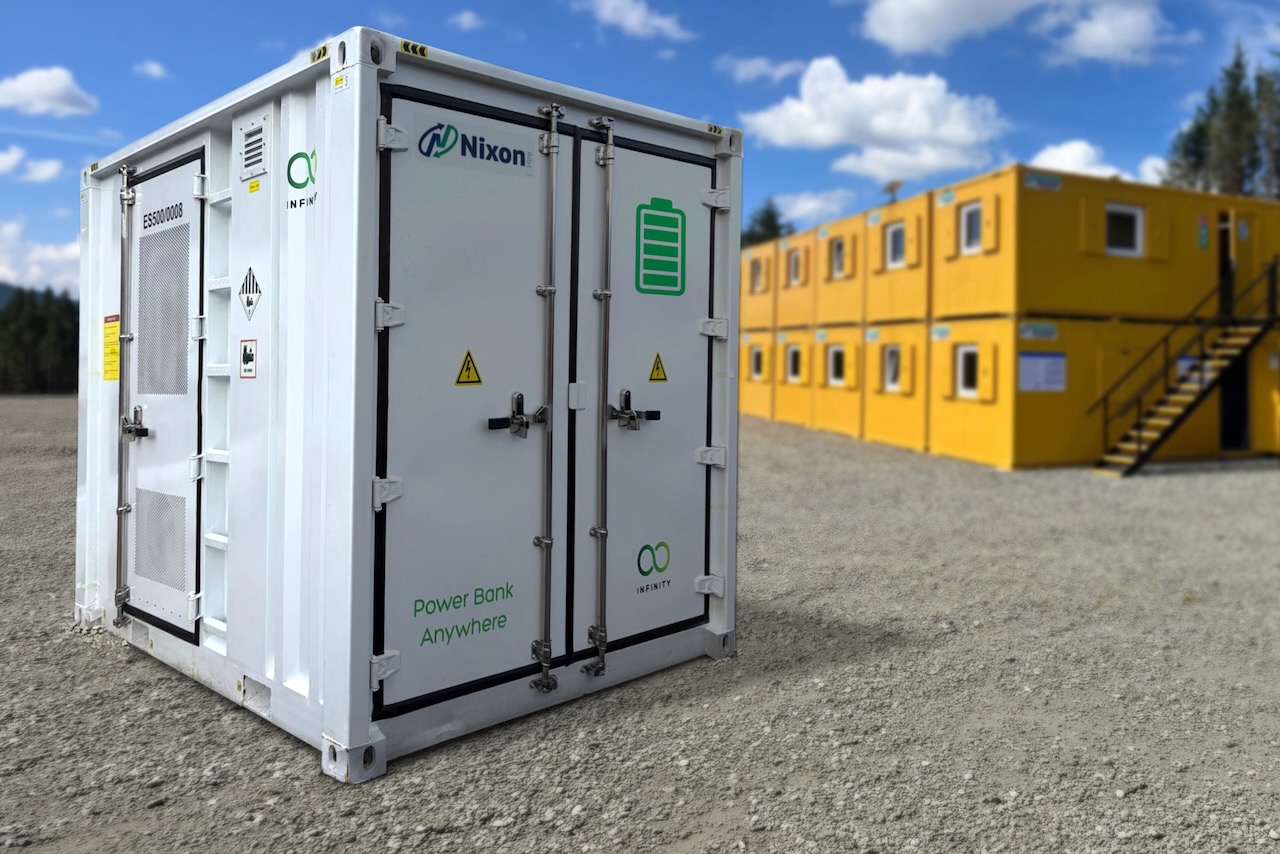
Nixon Hire has invested over £1m for UK-exclusive supply of 14 Infinity Cube Europe Pro battery storage units for 18 months, with capacities of 200kW (S Pro), 300kW (M Pro) and 550kW (L Pro) and the ability to link units and coordinate up to three generators. Early deployments include an L Pro powering 106 modular office bays plus welfare and washing blocks on a major BESS project, and an M Pro running a tower crane and a Premier League training-ground kitchen. One site reported monthly savings of 13,000 litres of fuel, over £20,000 in costs and 33.8 tonnes of CO2, with performance tracked via Nixon’s Renewable Energy Hub and Pulse portal.