Transport’s climate adaptation: five lessons for UK geotechnical design teams
Reviewed by Joe Ashwell
First reported on New Civil Engineer
30 Second Briefing
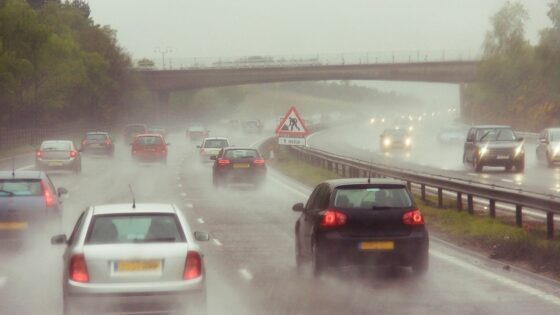
Record UK heat this summer and Met Office warnings of a strong El Niño driving wetter, stormier conditions this autumn and winter are forcing transport authorities to reassess drainage, slope stability and track formation design. Network Rail, local highways teams and port operators are being pushed towards higher-capacity culverts, upgraded ballast and formation drainage, and more robust earthwork reinforcement to cope with prolonged saturation and intense convective storms. For geotechnical and civil engineers, design storms, return periods and climate allowances in asset management plans now need urgent recalibration.
Technical Brief
- Met Office El Niño guidance is being treated as a formal design constraint for UK transport assets.
- Network operators are revisiting safety cases and ALARP demonstrations where climate loading assumptions underpin risk acceptance.
- Asset management plans are being re‑sequenced so high‑risk cuttings and embankments receive intrusive investigation earlier.
- Inspection regimes are shifting from fixed intervals to trigger‑based inspections tied to Met Office severe weather alerts.
- Emergency earthworks response plans are being updated to pre‑position plant and materials near known geohazard hotspots.
- Drainage maintenance is being reframed as a safety‑critical activity, with blocked systems explicitly linked to derailment/overturn risk.
- For design approvals, authorities are asking for clearer traceability between climate projections, partial factors and residual risk statements.
Our Take
The Met Office features repeatedly in our UK transport coverage, from extreme heat warnings for rail (24 June 2026) to urban heat vulnerability mapping (8 September 2026), signalling that climate adaptation guidance is now being driven by operational meteorology rather than historic design envelopes.
Met Office–DfT guidance on space weather impacts to GNSS and signalling (4 August 2026) suggests that climate adaptation for UK transport is broadening beyond rainfall and temperature to include low‑probability, high‑impact hazards that can undermine digital control and safety systems.
Prepared by collating external sources, AI-assisted tools, and Geomechanics.io’s proprietary mining database, then reviewed for technical accuracy & edited by our geotechnical team.
Related Articles

Related Industries & Products
Mining
Geotechnical software solutions for mining operations including CMRR analysis, hydrogeological testing, and data management.
Construction
Quality control software for construction companies with material testing, batch tracking, and compliance management.
CMRR-io
Streamline coal mine roof stability assessments with our cloud-based CMRR software featuring automated calculations, multi-scenario analysis, and collaborative workflows.
HYDROGEO-io
Comprehensive hydrogeological testing platform for managing, analysing, and reporting on packer tests, lugeon values, and hydraulic conductivity assessments.
GEODB-io
Centralised geotechnical data management solution for storing, accessing, and analysing all your site investigation and material testing data.