Geomechanics.io

  • Free Tools
Sign UpLog In

    Geomechanics.io

    Geomechanics, Streamlined.

    © 2026 Geomechanics.io. All rights reserved.

    Geomechanics.io

    CMRR-ioGEODB-ioHYDROGEO-ioQCDB-ioFree Tools & CalculatorsBlogLatest Industry News

    Industries

    MiningConstructionTunnelling

    Company

    Terms of UsePrivacy PolicyLinkedIn
    Projects
    Sustainability
    Standard/Guideline

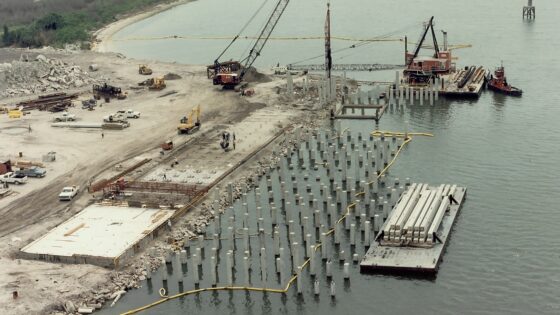
    Growing foundations reuse: investigation, reliability and carbon lessons for engineers

    September 23, 2026|

    Reviewed by Tom Sullivan

    Growing foundations reuse: investigation, reliability and carbon lessons for engineers

    First reported on New Civil Engineer

    30 Second Briefing

    Reuse of existing piled and raft foundations is accelerating on commercial property schemes as clients accept higher investigation spend in exchange for major embodied carbon and programme savings. Engineers are combining detailed pile integrity testing, targeted coring and advanced geotechnical back‑analysis with updated Eurocode‑based reliability methods to justify reusing legacy foundations originally designed for very different load cases. Planning and funding bodies are now more willing to accept partial reuse strategies, shifting project briefs away from default demolition and full replacement towards selective strengthening, load‑sharing and local pile augmentation.

    Technical Brief

    • Good historic piling records are now treated as primary design data, not just archive information.
    • Engineers are reinterpreting legacy pile load tests and construction logs to derive updated characteristic resistances.
    • Where records are poor, teams are commissioning new static load tests on a small, representative pile subset.
    • Structural engineers are routinely checking old pile caps and ground beams for new punching and shear demands.
    • Contractors are sequencing demolition to expose caps and heads early, enabling intrusive checks before superstructure design freeze.
    • Insurance and warranty providers are publishing explicit acceptance criteria for reused foundations, reducing project-by-project negotiation.
    • Some local planning authorities now request quantified embodied‑carbon comparisons between full replacement and partial reuse options.

    Our Take

    New Civil Engineer’s recent webinar on BIM, CDEs and asset management platforms suggests that robust digital records at project close-out are becoming a prerequisite for safe foundations reuse, as designers need verifiable as-built and ground data to justify reusing piles or substructures.

    The proposal for a National Bridge Retrofit Library highlighted in New Civil Engineer’s bridges coverage points to a similar direction of travel: centralised, standardised knowledge on existing assets, which would materially lower the technical and liability barriers to reusing foundations on future retrofit schemes.

    Geotechnical Software for Modern Teams

    Centralise site data, logs, and lab results with GEODB-io, CMRR-io, and HYDROGEO-io.

    No credit card required.

    • Save and export unlimited calculations
    • Advanced data visualisation
    • Generate professional PDF reports
    • Cloud storage for all your projects

    Prepared by collating external sources, AI-assisted tools, and Geomechanics.io’s proprietary mining database, then reviewed for technical accuracy & edited by our geotechnical team.

    Related Articles

    Chalk foundations in the UK: investigation and design lessons for engineers
    Geotechnical
    about 13 hours ago

    Chalk foundations in the UK: investigation and design lessons for engineers

    Industry geotechnical specialists at the John Mitchell lecture warned that UK foundation design on chalk is still misjudging key behaviours such as solution features, variable weathering profiles and the risk of brittle collapse under cyclic loading. Speakers pointed to recent pile and shallow foundation projects where inadequate chalk characterisation, limited core recovery and over-reliance on generic SPT correlations led to unexpected settlements and construction delays. Attendees were urged to adopt more rigorous chalk-specific investigation, including targeted boreholes, high-quality sampling and site-specific load testing, before finalising foundation schemes.

    Network Rail £41M North West earthworks: design and risk notes for geotechnical teams
    Geotechnical
    about 13 hours ago

    Network Rail £41M North West earthworks: design and risk notes for geotechnical teams

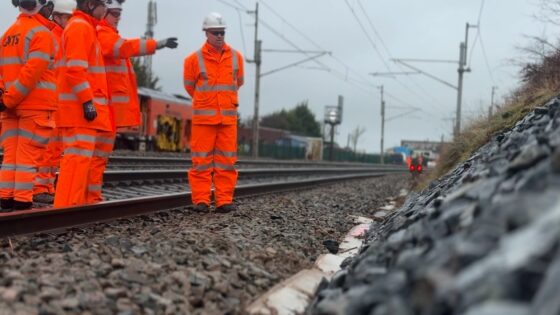
    Network Rail is delivering £41M of earthworks across key North West rail corridors to improve cuttings and embankments against winter rainfall, freeze–thaw and slope instability. Works are expected to include regrading and strengthening of existing earthwork assets, improved drainage systems and renewed trackside access to reduce washouts, slips and emergency speed restrictions. Geotechnical teams will need to manage construction around live traffic, legacy Victorian earth structures and variable ground conditions typical of the region’s glacial tills and weathered rock.

    Ground conditions in the weather forecast: practical implications for engineers
    Geotechnical
    2 days ago

    Ground conditions in the weather forecast: practical implications for engineers

    Calls to add ground condition metrics to public weather forecasts argue that engineers, utilities and transport operators now need near real-time data on soil moisture, pore pressure and desiccation risk, not just rainfall totals and wind speeds. Proponents point to recent UK failures on clay cuttings, embankment slips and buried pipe bursts after prolonged drought–storm cycles, where Met Office rainfall data alone gave little warning of loss of shear strength or shrink–swell movement. Integrating sensor networks, satellite soil-moisture indices and probabilistic geotechnical models into daily forecasts could materially change inspection, access planning and temporary works decisions.

    Related Industries & Products

    Construction

    Quality control software for construction companies with material testing, batch tracking, and compliance management.

    Mining

    Geotechnical software solutions for mining operations including CMRR analysis, hydrogeological testing, and data management.

    QCDB-io

    Comprehensive quality control database for manufacturing, tunnelling, and civil construction with UCS testing, PSD analysis, and grout mix design management.

    AllGeotechnicalInfrastructureHazardsEnvironmental