Geomechanics.io

  • Free Tools
Sign UpLog In
Built byBoxcut Studio

Geomechanics.io

Geomechanics, Streamlined.

© 2026 Geomechanics.io. All rights reserved.

Geomechanics.io

CMRR-ioGEODB-ioHYDROGEO-ioQCDB-ioFree Tools & CalculatorsBlogLatest Industry News

Industries

MiningConstructionTunnelling

Company

Terms of UsePrivacy PolicyLinkedIn
    Product
    Projects

    Sripath ButaPhalt for PMB: logistics and plant integration notes for engineers

    October 29, 2026|

    Reviewed by Tom Sullivan

    Sripath ButaPhalt for PMB: logistics and plant integration notes for engineers

    First reported on Roads & Infrastructure (AU)

    30 Second Briefing

    Sripath is targeting long‑standing pain points in polymer modified bitumen (PMB) production with its ButaPhalt additive, which can be blended using existing asphalt plant equipment and standard production temperatures. The butadiene‑based modifier is supplied as a pelletised or pastille product, avoiding the need for high‑shear mills, dedicated PMB tanks or prolonged high‑temperature storage that can cause polymer degradation and phase separation. For road agencies and contractors, this approach simplifies PMB logistics, supports in‑line dosing at drum and batch plants, and may lower barriers to specifying higher‑performance binders on regional projects.

    Technical Brief

    • Pellets/pastilles are engineered for rapid melting and dispersion, avoiding undissolved polymer agglomerates in the binder.
    • Modifier is formulated to minimise storage stability issues such as phase separation and settlement in tanks.
    • Rheological behaviour is targeted to deliver PMB-like elasticity and rut resistance at typical service temperatures.
    • Product design specifically addresses shear-sensitive polymers that normally degrade under prolonged high-shear mixing.
    • Reduced need for dedicated PMB infrastructure can be material for regional councils with limited depot capacity.
    • Approach aligns with agencies seeking higher-performance surfacings on lower-volume roads without centralised PMB plants.

    Our Take

    Sripath’s presence in multiple Roads & Infrastructure Magazine pieces, including the ButaPhalt launch in late 2025, suggests the company is positioning itself as a go‑to additives specialist for Australian road agencies looking to fine‑tune pavement performance rather than overhaul existing specifications.

    Given that recent Roads & Infrastructure content has highlighted people and culture over mega‑projects, Sripath’s Australia‑facing work is likely to gain traction where it can be framed as reducing maintenance ‘pain points’ for road crews and asset owners, not just improving lab‑bench performance metrics.

    Geotechnical Software for Modern Teams

    Centralise site data, logs, and lab results with GEODB-io, CMRR-io, and HYDROGEO-io.

    No credit card required.

    • Save and export unlimited calculations
    • Advanced data visualisation
    • Generate professional PDF reports
    • Cloud storage for all your projects

    Prepared by collating external sources, AI-assisted tools, and Geomechanics.io’s proprietary mining database, then reviewed for technical accuracy & edited by our geotechnical team.

    Related Articles

    NCE podcast on Future Build: regenerative materials insights for designers
    Materials
    about 14 hours ago

    NCE podcast on Future Build: regenerative materials insights for designers

    Engineers Collective’s latest podcast episode features Future Build author discussing how next‑generation construction materials could move beyond low‑carbon to actively restore ecosystems and sequester CO₂. The conversation covers bio‑based composites such as cross‑laminated timber and mycelium blocks, plus cement alternatives using supplementary cementitious materials and carbon‑mineralising aggregates. For civil and geotechnical designers, the focus is on specifying materials with quantified embodied‑carbon data, durability comparable to C40/50 concrete, and verifiable carbon‑capture or regenerative performance over the asset life.

    Concretene’s £4.5m graphene admixture: mix design and carbon notes for engineers
    Materials
    3 days ago

    Concretene’s £4.5m graphene admixture: mix design and carbon notes for engineers

    Concretene has secured £4.5m to scale production of its biogas-derived graphene admixture, designed to cut cement content in standard mixes by 10–20% with no loss of strength, durability or changes to batching and placement. The University of Manchester spin-out will use wastewater biogas from United Utilities to manufacture carbon-negative graphene at multi-tonne scale in Manchester under a circular production model. Backed with £2m from NPIF II – PXN Equity Finance plus follow-on investment from LocalGlobe and Molten Ventures, the funding will support industrial-scale admixture manufacture and large concrete trials with partners including Arup.

    Royal Engineers’ low‑resource concrete: durability and design notes for field engineers
    Materials
    6 days ago

    Royal Engineers’ low‑resource concrete: durability and design notes for field engineers

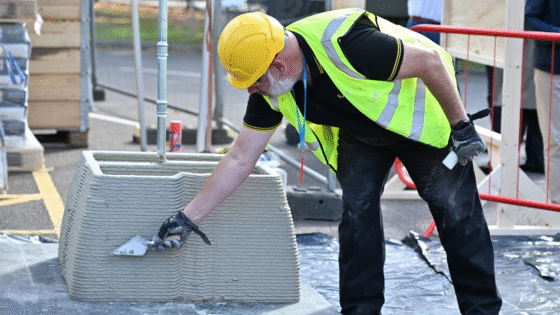
    Royal Engineers have trialled low-resource concrete mixes using crushed recycled brick as aggregate, salt water as mix water and on-site 3D printing to build structures in conflict and disaster zones where fresh water and conventional materials are scarce. The work focuses on rapidly deployable field production, aiming to print blast walls, shelters and foundations without fixed batching plants or potable water supplies. For civil and military engineers, the approach raises design questions around chloride-induced reinforcement corrosion, variable brick aggregate grading and verifying strength without standard laboratory testing.

    Related Industries & Products

    Construction

    Quality control software for construction companies with material testing, batch tracking, and compliance management.

    CMRR-io

    Streamline coal mine roof stability assessments with our cloud-based CMRR software featuring automated calculations, multi-scenario analysis, and collaborative workflows.

    HYDROGEO-io

    Comprehensive hydrogeological testing platform for managing, analysing, and reporting on packer tests, lugeon values, and hydraulic conductivity assessments.

    GEODB-io

    Centralised geotechnical data management solution for storing, accessing, and analysing all your site investigation and material testing data.

    AllGeotechnicalInfrastructureHazardsEnvironmental