South London partial building collapse: stability lessons for urban engineers
Reviewed by Joe Ashwell
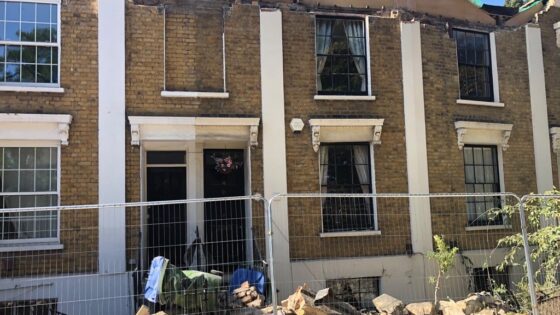
First reported on New Civil Engineer
30 Second Briefing
Residents of 14 properties evacuated after the partial collapse of three terraced houses in south London have been allowed back home more than 11 weeks after the incident. Structural engineers have evidently deemed the remaining buildings stable enough for reoccupation following inspections and temporary works to secure the damaged terrace. The case underlines the time and access constraints that follow even localised collapse events, with extended exclusion zones needed while assessing party wall integrity, shared foundations and potential progressive failure in dense urban streets.
Technical Brief
- Failure investigation would focus on shared foundations, wall–floor connections and any recent intrusive works or alterations.
- Structural engineers likely used staged intrusive surveys and back-analysis of load paths before confirming residual capacity.
- Monitoring regime would typically include tell-tales or crack gauges across party walls and key settlement points.
- Temporary works probably involved façade retention, propping of floor diaphragms and shoring of compromised masonry panels.
- Emergency response protocols would align with UK building control and fire service guidance for unstable structures.
- Similar Victorian/Edwardian terraces in dense streets may warrant proactive condition surveys and stricter control of refurbishments.
Our Take
In our Hazards coverage, UK urban failures like this south London partial collapse sit alongside infrastructure-focused pieces, suggesting regulators may increasingly look to apply lessons from bridge and airport asset management to residential building stock as well.
With 14 properties affected over an 11‑week exclusion, the incident falls into the smaller‑scale end of our failure database, which typically prompts local authorities to prioritise rapid condition assessment protocols and temporary works guidance rather than wholesale code rewrites.
New Civil Engineer’s parallel work on BIM, CDEs and asset data handover (highlighted in its webinar coverage) signals that digital asset records could become central to post‑incident investigations and liability questions for UK residential projects in dense areas like south London.
Prepared by collating external sources, AI-assisted tools, and Geomechanics.io’s proprietary mining database, then reviewed for technical accuracy & edited by our geotechnical team.
Related Articles



Related Industries & Products
Construction
Quality control software for construction companies with material testing, batch tracking, and compliance management.
Mining
Geotechnical software solutions for mining operations including CMRR analysis, hydrogeological testing, and data management.
CMRR-io
Streamline coal mine roof stability assessments with our cloud-based CMRR software featuring automated calculations, multi-scenario analysis, and collaborative workflows.
HYDROGEO-io
Comprehensive hydrogeological testing platform for managing, analysing, and reporting on packer tests, lugeon values, and hydraulic conductivity assessments.
GEODB-io
Centralised geotechnical data management solution for storing, accessing, and analysing all your site investigation and material testing data.