Geomechanics.io

  • Free Tools
Sign UpLog In

Geomechanics.io

Geomechanics, Streamlined.

© 2026 Geomechanics.io. All rights reserved.

Geomechanics.io

CMRR-ioGEODB-ioHYDROGEO-ioQCDB-ioFree Tools & CalculatorsBlogLatest Industry News

Industries

MiningConstructionTunnelling

Company

Terms of UsePrivacy PolicyLinkedIn
    Product
    Projects

    Reliable density measurement of ore slurries: process control gains for engineers

    August 12, 2026|

    Reviewed by Tom Sullivan

    Reliable density measurement of ore slurries: process control gains for engineers

    First reported on Australian Mining

    30 Second Briefing

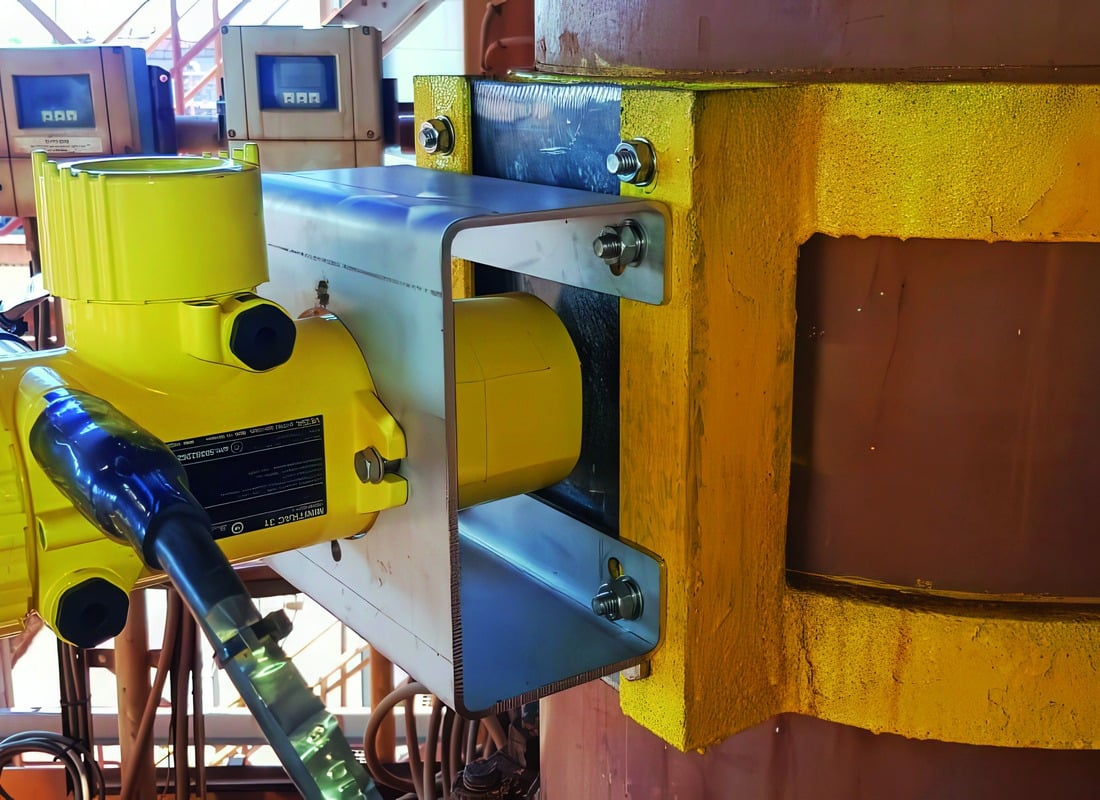
    VEGA’s MINITRAC 31 radiometric sensors are being used in Madagascar to measure ore slurry density directly from the mine, providing non-contact readings through the pipeline wall under highly abrasive laterite nickel–cobalt conditions. The system operates reliably in tropical climate extremes and with variable solids content, where conventional differential pressure or nuclear gauges struggle with scaling, wear and calibration drift. For process engineers, more stable density data supports tighter control of slurry transport, thickener performance and downstream hydrometallurgical circuits.

    Technical Brief

    • Radiometric measurement is unaffected by internal scaling, erosion, or liner changes within the laterite pipeline.
    • Sensor housings and electronics are sealed for high humidity, salt-laden air and tropical temperature cycles.
    • Calibration relies on reference density points, avoiding frequent shutdowns for mechanical gauge zeroing or cleaning.
    • Non-intrusive installation allows retrofit on existing high-pressure slurry lines without cutting or welding.
    • Measurement stability supports tighter pump speed and cyclone feed control in the hydrometallurgical plant.
    • Radiometric density is particularly useful where laterite particle size distribution and solids loading fluctuate rapidly.
    • Similar radiometric systems are increasingly specified on remote slurry pipelines with poor access for maintenance.

    Our Take

    VEGA’s slurry density work for nickel and cobalt sits alongside its recent deployments of non-contact radar and level sensors in European building materials plants, signalling that the company is standardising a common instrumentation platform from quarry through to fine-process critical minerals circuits.

    Within our 1283 Mining stories, nickel and cobalt pieces are often tied to process efficiency and reliability rather than pure exploration, so a focus on accurate ore slurry density in Madagascar and Australia likely reflects operators trying to stabilise recovery and energy use in high-throughput critical minerals plants.

    The pairing of VEGA’s process control gear with Australian Mining’s coverage of Nederman MikroPul’s dust and emissions control solutions suggests that Australian sites are increasingly treating instrumentation and environmental performance as an integrated plant upgrade pathway rather than separate capex lines.

    Geotechnical Software for Modern Teams

    Centralise site data, logs, and lab results with GEODB-io, CMRR-io, and HYDROGEO-io.

    No credit card required.

    • Save and export unlimited calculations
    • Advanced data visualisation
    • Generate professional PDF reports
    • Cloud storage for all your projects

    Prepared by collating external sources, AI-assisted tools, and Geomechanics.io’s proprietary mining database, then reviewed for technical accuracy & edited by our geotechnical team.

    Related Articles

    Atlas Copco AIRCUBE modular compressor rooms: schedule and capex lens for mines
    Mining
    about 2 hours ago

    Atlas Copco AIRCUBE modular compressor rooms: schedule and capex lens for mines

    Atlas Copco’s AIRCUBE modular compressor rooms replace conventional stick-built compressor houses on mines, arriving as pre-engineered containerised units with integrated ventilation, electricals and controls for rapid plug-and-play deployment. Units can be craned into position on simple concrete pads, connected to existing ring mains and power within days rather than the weeks or months typical for full civil works and building construction. For brownfield expansions and remote greenfield sites, this compresses project schedules, reduces on-site trades and simplifies future capacity upgrades or relocations.

    Blue Moon’s 33 tungsten–antimony projects: portfolio and processing lens for engineers
    Mining
    about 2 hours ago

    Blue Moon’s 33 tungsten–antimony projects: portfolio and processing lens for engineers

    Blue Moon Metals is acquiring 33 tungsten and antimony projects on BLM and Forest Service lands in the western U.S. in a US$20.5 million cash-and-shares deal, adding a 1% NSR royalty and annual holding costs of about US$162,000. The portfolio includes historic high-grade tungsten assets such as the Oregon mine in Colorado (5,000 tonnes at 14.51% WO₃) and Wildhorse Canyon in Idaho (7,461 tonnes at 0.62% WO₃) as potential direct-shipping feed to the Springer processing complex in Nevada, plus five antimony projects grading 2–10% stibnite, marking Blue Moon’s first move into antimony.

    Tembo 600K oz gold beside Barrick: project economics and mine design notes
    Mining
    about 2 hours ago

    Tembo 600K oz gold beside Barrick: project economics and mine design notes

    Lake Victoria Gold’s Tembo project in Tanzania has reported an initial resource of almost 600,000 oz. gold adjacent to Barrick’s Bulyanhulu mine, including 2.69 million indicated tonnes at 1.16 g/t and 13.33 million inferred tonnes at 1.12 g/t across the Ngula 1, Nyakagwe Village and Nyakagwe East near-surface deposits. A 5,000-metre infill drilling campaign will target Ngula 1, already drilled to about 200 m depth and hosting over half of inferred ounces, while a toll-milling deal is being advanced with Nyati Resources’ 500 t/d plant on a Tembo licence. Combined with the shovel-ready Imwelo project, expected to average 3.7 g/t in its first two years, the company is positioning for small-scale multi-asset production in Tanzania.

    Related Industries & Products

    Mining

    Geotechnical software solutions for mining operations including CMRR analysis, hydrogeological testing, and data management.

    Construction

    Quality control software for construction companies with material testing, batch tracking, and compliance management.

    CMRR-io

    Streamline coal mine roof stability assessments with our cloud-based CMRR software featuring automated calculations, multi-scenario analysis, and collaborative workflows.

    HYDROGEO-io

    Comprehensive hydrogeological testing platform for managing, analysing, and reporting on packer tests, lugeon values, and hydraulic conductivity assessments.

    GEODB-io

    Centralised geotechnical data management solution for storing, accessing, and analysing all your site investigation and material testing data.

    AllGeotechnicalInfrastructureHazardsEnvironmental