Geomechanics.io

  • Free Tools
Sign UpLog In

Geomechanics.io

Geomechanics, Streamlined.

© 2026 Geomechanics.io. All rights reserved.

Geomechanics.io

CMRR-ioGEODB-ioHYDROGEO-ioQCDB-ioFree Tools & CalculatorsBlogLatest Industry News

Industries

MiningConstructionTunnelling

Company

Terms of UsePrivacy PolicyLinkedIn
    Projects
    Sustainability

    Nova and RSK Cheshire quarry floating solar: design and stability notes for engineers

    June 4, 2026|

    Reviewed by Joe Ashwell

    Nova and RSK Cheshire quarry floating solar: design and stability notes for engineers

    First reported on New Civil Engineer

    30 Second Briefing

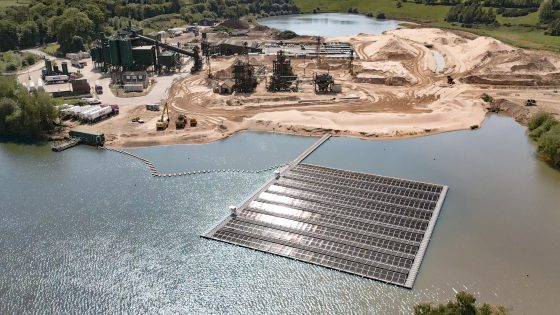
    Nova has switched on a floating solar farm at a Cheshire silica sand quarry, delivering on-site power generation for one of the UK’s largest producers of high-quality industrial silica sand. Developed with environmental consultancy RSK, the array is mounted on a buoyant platform system on the quarry lake, preserving limited land area for extraction and processing infrastructure. The installation reduces grid dependence for energy-intensive washing and grading plant, and will require geotechnical and hydraulic checks on anchoring, bank stability and water-level variability over the quarry’s remaining life.

    Technical Brief

    • Similar quarry-lake PV schemes are emerging where planning restricts land-based renewables on active mineral sites.

    Our Take

    RSK’s appearance here alongside earlier coverage of Balfour Beatty Rail adopting Engine Carbon Clean systems signals that the RSK Group is positioning itself as a cross-sector decarbonisation adviser in the UK, spanning both quarrying and rail infrastructure.

    The Cheshire location means this floating solar installation sits in a mature, tightly regulated UK planning environment, which likely gives RSK additional leverage to replicate similar water-based solar schemes at other British quarries and pits where visual and land-take constraints are sensitive.

    Geotechnical Software for Modern Teams

    Centralise site data, logs, and lab results with GEODB-io, CMRR-io, and HYDROGEO-io.

    No credit card required.

    • Save and export unlimited calculations
    • Advanced data visualisation
    • Generate professional PDF reports
    • Cloud storage for all your projects

    Prepared by collating external sources, AI-assisted tools, and Geomechanics.io’s proprietary mining database, then reviewed for technical accuracy & edited by our geotechnical team.

    Related Articles

    Environment Agency’s 14% surface water rating: design implications for UK water engineers
    Environmental
    10 days ago

    Environment Agency’s 14% surface water rating: design implications for UK water engineers

    New Environment Agency classifications under the Water Environment (Water Framework Directive) Regulations show only 14.3% of England’s surface water bodies achieve “Good ecological status” against retained EU standards. The results cover rivers, lakes, estuaries and coastal waters, and are based on biological, chemical and hydromorphological quality elements defined in the Directive. For civil and water engineers, the figures signal continued regulatory pressure on combined sewer overflows, wastewater treatment works and diffuse pollution controls in drainage and catchment management schemes.

    Grey coastal protection as habit: design implications for coastal engineers
    Environmental
    10 days ago

    Grey coastal protection as habit: design implications for coastal engineers

    Grey coastal protection is challenged as a default choice, with the Sir John Armitt Prize going to a coastal defence scheme that departs from traditional concrete and rock armour. The award citation is used to argue that hard, grey infrastructure is often a habit rather than an engineering necessity, opening the door for nature-based solutions such as dunes, saltmarsh and managed realignment. For coastal engineers, this signals growing professional backing for hybrid and soft defences where hydraulic loading, sediment transport and long-term adaptability allow.

    Era4 landfill gas-powered data centre in Canterbury: design notes for ground engineers
    Environmental
    11 days ago

    Era4 landfill gas-powered data centre in Canterbury: design notes for ground engineers

    Era4 is proposing a landfill gas-powered data centre in Canterbury, using on-site electricity generation from captured methane to run high-density AI compute loads rather than exporting power to the grid. The developer aims to integrate gas engines with modular data hall construction to match generation profiles, arguing this could provide lower-carbon, baseload power compared with diesel backup and grid-only supply. For civil and geotechnical teams, the concept raises design questions around foundation vibration from reciprocating engines, gas collection infrastructure, and long-term settlement on or adjacent to landfill.

    Related Industries & Products

    Mining

    Geotechnical software solutions for mining operations including CMRR analysis, hydrogeological testing, and data management.

    Construction

    Quality control software for construction companies with material testing, batch tracking, and compliance management.

    CMRR-io

    Streamline coal mine roof stability assessments with our cloud-based CMRR software featuring automated calculations, multi-scenario analysis, and collaborative workflows.

    HYDROGEO-io

    Comprehensive hydrogeological testing platform for managing, analysing, and reporting on packer tests, lugeon values, and hydraulic conductivity assessments.

    GEODB-io

    Centralised geotechnical data management solution for storing, accessing, and analysing all your site investigation and material testing data.

    AllGeotechnicalInfrastructureHazardsEnvironmental