Grey coastal protection as habit: design implications for coastal engineers
Reviewed by Tom Sullivan
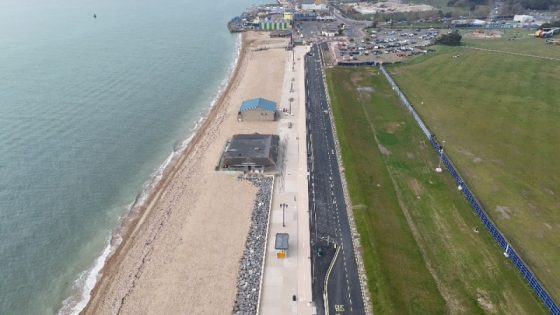
First reported on New Civil Engineer
30 Second Briefing
Grey coastal protection is challenged as a default choice, with the Sir John Armitt Prize going to a coastal defence scheme that departs from traditional concrete and rock armour. The award citation is used to argue that hard, grey infrastructure is often a habit rather than an engineering necessity, opening the door for nature-based solutions such as dunes, saltmarsh and managed realignment. For coastal engineers, this signals growing professional backing for hybrid and soft defences where hydraulic loading, sediment transport and long-term adaptability allow.
Technical Brief
- Sir John Armitt Prize citation explicitly praises a coastal defence that omits conventional concrete seawalls and rock armour.
- Award judges focus on how the scheme reshapes shoreline morphology rather than simply armouring a fixed line.
- The recognised project reportedly uses natural sediment buffers to dissipate wave energy before it reaches hard assets.
- Design intent is to allow shoreline position to migrate within a defined corridor instead of fixing a rigid toe line.
- Long-term performance is framed around sediment budget management and habitat evolution, not just crest level exceedance.
- Maintenance strategy shifts from periodic concrete repair to adaptive management of dunes, vegetation and intertidal profiles.
- Risk discussion in the citation centres on residual flood probability and asset vulnerability, not structure “failure” in isolation.
- For other UK coastal schemes, the prize provides a precedent for funding and consenting non-standard, hybrid defence layouts.
Our Take
New Civil Engineer’s recent focus on bridge retrofits and digital asset handover in its Bridges Conference and BIM webinars suggests that any move away from default ‘grey’ coastal defences will have to plug into the same asset-management thinking, not just landscape or ecology arguments.
Sir John Armitt’s involvement gives this discussion added weight for UK infrastructure planners, as his previous commentary in New Civil Engineer-linked forums has often influenced how clients interpret long-term resilience and whole-life cost in project briefs.
Prepared by collating external sources, AI-assisted tools, and Geomechanics.io’s proprietary mining database, then reviewed for technical accuracy & edited by our geotechnical team.
Related Articles



Related Industries & Products
Construction
Quality control software for construction companies with material testing, batch tracking, and compliance management.
Mining
Geotechnical software solutions for mining operations including CMRR analysis, hydrogeological testing, and data management.
CMRR-io
Streamline coal mine roof stability assessments with our cloud-based CMRR software featuring automated calculations, multi-scenario analysis, and collaborative workflows.
HYDROGEO-io
Comprehensive hydrogeological testing platform for managing, analysing, and reporting on packer tests, lugeon values, and hydraulic conductivity assessments.
GEODB-io
Centralised geotechnical data management solution for storing, accessing, and analysing all your site investigation and material testing data.