Geomechanics.io

  • Free Tools
Sign UpLog In
Built byBoxcut Studio

Geomechanics.io

Geomechanics, Streamlined.

© 2026 Geomechanics.io. All rights reserved.

Geomechanics.io

CMRR-ioGEODB-ioHYDROGEO-ioQCDB-ioFree Tools & CalculatorsBlogLatest Industry News

Industries

MiningConstructionTunnelling

Company

Terms of UsePrivacy PolicyLinkedIn
    Projects
    Safety
    Sustainability

    NCE Floods & Water Awards: 21-category snapshot for flood risk engineers

    November 19, 2026|

    Reviewed by Joe Ashwell

    NCE Floods & Water Awards: 21-category snapshot for flood risk engineers

    First reported on New Civil Engineer

    30 Second Briefing

    Entries have opened for New Civil Engineer’s inaugural Floods & Water Awards, featuring 21 categories spanning project delivery, technical innovation and long-term community impact in flood and water management. Categories cover areas such as flood risk schemes, drainage and SuDS, asset resilience, digital tools and data-led decision-making, and organisational or individual contributions. The programme gives geotechnical, civil and water engineers a platform to benchmark approaches to flood defence design, catchment-scale planning and resilience upgrades against UK best practice.

    Technical Brief

    • Awards framework explicitly separates “projects, innovation and impact” from “organisation and contribution”, encouraging distinct safety lenses.
    • Category structure enables direct comparison of emergency-response planning, operational flood safety and long-term residual-risk management.
    • Entry portal groups categories behind a single online interface, standardising submitted safety evidence and documentation formats.
    • Digital submission route encourages inclusion of monitoring data, hydraulic models and geotechnical design outputs as safety proof.
    • Cross-cutting focus on both floods and wider water management promotes integration of SuDS, drainage and defence operations into one risk regime.
    • Recognition of organisational and individual contributions incentivises formalisation of safety leadership, training and incident-learning processes.
    • For similar schemes, such award taxonomies often become de facto benchmarks when auditing flood and water safety practice.

    Our Take

    With 21 categories, the Floods & Water Awards sit at the more granular end of NCE’s awards portfolio, which in our database also includes broader schemes like the British Construction & Infrastructure Awards and NCE Bridges Awards that tend to focus on multi-hazard infrastructure performance rather than a single risk type.

    NCE’s recent early-careers initiatives and challenges (such as the Bridges Conference competitions and the Heathrow innovation competition) suggest that the Floods & Water Awards could be a useful route for younger practitioners and smaller consultancies to gain visibility for novel flood-risk and water-management approaches that might not yet be deployed at major project scale.

    Geotechnical Software for Modern Teams

    Centralise site data, logs, and lab results with GEODB-io, CMRR-io, and HYDROGEO-io.

    Cancel at any time.

    • Save and export unlimited calculations
    • Advanced data visualisation
    • Generate professional PDF reports
    • Cloud storage for all your projects

    Prepared by collating external sources, AI-assisted tools, and Geomechanics.io’s proprietary mining database, then reviewed for technical accuracy & edited by our geotechnical team.

    Related Articles
    South London partial building collapse: stability lessons for urban engineers
    Hazards
    8 days ago

    South London partial building collapse: stability lessons for urban engineers

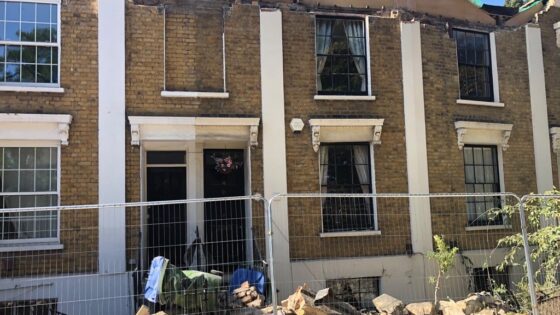
    Residents of 14 properties evacuated after the partial collapse of three terraced houses in south London have been allowed back home more than 11 weeks after the incident. Structural engineers have evidently deemed the remaining buildings stable enough for reoccupation following inspections and temporary works to secure the damaged terrace. The case underlines the time and access constraints that follow even localised collapse events, with extended exclusion zones needed while assessing party wall integrity, shared foundations and potential progressive failure in dense urban streets.

    Habas Demir Celik blast in Turkey: crane and furnace safety lessons for engineers
    Hazards
    9 days ago

    Habas Demir Celik blast in Turkey: crane and furnace safety lessons for engineers

    A blast at the Habas Demir Celik iron and steel plant in Aliaga, Izmir province, killed 16 workers when a ceiling crane snapped and fell into an arc furnace during molten steel casting around noon on 9 November. Ten people remain trapped under rubble, while 13 were injured and two are in serious condition, with casualties distributed across several regional hospitals. The Turkish government has opened an investigation, putting overhead crane integrity, furnace-area lifting operations and maintenance regimes under immediate scrutiny for heavy steel plants.

    Codelco Andina tailings spill: incident and water-risk lessons for engineers
    Hazards
    13 days ago

    Codelco Andina tailings spill: incident and water-risk lessons for engineers

    Codelco has halted processing at its Andina copper division after an obstruction in the tailings transport system near the Rápido RV4 sector caused a partial tailings release that may have entered the Blanco River within the Río Blanco canyon, upstream of the Aconcagua River basin. Emergency actions include shutting the concentrator, suspending tailings transport, diverting flows to the Piuquenitos reservoir, and continuous river sampling, while water utility Esval has closed its Aconcagua surface intake and switched to underground sources for Los Andes. The incident coincides with disclosure of 42,100 tonnes of previously inflated copper output and a 17,000‑tonne inventory reporting discrepancy, intensifying regulatory and community scrutiny of tailings and water-risk management at Andina.

    Related Industries & Products

    Construction

    Quality control software for construction companies with material testing, batch tracking, and compliance management.

    Mining

    Geotechnical software solutions for mining operations including CMRR analysis, hydrogeological testing, and data management.

    QCDB-io

    Comprehensive quality control database for manufacturing, tunnelling, and civil construction with UCS testing, PSD analysis, and grout mix design management.

    AllGeotechnicalInfrastructureHazardsEnvironmental