Mining’s nameplate capacity gap: critical mineral risk lens for project teams
Reviewed by Joe Ashwell
First reported on MINING.com
30 Second Briefing
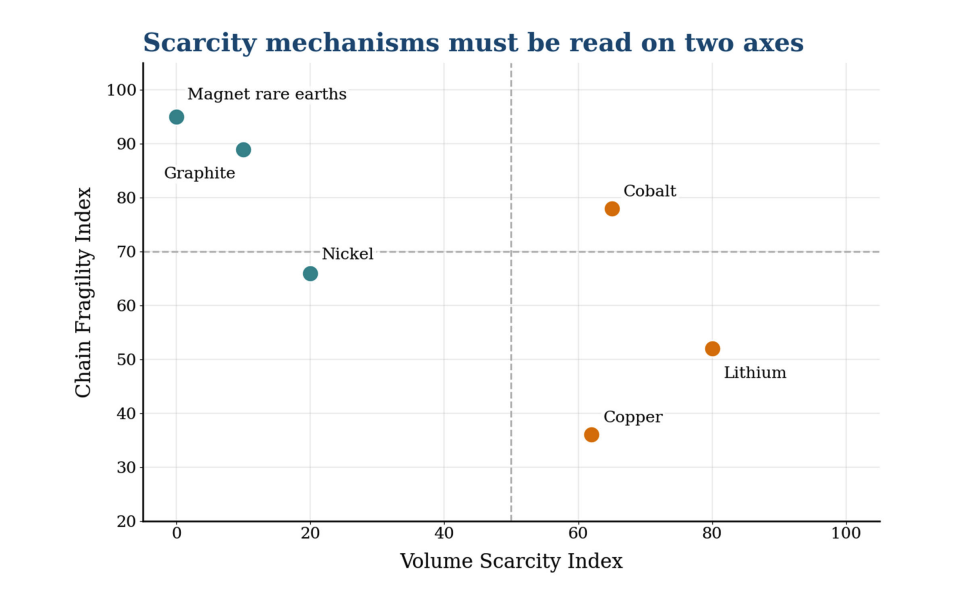
Critical-mineral supply to 2035 may fall well short of demand even where headline tonnages look adequate, with GEM Mining Consulting estimating only 68% lithium, 74% cobalt and 75% copper coverage under the IEA Global Critical Minerals Outlook 2026. Battery-grade graphite and magnet rare earths appear better supplied at 96% and 107% coverage but post the highest chain-fragility scores, 89 and 95 out of 100, driven by concentrated processing and limited diversified refining. GEM’s worked example cuts a 100,000 t/y nameplate project to 60,200 t/y of “reliable” output once commissioning, ramp-up, quality qualification and operating disruptions are applied, signalling that smaller but technically de-risked plants may carry greater strategic weight than large undeveloped resources.
Technical Brief
- GEM’s worked example reduces 100,000 t/y nameplate to 60,200 t/y “reliable” output after derating.
- Derating explicitly covers commissioning losses, ramp-up underperformance, off-spec product, customer qualification delays and operating disruptions.
- Chain Fragility is scored 0–100 as a screening index, not a probabilistic disruption forecast.
- Lithium records the highest GEM Volume Scarcity Index at 80, with copper at 62.
- Cobalt is singled out for combining a supply deficit with high chain fragility, scoring 78.
- Nickel’s 66 chain-fragility score is attributed to Indonesia–China concentration and limited diversified refining capacity.
- GEM’s framework separates “volume scarcity” (IEA 2035 coverage) from “chain fragility” (processing, refining, customer concentration).
- For project evaluation, emphasis shifts from in-situ reserves to financed, permitted, qualified and logistically deliverable tonnes.
Our Take
In our database of 1279 Mining stories, copper and cobalt repeatedly appear in pieces on Arctic logistics and sanctions‑hit refining (such as the July 16 item on Sherritt’s Fort Saskatchewan cobalt refinery), which reinforces the study’s message that geopolitical and infrastructure risks can erode the apparent 74–75% supply coverage by 2035 for these metals.
GEM’s earlier work on integrated mining districts for copper, lithium, nickel and graphite suggests one mitigation path for the high Volume Scarcity Index for lithium (80) and copper (62): clustering projects to share processing, power and logistics could partially offset the nameplate–vs–effective capacity gap highlighted in this IEA‑aligned outlook through 2035.
Prepared by collating external sources, AI-assisted tools, and Geomechanics.io’s proprietary mining database, then reviewed for technical accuracy & edited by our geotechnical team.
Related Articles


Related Industries & Products
Mining
Geotechnical software solutions for mining operations including CMRR analysis, hydrogeological testing, and data management.
Construction
Quality control software for construction companies with material testing, batch tracking, and compliance management.
CMRR-io
Streamline coal mine roof stability assessments with our cloud-based CMRR software featuring automated calculations, multi-scenario analysis, and collaborative workflows.
HYDROGEO-io
Comprehensive hydrogeological testing platform for managing, analysing, and reporting on packer tests, lugeon values, and hydraulic conductivity assessments.
GEODB-io
Centralised geotechnical data management solution for storing, accessing, and analysing all your site investigation and material testing data.