Managed aquifer recharge for UK floods and droughts: design notes for engineers
Reviewed by Joe Ashwell
First reported on New Civil Engineer
30 Second Briefing
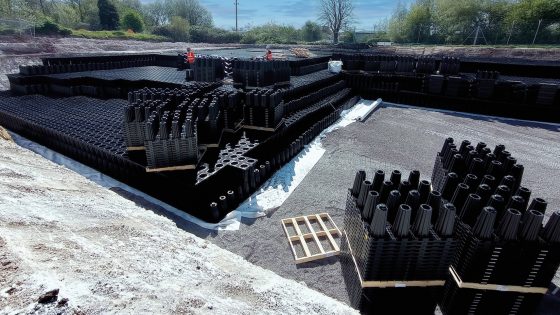
Stormwater engineer David Schofield argues that large-scale managed aquifer recharge (MAR) using infiltration basins and recharge wells could simultaneously reduce UK surface-water flood peaks and bolster drought resilience. He points to schemes where storm flows are diverted from combined sewers into gravel-filled soakaways and deep injection wells, storing millions of cubic metres in permeable chalk and sandstone rather than building ever-larger attenuation tanks. For geotechnical and civil designers, MAR shifts focus towards subsurface storage capacity, soil permeability, groundwater mounding, and long-term water quality monitoring.
Technical Brief
- Managed aquifer recharge is framed as an alternative to escalating hard-defence schemes and river channelisation.
- The op-ed flags potential clogging of infiltration structures by urban sediments, implying ongoing maintenance and pretreatment.
- Water quality risks focus on hydrocarbons, metals and pathogens mobilised from urban runoff entering potable aquifers.
Prepared by collating external sources, AI-assisted tools, and Geomechanics.io’s proprietary mining database, then reviewed for technical accuracy & edited by our geotechnical team.
Related Articles



Related Industries & Products
Construction
Quality control software for construction companies with material testing, batch tracking, and compliance management.
CMRR-io
Streamline coal mine roof stability assessments with our cloud-based CMRR software featuring automated calculations, multi-scenario analysis, and collaborative workflows.
HYDROGEO-io
Comprehensive hydrogeological testing platform for managing, analysing, and reporting on packer tests, lugeon values, and hydraulic conductivity assessments.
GEODB-io
Centralised geotechnical data management solution for storing, accessing, and analysing all your site investigation and material testing data.