Geomechanics.io

  • Free Tools
Sign UpLog In
Built byBoxcut Studio

Geomechanics.io

Geomechanics, Streamlined.

© 2026 Geomechanics.io. All rights reserved.

Geomechanics.io

CMRR-ioGEODB-ioHYDROGEO-ioQCDB-ioFree Tools & CalculatorsBlogLatest Industry News

Industries

MiningConstructionTunnelling

Company

Terms of UsePrivacy PolicyLinkedIn
    Projects
    Safety

    Mainmark Godstone sinkhole repairs: resin injection lessons for ground engineers

    October 9, 2026|

    Reviewed by Joe Ashwell

    Mainmark Godstone sinkhole repairs: resin injection lessons for ground engineers

    First reported on The Construction Index

    30 Second Briefing

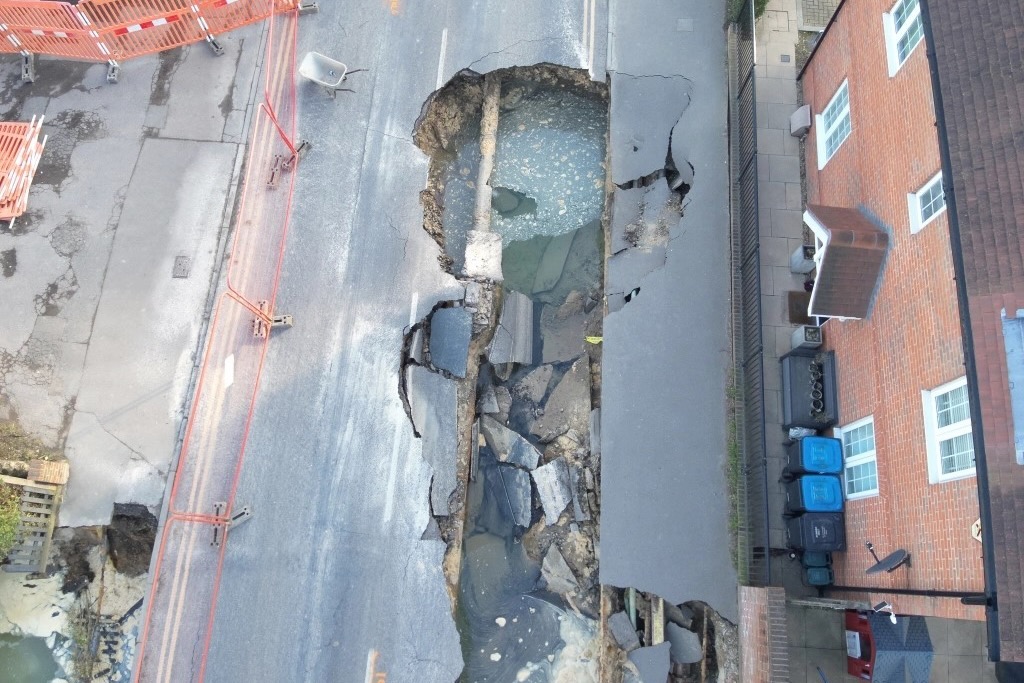
    Mainmark has completed a three‑week ground improvement programme in Godstone, Surrey, following an 18‑month repair effort after a 20m long, 5m wide, 5m deep sinkhole on the High Street exposed historic sand mine workings about 8m below ground. Working within a multidisciplinary team for Surrey County Council, Mainmark installed roughly 600 resin injection points across High Street and Salisbury Road, targeting depths of 1–4m to strengthen weak and disturbed ground. The works aimed to cut off potential void migration pathways above the remediated mine network before full road reconstruction.

    Technical Brief

    • Ground collapse in February 2025 created a 20m × 5m × 5m void in Godstone High Street.
    • Subsequent investigation identified historic sand mine workings approximately 8m below the village footprint.
    • Initial failure mechanism was linked to sandstone erosion from a burst water main, then reclassified as multi‑cause.
    • Deeper mine workings were first remediated by the wider project team before near‑surface treatment commenced.
    • Mainmark’s resin injection was explicitly used as a secondary barrier to block future void migration pathways.
    • Mainmark emphasised that damaged utilities alone rarely explain collapses, reinforcing the need for full subsurface forensics.
    • Case underlines that legacy shallow mining beneath highways demands layered remediation strategies, not single‑technique fixes.

    Our Take

    Mainmark UK’s use of resin injection at the Godstone sand voids echoes its Tottenham Hale station work for Network Rail, signalling that rail and local authorities in the UK are increasingly comfortable with resin-based stabilisation for critical transport assets rather than full reconstruction.

    An 18‑month repair programme with around 600 injection points over shallow depths suggests that for legacy shallow mine workings like those beneath Godstone in Surrey, staged, targeted treatment is becoming a preferred risk‑management approach over large‑scale excavation, especially where high streets must remain partially operational.

    Within our 26 Geotechnical stories, Mainmark appears repeatedly in pavement and rail rehabilitation pieces, indicating that its Teretek-style resin systems are moving from niche remediation into a standard option for managing subsidence and voiding in sand‑dominated ground conditions in the UK and Australia.

    Geotechnical Software for Modern Teams

    Centralise site data, logs, and lab results with GEODB-io, CMRR-io, and HYDROGEO-io.

    No credit card required.

    • Save and export unlimited calculations
    • Advanced data visualisation
    • Generate professional PDF reports
    • Cloud storage for all your projects

    Prepared by collating external sources, AI-assisted tools, and Geomechanics.io’s proprietary mining database, then reviewed for technical accuracy & edited by our geotechnical team.

    Related Articles

    Transport’s climate adaptation: five lessons for UK geotechnical design teams
    Geotechnical
    2 days ago

    Transport’s climate adaptation: five lessons for UK geotechnical design teams

    Record UK heat this summer and Met Office warnings of a strong El Niño driving wetter, stormier conditions this autumn and winter are forcing transport authorities to reassess drainage, slope stability and track formation design. Network Rail, local highways teams and port operators are being pushed towards higher-capacity culverts, upgraded ballast and formation drainage, and more robust earthwork reinforcement to cope with prolonged saturation and intense convective storms. For geotechnical and civil engineers, design storms, return periods and climate allowances in asset management plans now need urgent recalibration.

    Growing foundations reuse: investigation, reliability and carbon lessons for engineers
    Geotechnical
    16 days ago

    Growing foundations reuse: investigation, reliability and carbon lessons for engineers

    Reuse of existing piled and raft foundations is accelerating on commercial property schemes as clients accept higher investigation spend in exchange for major embodied carbon and programme savings. Engineers are combining detailed pile integrity testing, targeted coring and advanced geotechnical back‑analysis with updated Eurocode‑based reliability methods to justify reusing legacy foundations originally designed for very different load cases. Planning and funding bodies are now more willing to accept partial reuse strategies, shifting project briefs away from default demolition and full replacement towards selective strengthening, load‑sharing and local pile augmentation.

    Chalk foundations in the UK: investigation and design lessons for engineers
    Geotechnical
    17 days ago

    Chalk foundations in the UK: investigation and design lessons for engineers

    Industry geotechnical specialists at the John Mitchell lecture warned that UK foundation design on chalk is still misjudging key behaviours such as solution features, variable weathering profiles and the risk of brittle collapse under cyclic loading. Speakers pointed to recent pile and shallow foundation projects where inadequate chalk characterisation, limited core recovery and over-reliance on generic SPT correlations led to unexpected settlements and construction delays. Attendees were urged to adopt more rigorous chalk-specific investigation, including targeted boreholes, high-quality sampling and site-specific load testing, before finalising foundation schemes.

    Related Industries & Products

    Mining

    Geotechnical software solutions for mining operations including CMRR analysis, hydrogeological testing, and data management.

    Construction

    Quality control software for construction companies with material testing, batch tracking, and compliance management.

    CMRR-io

    Streamline coal mine roof stability assessments with our cloud-based CMRR software featuring automated calculations, multi-scenario analysis, and collaborative workflows.

    HYDROGEO-io

    Comprehensive hydrogeological testing platform for managing, analysing, and reporting on packer tests, lugeon values, and hydraulic conductivity assessments.

    GEODB-io

    Centralised geotechnical data management solution for storing, accessing, and analysing all your site investigation and material testing data.

    AllGeotechnicalInfrastructureHazardsEnvironmental