Lovell Charlton housing pause: stability and temporary works lessons for engineers
Reviewed by Tom Sullivan
First reported on New Civil Engineer
30 Second Briefing
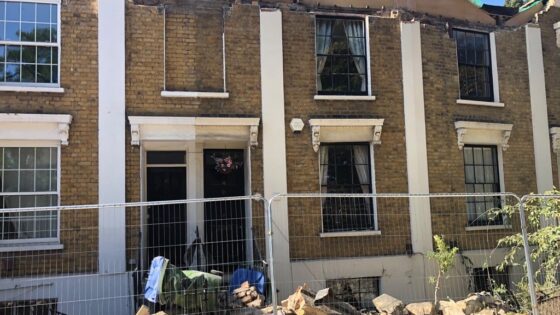
Lovell has halted construction on a housing development in Charlton, south London, after three nearby homes suffered a partial collapse, prompting concerns over local ground and structural stability. An independent structural engineer has been appointed to carry out a visual survey of the affected properties and surrounding area to identify any link between site works and the damage. The pause in activity signals potential implications for temporary works design, excavation support, and monitoring requirements on dense urban infill schemes.
Technical Brief
- Partial collapse mechanism likely involves loss of support to existing shallow foundations from adjacent works.
- Failure investigation will start with visual crack mapping, distortion measurements and comparison with pre-construction condition surveys.
- Independent structural engineer’s remit will typically extend beyond the three houses to adjoining terraces and party walls.
- Ground investigation data, excavation records and temporary works drawings will be key evidence for causation analysis.
- Ongoing monitoring should include frequent level surveys, crack gauges and possibly tilt sensors on affected and neighbouring properties.
- Remedial options may range from localised underpinning and masonry stitching to full façade retention with new backing structures.
- Safety management will be benchmarked against CDM Regulations duties on designers and contractors for adjacent-structure stability.
- For dense urban infill, incident reinforces need for conservative excavation support design and real-time movement trigger action plans.
Our Take
Lovell’s parallel push into large greenfield schemes such as the £42m Swinfen Vale development in Ellistown suggests that any geotechnical failure on an urban site like Charlton will be closely scrutinised for lessons that can be standardised across its wider UK housing portfolio.
Our geotechnical coverage includes several ‘Failure’ and ‘Safety’ tagged pieces where temporary works and ground investigation strategies were later revised; the Charlton incident is likely to feed into similar revisions for Lovell’s emerging Renew Central refurbishment and retrofit operations, where interaction with existing structures is even more sensitive.
Because this event occurs in a dense south London setting rather than on a standalone estate, it will heighten attention in our database on how UK housebuilders like Lovell manage third-party property risk and monitoring when excavating or piling immediately adjacent to older housing stock.
Prepared by collating external sources, AI-assisted tools, and Geomechanics.io’s proprietary mining database, then reviewed for technical accuracy & edited by our geotechnical team.
Related Articles

Related Industries & Products
Construction
Quality control software for construction companies with material testing, batch tracking, and compliance management.
Mining
Geotechnical software solutions for mining operations including CMRR analysis, hydrogeological testing, and data management.
QCDB-io
Comprehensive quality control database for manufacturing, tunnelling, and civil construction with UCS testing, PSD analysis, and grout mix design management.