Long Baseline Neutrino Facility caverns: geotechnical design notes for engineers
Reviewed by Joe Ashwell
First reported on New Civil Engineer
30 Second Briefing
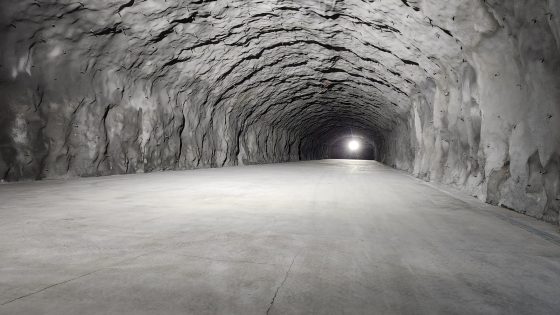
Excavation is under way 1.5km below ground at the Long Baseline Neutrino Facility in South Dakota to create three caverns, each roughly cathedral-sized, to house the Deep Underground Neutrino Experiment’s liquid-argon detectors. The 1,300km-long beamline from Fermilab to the former Homestake gold mine demands tight control of rock mass behaviour, with extensive pre-grouting, cable bolting and shotcrete linings in complex, stressed Precambrian formations. Construction sequencing, spoil handling through deep shafts and long-term groundwater management are central geotechnical risks for the multi-year programme.
Technical Brief
- Rock support design is governed by long-term detector stability requirements, with very tight deformation tolerances.
- Construction safety planning includes blast vibration limits to protect existing underground infrastructure and sensitive scientific equipment.
- Lessons on deep excavation safety management are expected to inform future large caverns for nuclear and data facilities.
Our Take
Safety-tagged items in our coverage usually concern operational mines or transport tunnels, so the Deep Underground Neutrino Experiment adds a less common angle: long-term geotechnical stability for ultra-sensitive scientific equipment, where even micro-seismicity and minor convergence become performance, not just safety, constraints.
With no commodity or country attached in the article facts, LBNF/Dune stands out in the Projects and Sustainability tags as a rare example where deep excavation is justified purely by scientific and environmental knowledge goals, which can influence how regulators and local stakeholders weigh risk versus benefit compared with resource-extraction caverns.
Prepared by collating external sources, AI-assisted tools, and Geomechanics.io’s proprietary mining database, then reviewed for technical accuracy & edited by our geotechnical team.
Related Articles


Related Industries & Products
Construction
Quality control software for construction companies with material testing, batch tracking, and compliance management.
Tunnelling
Specialised solutions for tunnelling projects including grout mix design, hydrogeological analysis, and quality control.
QCDB-io
Comprehensive quality control database for manufacturing, tunnelling, and civil construction with UCS testing, PSD analysis, and grout mix design management.