Japan seabed heavy rare earths deposit: project economics and design lens
Reviewed by Joe Ashwell
First reported on MINING.com
30 Second Briefing
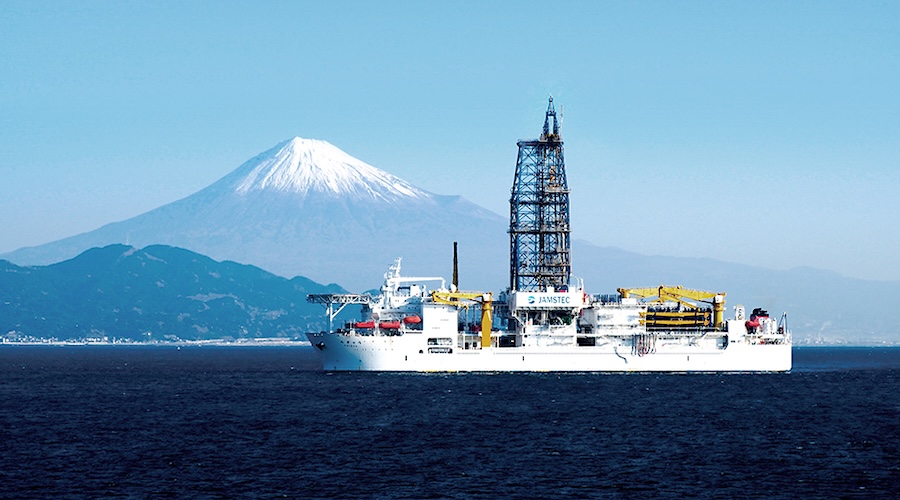
Japan’s month-long deep-sea trial near Minamitori Island recovered 50 tonnes of rare earth-bearing mud from ~6,000 m water depth, with medium and heavy rare earths making up about 54% of total rare earth content, including yttrium, gadolinium and dysprosium. The government-backed vessel Chikyu achieved the world’s first continuous recovery of such mud, with a commercial feasibility assessment due by March 2028. A follow-up trial in February 2027 aims for 350 tonnes/day, with dewatering on Minamitori and onshore separation, refining and smelting tests in Japan.
Technical Brief
- Deep-sea drilling vessel Chikyu operated at ~6,000 m water depth on a continuous mud-recovery campaign.
- Trial area lies near Minamitori Island, ~1,900 km southeast of Tokyo in Pacific abyssal plain.
- Mission duration was about one month, constraining spatial coverage and preventing a compliant resource estimate.
- Japan’s government withheld deposit tonnage and grade data, citing insufficient sampling density and duration.
- Identified elements include yttrium, gadolinium and dysprosium, all critical for high-performance magnet and electronics supply chains.
- Earlier University of Tokyo–Nippon Foundation work mapped >200 Mt of manganese nodules at ~5,500 m depth nearby.
- Those nodules are estimated to contain ~610,000 t cobalt and ~740,000 t nickel relative to Japan’s long-term demand.
- Export controls imposed by China on heavy rare earths since 2025 form a key geopolitical driver for this offshore programme.
Our Take
With medium and heavy rare earths making up 54% of the mud’s rare earth content, Minamitori contrasts with many onshore deposits in our database that are light-REE dominant, implying stronger strategic value for permanent magnet supply chains if separation and refining hurdles can be solved domestically in Japan.
Given China’s 2023 restrictions on rare earth processing technology noted in the July 2026 policy piece, Japan’s move to complete a commercial assessment by 2028 signals an attempt to secure a sovereign heavy-REE and cobalt–nickel backstop that reduces exposure to Chinese-controlled refining capacity rather than just diversifying raw ore sources.
Prepared by collating external sources, AI-assisted tools, and Geomechanics.io’s proprietary mining database, then reviewed for technical accuracy & edited by our geotechnical team.
Related Articles


Related Industries & Products
Mining
Geotechnical software solutions for mining operations including CMRR analysis, hydrogeological testing, and data management.
Construction
Quality control software for construction companies with material testing, batch tracking, and compliance management.
CMRR-io
Streamline coal mine roof stability assessments with our cloud-based CMRR software featuring automated calculations, multi-scenario analysis, and collaborative workflows.
HYDROGEO-io
Comprehensive hydrogeological testing platform for managing, analysing, and reporting on packer tests, lugeon values, and hydraulic conductivity assessments.
GEODB-io
Centralised geotechnical data management solution for storing, accessing, and analysing all your site investigation and material testing data.