Geomechanics.io

  • Free Tools
Sign UpLog In

Geomechanics.io

Geomechanics, Streamlined.

© 2026 Geomechanics.io. All rights reserved.

Geomechanics.io

CMRR-ioGEODB-ioHYDROGEO-ioQCDB-ioFree Tools & CalculatorsBlogLatest Industry News

Industries

MiningConstructionTunnelling

Company

Terms of UsePrivacy PolicyLinkedIn
    AllGeotechnicalMiningInfrastructureMaterialsHazardsEnvironmentalSoftwarePolicy
    Research
    Sustainability
    Safety

    Hinkley Point C acoustic fish deterrent: design and permitting lessons for engineers

    February 10, 2026|

    Reviewed by Tom Sullivan

    Hinkley Point C acoustic fish deterrent: design and permitting lessons for engineers

    First reported on New Civil Engineer

    30 Second Briefing

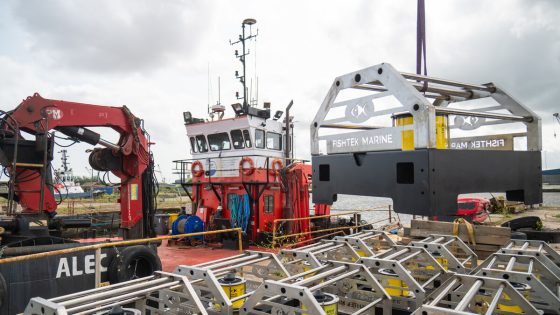
    An ultrasonic acoustic fish deterrent designed for EDF’s Hinkley Point C cooling water intakes has proved “highly effective” in Swansea University trials, significantly reducing fish approach rates to the intake zone. The system uses targeted sound frequencies to steer multiple species away from the intake channel, aiming to meet Environment Agency requirements on impingement and entrainment without major changes to the intake structure. Trial results may remove the need for a large compensatory saltmarsh scheme on the Severn Estuary, easing local planning and coastal engineering constraints.

    Technical Brief

    • If accepted by regulators, similar deterrent configurations could be specified for other large estuarine cooling-water abstractions.

    Our Take

    Within the 11 Environmental stories in our coverage, Hinkley Point C is one of the few UK assets where marine ecology mitigation is being trialled at full scale, signalling regulators’ expectation that large coastal plants demonstrate measurable biodiversity safeguards rather than just desk-based assessments.

    For United Kingdom projects, our database shows most recent Safety-tagged pieces focus on construction workforce risk, so an acoustic fish deterrent at Hinkley Point C broadens the safety lens to encompass ecological risk management that can influence future permitting conditions for other coastal energy schemes.

    Swansea University’s involvement aligns with a pattern in our Sustainability-tagged items where UK universities act as lead technical partners on impact monitoring, which often helps operators translate research-grade findings into licence conditions and long-term environmental performance baselines.

    Geotechnical Software for Modern Teams

    Centralise site data, logs, and lab results with GEODB-io, CMRR-io, and HYDROGEO-io.

    No credit card required.

    • Save and export unlimited calculations
    • Advanced data visualisation
    • Generate professional PDF reports
    • Cloud storage for all your projects

    Prepared by collating external sources, AI-assisted tools, and Geomechanics.io’s proprietary mining database, then reviewed for technical accuracy & edited by our geotechnical team.


    Related Articles

    Environment Agency drone squad: LiDAR enforcement lessons for waste engineers
    Environmental
    5 days ago

    Environment Agency drone squad: LiDAR enforcement lessons for waste engineers

    Environment Agency drones are being deployed more aggressively against organised fly-tipping, with a 33-strong pilot squad logging 272 flight hours since July and preparing to carry light detection and ranging (LiDAR) payloads for high-resolution volumetric mapping of illegal waste sites. Moving LiDAR from manned aircraft to UAVs is intended to give prosecutors precise 3D evidence of waste locations and extents, while a new screening tool cross-checks lorry licence applications against waste permit records to flag suspect operators. Enforcement capacity has been boosted with the joint waste crime unit expanded from 13 to 20 staff, supporting 751 illegal sites shut and 221 prosecutions since March 2025 under a £15.6m enforcement budget.

    UK geothermal as mainstream heat: design and monitoring notes for engineers
    Environmental
    15 days ago

    UK geothermal as mainstream heat: design and monitoring notes for engineers

    Britain is being urged to treat deep and shallow geothermal as a mainstream heat source, with a new national roadmap arguing that the country’s substantial but underused subsurface resource could displace a significant share of gas‑fired heating. The plan points to proven concepts such as mine‑water geothermal in former coalfields and district heating from deep sedimentary aquifers, which can be integrated with existing heat networks and large heat pumps. For civil and geotechnical engineers, this signals growing demand for high‑temperature boreholes, well integrity design and long‑term monitoring of thermal–hydraulic behaviour in urban ground.

    WSP and Mott MacDonald Wylfa SMR deal: permitting and EIA lens for engineers
    Environmental
    19 days ago

    WSP and Mott MacDonald Wylfa SMR deal: permitting and EIA lens for engineers

    WSP and Mott MacDonald have secured a £25M contract from Great British Energy – Nuclear (GBE‑N) to deliver environmental services and permitting support for the proposed small modular reactor (SMR) development at Wylfa on Anglesey. The consultancies will lead environmental impact assessment, regulatory interface and consents strategy for the multi‑unit SMR site, a former nuclear location with complex coastal, seismic and ecological constraints. Early permitting work will be critical for geotechnical investigations, marine works and long‑lead nuclear island foundations once a reactor technology is selected.

    Related Industries & Products

    Construction

    Quality control software for construction companies with material testing, batch tracking, and compliance management.

    QCDB-io

    Comprehensive quality control database for manufacturing, tunnelling, and civil construction with UCS testing, PSD analysis, and grout mix design management.