Heidelberg low carbon concrete at 33–35 Piccadilly: mix design notes for engineers
Reviewed by Joe Ashwell
First reported on The Construction Index
30 Second Briefing
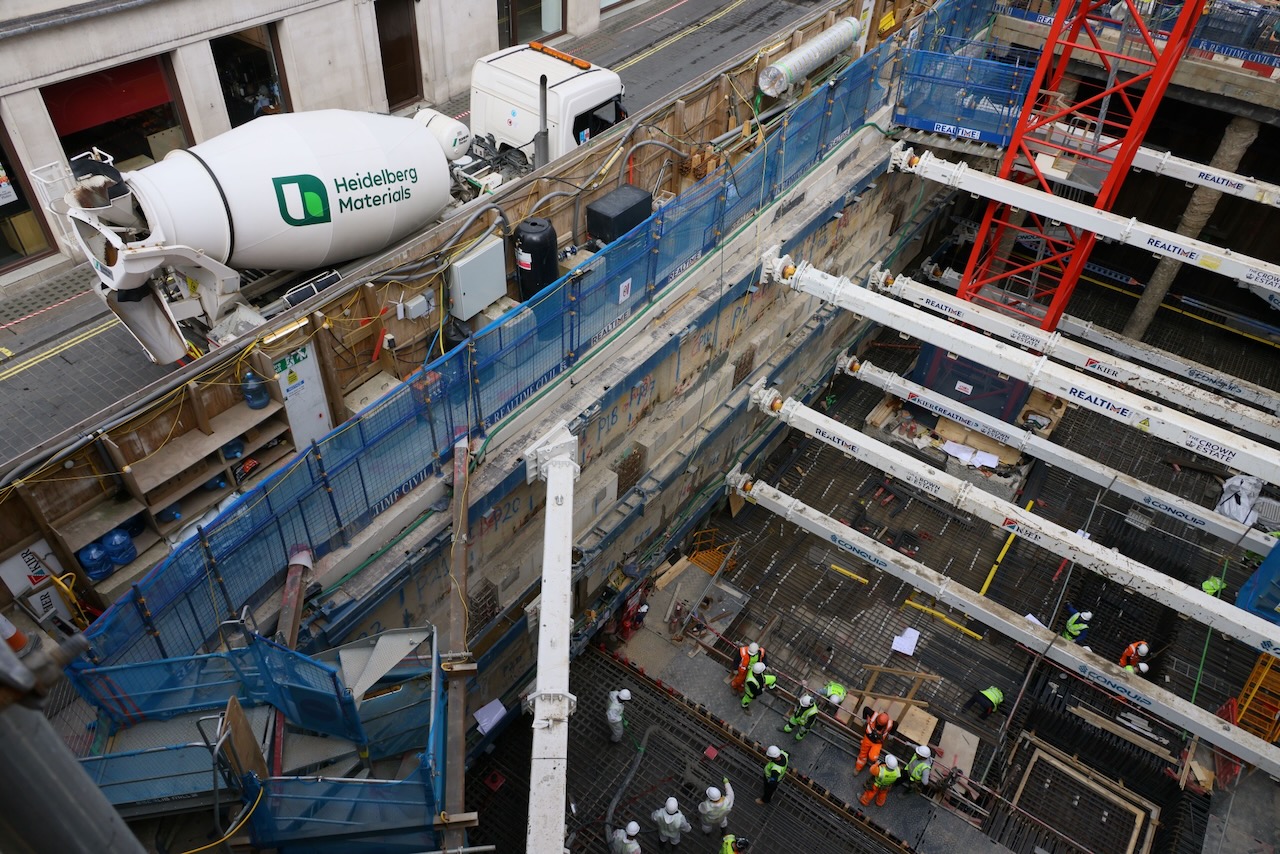
Heidelberg has supplied low carbon concrete, using carbon capture–decarbonised cement and GGBS, to Realtime Civil Engineering and Kier for the Crown Estate’s 33–35 Piccadilly redevelopment in central London. The mix design replaces a significant portion of Portland clinker with ground granulated blast-furnace slag, cutting embodied CO₂ compared with conventional CEM I concrete while maintaining structural performance suitable for a high-end commercial building. For contractors and designers, the project shows practical deployment of carbon capture–enabled binders on a constrained urban site with demanding specification control.
Technical Brief
- GGBS is incorporated as a latent hydraulic binder, activated by the remaining Portland clinker.
- Pumping distances and pressures are controlled to avoid segregation in the higher-fines, slag-rich mixes.
- Quality control focuses on heat of hydration, setting time and workability retention for urban pours.
- Durability performance is critical for a high-end commercial façade line directly exposed to urban pollutants.
Our Take
In our Materials coverage, Heidelberg and Heidelberg Materials UK recur frequently, with recent pieces on Westdown quarry and North Yorkshire asphalt, signalling a push to lock in both upstream aggregates and downstream product outlets in the United Kingdom.
The use of low‑carbon concrete at 33‑35 Piccadilly aligns with Heidelberg’s parallel deployment of evoZero cement in Marley’s Edgemere 2.0 roof tiles, suggesting the company is actively seeding multiple UK product lines that can absorb its captured and ‘banked’ CO₂ volumes.
Pairing a prestige London project with the Crown Estate as client gives Heidelberg a high‑visibility reference for its lower‑carbon mixes, which is likely to help when bidding for other sustainability‑tagged projects in our database, especially in dense urban settings where embodied carbon is under scrutiny.
Prepared by collating external sources, AI-assisted tools, and Geomechanics.io’s proprietary mining database, then reviewed for technical accuracy & edited by our geotechnical team.
Related Articles


Related Industries & Products
Construction
Quality control software for construction companies with material testing, batch tracking, and compliance management.
Mining
Geotechnical software solutions for mining operations including CMRR analysis, hydrogeological testing, and data management.
QCDB-io
Comprehensive quality control database for manufacturing, tunnelling, and civil construction with UCS testing, PSD analysis, and grout mix design management.