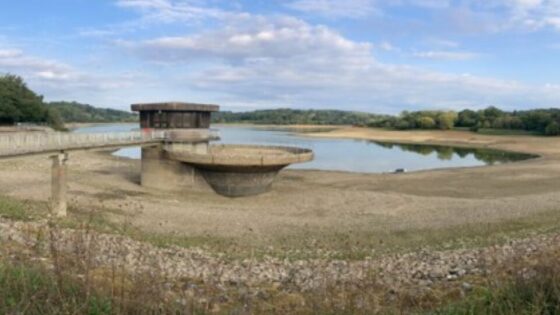
England’s low reservoir levels: operational implications for water engineers
Reviewed by Joe Ashwell
First reported on New Civil Engineer
30 Second Briefing
Most reservoirs in England are now at “notably” or “exceptionally” low storage levels after a sixth consecutive dry month, triggering government intervention and temporary drought measures to safeguard public supply. The Environment Agency has activated drought plans and is working with water companies on options including reduced abstraction from sensitive catchments and accelerated deployment of temporary use bans. Civil and water engineers should anticipate tighter operating constraints on raw water intakes, revised yield assumptions for treatment works, and potential fast‑tracked resilience schemes such as inter‑basin transfers and leakage reduction projects.
Technical Brief
- Drawdown of this magnitude increases risk of rapid pore pressure changes in upstream embankment zones.
- Low heads at intakes can induce vortex formation, air entrainment and cavitation risk in pump systems.
- Exposed clay cores and upstream shoulders face desiccation cracking, with potential for increased permeability on refill.
- Steeply exposed banks raise local instability risk, requiring updated geotechnical inspections and revised exclusion zones for public access.
- Reduced freeboard margin during any intense storm after drought heightens overtopping risk if spillway capacity is constrained by works.
- Safety‑critical surveillance (piezometers, settlement markers, leakage weirs) should be intensified during rapid storage fluctuations under UK reservoir safety regimes.
- Similar prolonged drawdowns will pressure owners to reassess design droughts, emergency drawdown provisions and long‑term dam safety cases.
Our Take
Six consecutive dry months in England heighten the operational importance of Environment Agency flood schemes such as the newly completed £42M Tonbridge and Hildenborough works, which will now need to manage more volatile swings between drought and intense storm events.
The low reservoir levels come as political proposals to abolish the Environment Agency and Natural England are being floated, which would inject extra uncertainty into long‑term water‑resource and flood‑risk planning for civil projects across the United Kingdom.
Recent Environment Agency projects in Oxfordshire and Cornwall in our coverage are heavily focused on flood alleviation, so sustained drought conditions are likely to push the agency and local authorities to rebalance portfolios towards integrated catchment management and storage rather than pure flood defence.
Prepared by collating external sources, AI-assisted tools, and Geomechanics.io’s proprietary mining database, then reviewed for technical accuracy & edited by our geotechnical team.
Related Articles



Related Industries & Products
Mining
Geotechnical software solutions for mining operations including CMRR analysis, hydrogeological testing, and data management.
Construction
Quality control software for construction companies with material testing, batch tracking, and compliance management.
CMRR-io
Streamline coal mine roof stability assessments with our cloud-based CMRR software featuring automated calculations, multi-scenario analysis, and collaborative workflows.
HYDROGEO-io
Comprehensive hydrogeological testing platform for managing, analysing, and reporting on packer tests, lugeon values, and hydraulic conductivity assessments.
GEODB-io
Centralised geotechnical data management solution for storing, accessing, and analysing all your site investigation and material testing data.